Another article deflating Bill Keller’s “more elevated” argument from USA Today: “For the first six months of the year, celebrity and gossip magazines such as Us Weekly posted double-digit newsstand gains while newsweeklies such as Time, Newsweek and U.S. News & World Report saw single-copy sales dip 3.4% to 16.6%.”
Year / 2005
Six Feet Under Finale
Just saw the finale. For a while, everything was rocking. The eyes were getting a-misty. The heart was still involved. There was the promise of some sense of finality, some ultimate message about existence that Alan Ball (who did, after all write and direct this send-off), hoped to provide for us. But what did we get in the final ten minutes?
Saccharaine moments that were, amazingly enough, more unconvincing than the Xmas future seen in the Richard Donner-Bill Murray version of Scrooged. (And that takes some doing.) Actors under really bad makeup living out their final moments in the future. A cheap finale. The overall message of living, so eloquently portrayed in the first hour, disrupted by some of the silliest moments ever seen in Six Feet Under‘s history. What Ms Chicha deservedly referred to as the most emotional car commercial ever. I don’t think so. Let’s try “most expensive car commercial ever.”
And it’s all thanks to Alan Ball that these characters were cheapened for an unconvincing future and, most likely, an unconvincing present.
Ah well. Go figure. The series went out with a bang and once again proved that, all along, this was an audacious yet flawed series. I have to agree with my good friend Beck that this series certainly did well, all things considered. And it certainly did me in because I’m an emotional fellow.
But I would argue that it was Jill Soloway and Kate Robin who knew how to write for this show and that contributed to the show’s convincing narrative, not Ball. Without these fantastic talents, the show would have quickly turned absurd and hackneyed. So here’s thanks to them or possibly Ball for hiring them.
Even so, the other thing that strikes me as false about the Six Feet Under solution is that salvation comes from a trust fund. This is about as realistic as D.W. Griffith’s shameless melodramas of blind women finding miraculous cures through generous scientists. In short, it just doesn’t happen. Which begs the question: how can anyone here be sad when the financial realities are out of scope with a sizable percentage of the population?
In the meantime, what does the man forever jaded against television have to look forward to? Why, Battlestar, of course!
Quick Roundup
- We’re very sorry to learn that George Fasel of A Girl and a Gun has passed away. Our condolences to his friends and family.
- Dan Wickett talks with more literary journal editors. At this rate, Mr. Wickett will have chatted with everyone in the literary world by June 2006.
- Bad Librarian’s chronicles continue, with remarks on the Patriot Act and a shocking personal revelation.
- Amazon will begin offering short story downloads. The stories will be 49 cents a pop. Presumably, each user who signs up for this service will have every known purchasing histroy detail logged and will be recommended tales that have nothing whatsoever to do with their literary interests. (Example: If you liked “The Snows of Kilimanjaro,” you might like “The Snows of Central Park West” by Bret Easton Ellis.)
- You have to love the way some folks jump to conclusions. The speculation continues with this latest press release (PDF) now making the rounds. The APA is now calling for the video game industry to reduce violence. Even if we accept the idea that video game violence is a major influence upon patterned behavior (and the resolution itself corrals this in with several other studies relating to “the media,” rather than “video games” explicitly), it apparently hasn’t occurred to these psychiatrists that parents might be the ones responsible for exposing their children to violent content and that the choice is theirs. As much as I would welcome the idea of preventing McDonald’s from operating, you wouldn’t, for example, see the AMA demand that the fast food industry stop selling hamburgers.
Bill Keller: Chickenhead of the Month
It’s been a while since we awarded anyone the Chickenhead of the Month. We like to reserve this special prize for a person making truly astounding leaps in logic.
Lo and behold! While we may be on hiatus from the Brownie Watch, we opened the NYTBR‘s pages yesterday and found a fantastic dollop of silliness from none other than Bill Keller himself!
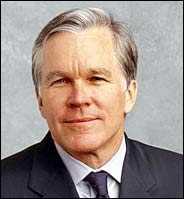 In a letter, New York Times Executive Editor Bill Keller responds to the Posner media essay that appeared a few weeks ago in the NYTBR. Keller has made a fantastic claim: namely, that the New York Times is in the business of providing something “more elevated and consequential.” If this is the case, how does this explain the continued ridiculousness of the Style Section? Or last week’s amazing devotion of Times resources to Bridget Jones? Or yesterday’s slipshod cover story in the Magazine, where an alternative source was served up by a bogus claim of “technological advances” and, as Mr. Birnbaum noted in the comments section, a wholesale refusal to reference Hubbert’s Peak?
If this is what Keller calls “more elevated and consequential,” then I shudder to think about what he considers conventional. What business does Keller have talking about a professional code when he has hordes of Times staffers devoting precious time and resources to distinguishing between a salwar kameez and a sari? How dare Keller pull this stunt within his own pages when, by his own admission a few months ago, his paper failed to cut the mustard in covering Iraq? When I think about professional code, I think of a a newspaper that dares to question anybody and anything — whether the Bush Administration or Hilary Clinton. It is not, as Keller suggests in his interpretation of Posner’s article, a matter of being either “liberal” or “supine,” but of being regularly active and constantly probing any and all subjects, where others would fall asleep at the wheel. That is, in a nutshell, journalism. And believe it or not, it is not nearly as partisan in the blogosphere as Keller would suggest.
Additionally, one wonders if Keller’s letter is a desperate ploy to give the NYTBR the illusion of intellectual debate. Despite a few brownie shipments sent to Mr. Tanenhaus and some successes, it has been clear to us that the Keller-Tanenhaus experiment has, for the most part, failed. Today’s NYTBR is more concerned with providing column inches to John Irving and Nora Roberts, giving odious reviewers like Leon Wieseltier and Joe Queenan more paychecks than they deserve, rather than reflecting culture and literature, much less providing an “elevated ” place to talk about it.
We suspect that the onus falls more on Keller than on Tanenhaus. We therefore grant Mr. Keller our “Chickenhead of the Month” award.