- So after a fusillade of April Fool’s posts and a threatening email sent by Martin Scorsese’s representative, I’m absolutely confident that you’ll be able to trust me with relaying legitimate news here on April 2. So here we go.
- The first issue of Hot Metal Bridge, a suitably naughty title that I approve of, edited by Carolyn Kellogg, has left the building. And you’ll find Michael Martone, Dan Chaon and Alan DeNiro within its pages.
- Could it be? An end to the Left Behind series? I mean, here I was hoping for more excuses to go to hell because, contrary to the Monkees (or, rather, Neil Diamond, who penned the song), I’m not a believer. Will some brave fundamentalist step in to fill Jerry Jenkins and Tim LaHaye’s shoes and get to the bottom of America’s evil in fictive form?
- There’s trouble a-brewing in Salt Lake City. It seems that Mark Spragg’s An Unfinished Life was set to be the One Book, One City choice, only to be rescinded for reasons unknown. Was it censorship or a legitimate kerfuffle? The Salt Lake Tribune has learned that someone complained of “coarse language” spoken by a character in Spragg’s book. Here’s hoping that more “coarse language” will be employed to get to the bottom of this brouhaha.
- Is this Santa Cruz Sentinel story on literary escorts an April Fool’s joke or legitimate journalism reporting upon those great unappreciated escorts?
- The Washington Post‘s Judith S. Gillies has info on the forthcoming PBS American novel documentary.
- Ten famous literary bars: where everybody knows your pen name.
- Tom Cox investigates author websites. (via Jenny D)
- If libraries want to get folks reading, perhaps jugglers are the answer.
- Why the litblogosphere rocks: Kelly Link appeared on The Bat Segundo Show. In that podcast, there was a considerable discussion on whether or not “literary fiction” was as horrid a label as “science fiction.” Eric Rosenfield wasn’t satisfied with some of Link’s responses, but now he’s corresponded with Link directly to set the matter straight.
- If you thought fan fiction was bad, Jason Boog examines fan screenwriting (or is that fan filmmaking?).
- Today in Letters entices literary readers once again with this letter from Fitzgerald to Maxwell Perkins.
- Congratulations to Mr. Orthofer (and his mysterious staff) for eight years of the Complete Review.
- Who knew? Jeff VanderMeer is running for SFWA President with a dubious platform that has one examining the date the announcement was made.
- I believe I linked to this before, but dig Kerouac on The Steve Allen Show. (via Outsider Writers)
- If you don’t make it to the end of the book or you’re feeling dispassionate about a book, there are two reasons: it is the book’s fault or you’re not a book critic. (via Bookninja)
- A.M. Homes: “I think about reviews of the memoir: What’s a negative review of a memoir? ‘Not only is she a lousy writer, her life sucks.'”
- Editor & Publisher: “While newspaper circulation continues to slide, readership is growing, especially with younger readers — when taking online newspaper sites into consideration. According to the latest data from the Newspaper Association of America, newspaper Web sites contributed a 13.7% increase in total newspaper audience for adults 25-to-34.” Again, the newspapers aren’t dying. They’re changing. Younger readers aren’t going away.
- The Book Babes have decided to step away from their Good Housekeeping duties and enter the blogging world.
- Terry Teachout on the Joan Didion theatrical adaptation. Ouch.
- I’ll let the readers decide which death ceremony is more ridiculous: Hunter S. Thompson’s ashes blown from a cannon or James Doohan’s ashes released into space.
- More April Fool’s fun: Major League Baseball’s first Civil Rights Game.
- Michael Glover talks with poet Tony Harrison.
- Tanenhaus enlists Michael Crichton? Surely an April Fool’s joke.
- Speaking of which, it appears that there are astonishing developments at Wired.
Month / April 2007
Tanenhaus Spending Too Much Time at Stag Parties with Wieseltier?
Sam Tanenhaus: “[I]f you can put a paperback original first novel on the cover, that is like orgasm time for us.”
Jane Smiley to Stop Writing About Horses
 Author Jane Smiley decided over the weekend to stop writing about horses.
“There’s only so much equestrian prose you can pen before you get sick and tired of it,” said Smiley, who had pledged to write about more humans and leave the horse writing to other professionals.
“I think it’s safe to say that I cornered the horse writing market. It’s really not fair to writers just starting out.”
Smiley’s sudden transition has not been without its problems. Smiley’s current novel-in-progress has featured a human protagonist, named Clive Seabiscuit, spending most of his days grazing upon the grass and frequently muttering theories about four foundations.
“Old habits die hard,” said Smiley. “But at least this is easier than the glue-sniffing habit it took twelve years for me to kick.”
Richard Powers’ Secret Ghost Writing Career
 National Book Award-winning writer Richard Powers has been revealed as a ghost writer of books “authored” by Tom Clancy and James Patterson.
“I’m not proud of what I did, but we needed a new porch,” said Powers in a rare interview. “Ever wonder why Dave Wallace picked The Hunt for Red October as one of his top ten books? Well, now you have your answer.”
Powers’ ghost writing career started off quietly under Tom Clancy. Word got around. Powers confessed that he had been approached by James Patterson, because Patterson was writing so many books that he had exhausted his rolodex of contacts.
“It was easy money,” said Powers. “I could put these books together over a weekend, because there wasn’t any neuroscience or VR environments involved. Just bad writing. In fact, writing bad sentences was the hardest part of the job.”
Lost Baudrillard Paper Reveals That “Garfield” is Not Real
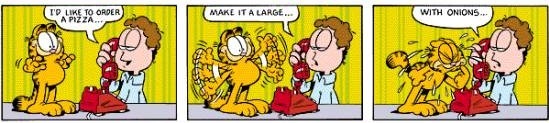 Scholars, sifting through the remainder of philosopher Jean Baudrillard’s papers, have located an essay in which Baudrillard declares:
The end of comics is, alas, also the end of the dustbins of comics. To this, we must add the Jim Davis comic, Garfield, which is not so much a comic as it is an ideology. Garfield is not an ideology that we can accept. It does not exist in the newspapers. It does not exist in our heads, hearts, and stomachs. We must look into the column inches occupied by Garfield and understand that it is not there.
It is unknown whether Baudrillard applied this criteria to all newspaper comics, but scholars are now sifting through notes Baudrillard had on The Family Circus, Marmaduke and Hagar the Horrible, all dismissed as (loosely translated from the French) “sucky comics.” But the general consensus so far is that Garfield, more than any other comic, spawned a deep animosity within Baudrillard.