Roundup?

Until we guest-bloggers pool our collective blogginess and figure out how to keep together Ed’s excellent Roundups, I offer you some reading from elsewhere. Consider it a bite-sized roundup. Particularly as I don’t know how to make WordPress do bullets, or pretty much anything useful. Ed: WordPress?

Bullet!: Books are not sweaters. This post made me sweat until I bled.
Bullet!: Harry Matthews goodstuff.
Bullet!: A good review for Chuck P’s Rant.
Bullet!: Your online writing hideaway.
Bullet!: Books we want and books we need.
Bullet!: A good place to go, every day. Well, go with your browser. You know what I mean.

Some young writers I admired in 1979: part one

Assembling was an annual compendium of “otherwise unpublishable” avant-garde art and literature compiled by Richard Kostelanetz and others between 1970 and 1982. Contributors were invited to send in up to four pages of 1,000 copies of 8 ½ x 11 pages, which were assembled alphabetically and bound into books.

I can recall taking my contributions to several editions of Assembling to Hanging Loose Press’s Bob Hershon at downtown Brooklyn’s Print Center, used by many artists and writers in those days before cheap copying.

My first few were prose experiments, but for 1979’s A Critical (Ninth) Assembling, I wrote a piece called “Some Young Writers I Admire” about ten people, several of whom were friends.

Three of the ten I lost touch with; I’m pretty sure they’ve stopped writing. There are a lot of casualties in literature.

I’d like to post about some of the others in the coming days, people still around, writing and publishing, like me, after more than 30 years.

The one pick you’ve probably heard of was then a poet. I praised his chapbooks Tiger Beat (Little Caesar Press, 1978) and Idols (The SeaHorse Press, 1979) and the little magazine he edited, Little Caesar, which I subscribed to. At the time I wrote the piece, he was the director of programming at Venice’s Beyond Baroque center, which had published several of my stories in their literary magazine.

I did not mention that once he had sent me a folded-over piece of paper on the outside of which he’d scrawled: Prepare to meet thy God. Inside, when I opened it, I found a rare colored Xerox photo of Leif Garrett.

The poet and editor I admired is famous today as a novelist: Dennis Cooper.

http://archive.salon.com/people/feature/2000/05/04/cooper/story.jpg

More of my admired no-longer-young writers in coming days.

The rooster has left the coop.

My name is Matt. I’m from Condalmo, a website at which I have thrown multiple rockin’ literary parties. Ed has, apparently, left the building. He’s left the place to some guest bloggers; I’m one of them. Allow me to lay my first egg (so to speak)…
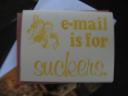
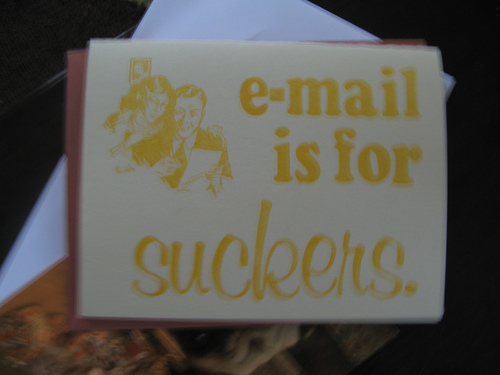
suckas image

The Modern Letter Project is a site I stumbled on the other night. I shudder at the inclusion of the instant-turn-off term pen pals, but here’s the deal:

The Modern Letter Project is a collaboration between Corie Trancho-Robie and Youngna Park that seeks to revive the lost art of snail mail pen pals. Beginning in March 2007, 140 people joined with us on this journey of letter writing, eager to connect with others the old fashioned way and engage in the fun of new stationery and decorated envelopes, the slowness of postal services and mostly, the thrill of real mail once a month that wasn’t a credit card offer.

Here is how it works:

Each participant receives one address per month for twelve months. For each of those months, they write a total of at least two letters:

1. To the address sent to them
2. A response to the person who has written to them

It is our hope that, at end of the year we will have a network of new pen pals, friends, and a collection of letters to treasure.

I feel it worth sharing because letter writing is a drum I beat from time to time at my site. Like you, I am somewhat chained to my e-mail – kind of difficult to run a blog without it, and easy to use, fast, “free” – wonderful for what it does. But listen: you know it’s different when you need to pay forty-whatever cents to send a letter, and when you’re writing it you want it to be worthwhile, thoughtful, not just something dashed off (as in “dude, I picked up the new Wilco, what’s on for next weekend, signed matty”) – email is to letter as instant message is to e-mail. Shorter and shorter, cramming it in.
With a letter, you’re putting something physical out there, something that can be held, saved. I have a letter from my grandfather. His handwriting was shaky, unsure. His thoughts were unsure. You won’t get that same feeling through an e-mail. Who wants to leave behind no trace for their offspring, no sense of their thoughts and ideas and actual physical presence, save electrons (or whatever) in Google’s massive mainframe? And who is going to weed through your thirty thousand e-mails to find that one important thing you wrote?
E-mail has recused people from letter writing, but I’m here to tell you it’s worth the time. Check this out, and get signed up at the LWP.

(oh, and why does WordPress have to completely suck? Gave me such a hard time with the image, the formatting, etc. Does it always suck this much? I can’t figure out how to add a “guest blogging” category for us, and am done trying, so this one gets filed under Erin O’Brien’s “Breasts”)

Memo to NBCC: it’s not just the book review sections that may disappear

David Carr’s Media Equation column in The New York Times today looks at the possibility that cutbacks and layoffs may not be enough to save The Star-Tribune in Minneapolis.

(Full disclosure: In December 1979, The Star-Tribune’s pre-merger predecessor, The Minneapolis Tribune, gave my first book the most perceptive review it received: “Richard Grayson’s anthology of short stories is unbelievably bad, bad, bad. How bad is it? Well, after a writer reviews his chosen book, he gets to keep it…I am not keeping this one. I want to give it to someone I really despise.”)

Hello. My name is Erin O’Brien.

I have big tits and I drive a Mini Cooper and everything I say is right.

Eff off.

Now here’s a book: Flatland by Edwin Abbott.

This baby is 118 pages and was first published in 1884. It crackles and giggles and winks. It is little and quirky (Jeepers! This book is a lot like me!). In Flatland there are only two dimensions (I have more) and all of the characters are geometric shapes (I am not).

The circles are priests: the controllers of our conduct and shapers of our destiny, the objects of universal homage and almost of adoration.

Irregular polygons are shunned:

I for my part have never known an Irregular who was not also what Nature evidently intended him to be–a hypocrite, a misanthropist, and, up to the limits of his power, a perpetrator of all manner of mischief.

All the women are lines:

For if a soldier is a wedge, a Woman is a needle; being, so to speak, all point, at least at the two extremities. Add to this the power of making herself practically invisible at will, and you will perceive that a Female, in Flatland, is a creature by no means to be trifled with.

You bet your ass I’ve got a point at both ends. As for all you Irregulars out there, why don’t you come up and trifle me sometime?

Since there is no High Priestess category available to me, all of my entries in these pages shall be listed under Breasts as well as others that I deem appropriate.

Oh yeah, I’m a writer.

Erin O'Brien