Posts by Edward Champion

Edward Champion is the Managing Editor of Reluctant Habits.

New Directors/New Films: Parque Vía (2008)

[This is the fourth in a series of dispatches relating to the New Directors/New Films series, running between March 25 and April 5 at MOMA and the Film Society of Lincoln Center.]

parquevia

The first image of Enrique Rivero’s striking feature debut sees a spider crushed by a boot. The boot belongs to a man with a wan and wrinkled face named Beto. Beto is a housekeeper living in a desolate and unoccupied manse in Mexico City that can’t be sold. He wears the same white shirt every day and scrubs the same ellipitical perimeter of the bathtub. His life is one of droll and circular routine. He turns corners in the house at rigid right angles. Gruesome news headlines blare at him from the television as he chows down on tacos. Last month’s newspapers, bundled in a tidy and philanthropic bunch, are given to him for reading. He feasts on the news of the outside world, but does not wish to involve himself in it. He is a spider caught within a web of perfunctory duty.

There’s some solace for Beto in visits from Lupe, a middle-aged woman who sleeps with him every week. Beto, we learn later, is a widower. But Lupe isn’t necessarily a black widow preying upon the last of his identity. The film does not explicitly state whether or not Beto pays Lupe for the privilege, but it does something much craftier. Our first glimpse of Lupe is through an extended long take as she dances with a man. We learn that she’s Mexico City’s answer to a dime dancing girl. (And it’s interesting that this taxi dancer rides to her appointment in taxis.) But we don’t see the man she’s with — just the back of his head. We do see Lupe’s bored expression. She snaps her gum. She fixes her hair. Her life is a husk and the man paying her for the privilege, too busy burying his head into her shoulder, cannot see this. That Rivero reveals such a major socioeconomic chasm with such sideways glimpses is a testament to his talent.

Is Beto paying Lupe for these weekly trysts? During one bored morning, shortly before Lupe’s visit, Beto orders some tamales from a cart, asking for the third one to be given to him on credit. He wolfs down the tamales. Lupe arrives. When she undresses, Beto claims that he is too full and cannot sleep with her. The underlying assumption is clear. A roll in the hay with Lupe is the price of two tamales. But is this precise detail something which the audience infers? Or is it the calculated truth? One is tempted to say yes to the latter question. Rivero himself is an engineer who turned to filmmaking. And he has presented us with a film, with many stretches in which nobody says a thing, that feels at times like a brazen calculation worked out over a series of large chalkboards. But in saying yes, does the audience confirm its blind worldview? Why shouldn’t Beto and Lupe have their small frivolities? Does the fact that Lupe is later arrested for lewd behavior attest to her lowly status? Or is this film challenging us with a more striking hypothesis? If we are presented with another view of class relations, carried out from a different viewpiont, will we come to the same conclusions?

This troubling series of dilemmas isn’t just limited to class. There’s an interesting dialectic here, operating often in yin-yang, between the interior and the exterior worlds. The dichotomy is there when trick-or-treaters knock on the door and Beto, lacking candy to give the youngsters, screws up his eyes and pretends to be a monster. But perhaps Beto does not have the eyes to see the world beyond the house? Beto sits in his chair, sucking down news and food, and the drapes behind him are drawn. But the daylight seeps through on the undrawn part of the window. Prospective buyers often stop by to look at the house. Beto observes them through the window. Initially, we do not hear the conversation. But as the film progresses, the chatter starts to penetrate through the window. And at this point, Beto isn’t capable of existing in the outside world without total collapse. But is it his occupation or his locale that causes such agoraphobia?

Parque Vía shares many qualities with Todd Haynes’s 1995 film, Safe. Both films feature main characters who have terrible physical reactions to the external world. But where Haynes had multiple chemical sensitivity, there isn’t a clear-cut diagnosis for Beto. We know that he doesn’t wish to leave the house. We also know that his occupation is far from secure, even if the house manages to get sold. And it’s something of a cruel joke that certain events playing out late in the film occur over Christmas.

Then there’s the mysterious Señora, her white hair bundled in a genteel beehive, who owns the estate and keeps Beto on the payroll. What are two tamales to her? What indeed are her pleasures outside of the parties we see from the perspective of her servants? She does something kind for Beto late in the film, but is her generosity rooted less out of an intrinsic concern for people beneath her social station and more from a cruder sense of blind duty? Is she just as isolated in her internal world as Beto? The Señora asks Beto if he is happy, and he says yes. But surely she should see that he’s not. She knows that Beto has lost his wife and she suggests to Beto that he should marry another woman. But are these not a vassal’s vagaries?

This film works as well as it does because it constantly challenges our assumptions like this. Rivero invites us to get close to people that the world does not wish to be intimate with, giving us small gestures such as Beto constantly curling his hands and little details like Beto’s alarm clock resting on top of a Bible. And yet Rivero’s intimacy is often false, and that’s only because his characters are locked into specific societal roles that we might perceive if only we could get beyond the class system. Beto’s world is sadly insular. He is talked about by others, but rarely engaged. Not even his fellow servants will answer his questions. So what does society do with a lonely man like Beto? Rivero doesn’t offer any easy answers, but he presents a cinematic viewpoint that gently compels us to step beyond our comforts and consider the richer possibilities of brotherhood. For if we don’t, we may just be hiding within our own dark houses.
New Directors/New Films: Every Little Step (2008)

[This is the third in a series of dispatches relating to the New Directors/New Films series, running between March 25 and April 5 at MOMA and the Film Society of Lincoln Center.]

everylittlestep

An actor friend and I recently entered into a heated but civil disagreement about his career. My friend insisted that it was now the time to self-promote and self-aggrandize like there was no tomorrow. I pointed out to my pal that he had talents that simply hadn’t yet been recognized by the right people, and that getting noticed simply wasn’t something he could calculate. He had the goods, but I had grave concerns that his work would be marred by solipsism, whether real or perceived. He had the obligation to stay working — whether it be dinner theater, off-Broadway, or top-notch production — and to practice as much humility and tenacity and dignity as he could under the circumstances. The acting business involves a lot of waiting, many nos, and an array of judgments which simply do not exist in any other occupation. Small wonder then that, when an actor does manage to secure himself a top perch, he is granted an unprecedented amount of assistants and press protection. For by the time an actor has made it this far, the relatively anonymous artist who struggled for years has capitulated his relative obscurity. But isn’t the acting profession something of a devil’s bargain? You entertain a crowd, but you do so at the expense of presenting your true self. And you do so knowing that you will have to fight tooth and nail to keep the rent paid and the work coming. Not many people can do this, but so many are driven to expend every ounce of spare energy into seizing a small scrap of the stage.

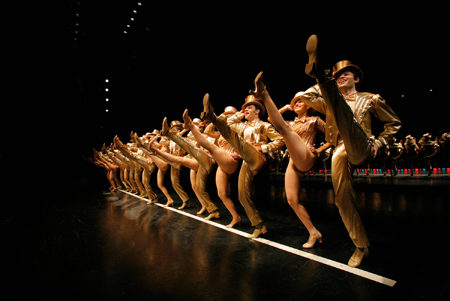
The documentary Every Little Step examines these often underreported realities with the casting sessions for the 2006 A Chorus Line revival. Filmmakers James D. Stern and Adam Del Deo were apparently granted backstage access as the casting stretched into endless callbacks over many months. I do not know if there were any quids pro quo arrived at during this documentary journey, but there’s certainly a meta irony given the show in question. As audience-friendly as A Chorus Line and Every Little Step both are, Stern and Del Deo are to be commended for exposing a handful of the profession’s ugly little truths. There is, for example, some concern about an actress up for the role of Connie. She was born in Japan, but can she nail the right dialect if she wasn’t born in the States? A cocky dancer and choreographer named Tyce Diorio boasts to the camera that he wants his own television show. But his clear hubris is immediately observed by the casting team and he is dumped. One dancer is asked to reproduce what she did last summer, but cannot recall specifically what it was and is too nervous and shell-shocked to ask.

The film is careful to expose what lies in the future for these young and hungry gypsy aspirants, but it doesn’t always present its mini-narratives holistically. One dancer’s father describes a moment in his early forties when both of his knees blew out. He still tried to dance anyway and found himself backstage with his boots soaked in blood. But what did he do when he knew he couldn’t dance? That might have been another documentary altogether, but this intriguing yet unfulfilled story demonstrates the film’s weakness in trying to tackle too much.

Of course, as every good Broadway aficionado knows, A Chorus Line was one of the first major Broadway productions to be workshopped, with Michael Bennett leading a recorded series of confessions after midnight that served as the transcribed template. The film does not quibble with the controversial claim that Bennett was the sole man behind the show, nor does it quite expose Bennett’s tendency to control every project that he was involved with.

I likewise found myself wondering how much Bob Avian (the revival’s director) was playing up his kindness before the cameras. He is presented here as a gruff, no-nonsense, barrel-chested administrator, his team shuttling around and encouraging prospective applicants. But Avian is capable of being genuinely moved. When Jason Tam delivers his gut-wrenching monologue as Paul, both the show’s production team and the audience watching this film know that he will get the part. So perhaps Every Little Step functions on three levels: the Broadway audience who will see the show is “entertained” by dancers begging for their parts (lightened somewhat by the Marvlin Hamlisch’s famous bouncer, “Dance: Ten; Looks: Three”), the audience who will see this film is “entertained” by dancers begging for their parts (lightened somewhat by crowd favorites getting the role), and the director being photographed is “entertained” by prospective dancers while making often brutal decisions (his duties lightened somewhat by a few on-camera moments that suggest he’s not that bad of a guy).

I was less taken with the film’s clear promotion of A Chorus Line, but quite engaged by the process of auditioning itself. Hearing a director describe the ideal Val as someone with “a truck driver’s mouth, but who’s really a sweetheart” is a sentiment you might find on any promotional pamphlet, as is Hamlisch himself describing yet again how the title “Tits and Ass” transmuted into “Dance: Ten; Looks: Three.” But seeing a director quietly beseech an actor on stage to get a performance right, because there may very well be some rejection that he must uncomfortably come to terms with, is the mark of a decent documentary. I wished Every Little Step had pursued more moments in the latter category. But a struggling actor may find some of the film’s quiet revelations engaging — in large part because the actor doesn’t always see himself from a camera’s third-person perspective.

New Review

The book appears to have been completely ignored by American newspapers. There’s this snobbish Bookforum review which observes “lowbrow thrills” and appears written by a humorless gentleman who wouldn’t know fun even if he were offered the role of his choice in a custard pie fight. (This regrettable quality is quite typical of the people who Albert Mobilio hires these days. It has been suggested to me that Mobilio does not laugh at all or that he titters infrequently at best. To expect humor, much less fun, in Bookforum‘s dilletantish pages is akin to asking a paraplegic to wake up one morning and participate in a 10K run. It’s simply not going to happen.)

My own take on Alberto Sánchez Piñol’s new novel, Pandora in the Congo, a book that is especially wonderful, can be found in today’s Barnes and Noble Review. I must also praise translator Mara Faye Lethem (who is disgracefully unmentioned in the Bookforum review). Translators are often granted the least hosannas. But between Pandora and Javier Calvo’s Wonderful World (which I am now sneaking pecks at between other books), Lethem is one of the few translators who truly gets pulp, perspective, and idiosyncratic voice. These are vital aspects of literature that are beyond the understanding of Mobilio’s army of hubristic hucksters, but are thankfully within the easy reach of the rest of us.

The Onion Narrative

On the morning of Saturday, March 21, 2009, I left the house to purchase an onion. This action, in and of itself, might be considered meaningless. Most would consider this a perfunctory deed or an insignificant errand. There isn’t a foolproof way to capture all comparable actions occurring at the same moment (9:30 AM EDT), but why should any of us ignore the potential pleasures contained within such a routine act? Are we taking this modern convenience for granted? Is a trip to the store to be sneered at? If we view a produce run with contempt, do we therefore view a previous age of humanity with contempt? Why should it have to be about us? A 10th century Viking berserking his way across North America certainly didn’t have this option of a neighborhood market. The Viking’s diet consisted of what he was able to hunt and gather. I am certain that if the Viking learned of developments eleven centuries later, common to every civilized being, and further ascertained that we were complaining about what a pain in the ass it was to get an onion so early in the morning (for the Viking surely had to spend half of his day plunging through the river for some fish), he’d put a battleaxe through our skulls. And we might very well deserve it. (At the risk of self-aggrandizement, let the record show that I did not complain.)

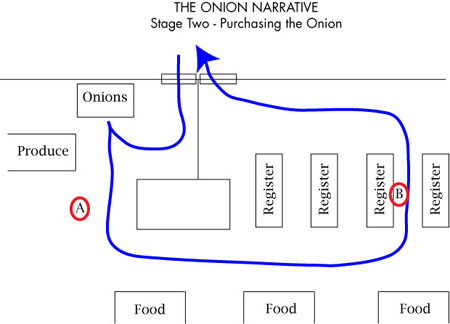
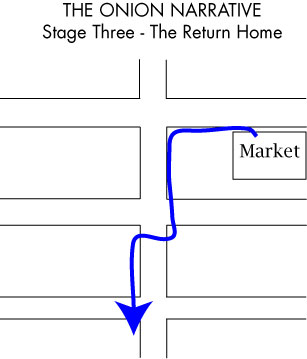
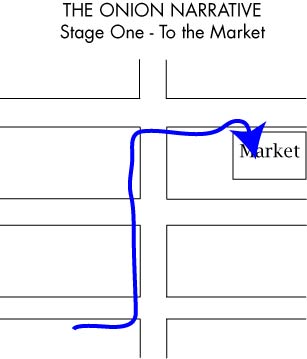
What I hope to document here is one such act, which I style “The Onion Narrative.” Because my effort to obtain this onion exists in the past, fixed and immalleable and further complicated by the mind tinkering even as it accounts for what happened. I have provided diagrams (certainly not to scale) that have divided my Onion Narrative into three tidy stages. And to demonstrate how imperfect this process is, as an experiment, I attempted to recreate my Onion Narrative on video, following the exact same walking route and purchasing yet another onion. My recollection of the details isn’t nearly as precise as I’d like to think. The video confirms that I overstated the width of the food aisles in my diagrams. For the diagrams, I used only memory as my guide. And the video camera placed additional limitations. I was forced to adjust the narrative circumstances contained within my memory. Because I was holding a camera, admittedly a small one, I was nevertheless required to take a dollar out of my wallet in advance so that I could hand it to the register clerk. This way, I wouldn’t have to set down the camera and extract the dinero from my leather pouch. In addition, the price of the onion was different from the initial price. The onion itself was different. Moreover, the social conditions surrounding my journey had drastically changed. (For one, there were more dog walkers.) I’ll explore the implication of these details very soon. But for the moment, let’s concentrate on the original narrative contained within my memory.

The Original Narrative

We needed the onion to make breakfast. We had run out of onions the night before because we had used the last one in our kitchen to make some homemade soup. The market was only blocks away from where we lived. The task offered an opportunity for me to walk. And I also found it somewhat comical that I would be going to the market for only one item. Just some commonplace produce that cost under a dollar. Was this bad time management on my part? After all, if you’re going to go to the store, shouldn’t you go there for multiple items so that you might save yourself some trips?

I did not see the situation that way. Here were my priorities for this five-minute excursion:

Priority One: Obtain onion.
Priority Two: Go for a walk, commune with the world, get away from the damn computer.
Priority Three: Find random opportunities for recurring curiosity about others to take root.

I willfully revolted against my first priority by purchasing not one onion, but three. It might be argued that by purchasing one onion, I had fulfilled my priority and that the two additional onions represented a new priority that I had whipped up on the spot; a spontaneity that I had not anticipated until I arrived at the onion bin. A more austere type might wish to punish me for my failure to obey the set dicta, or for not following the subconscious directions to the letter or for exceeding my budget, as ridiculously minuscule as it was. (For what it’s worth, I only purchased one onion when I recreated the incident.) I suppose it all depends on how much value you place on the onion or whether you feel comfortable having an extra onion around the house. Nearly anybody can afford an onion. Or at least nearly anybody lucky enough to have a roof over his head. And perhaps purchasing two extra onions doesn’t really matter if you have, as I did, even four dollars in your wallet. But if you only have a dollar and you purchase two more, then you are forced into a position of potential embarrassment when the clerk is forced to put the additional onions back. The second onion, beyond your means in this hypothetical case, determines your social position, which is very low indeed. But maybe you have no shame and you wish to max out your meager budget. Or maybe you want to see how the clerk will react to such a dilemma.

stageoneAs I progressed to the store (see the accompanying graph labeled Stage One), the first priority became less significant. I found myself considering the number of cigarette butts scattered on the sidewalk, which had proliferated considerably from last evening. This then led me to wonder if there was a higher percentage of smokers in my neighborhood than I originally estimated, or whether there were some people who who only liked to smoke on Friday night. But could I really make such a judgment when I wasn’t devoting my complete attention to how frequently the streets were cleaned or the people cleaning them? I then began to observe people as I walked. Over the course of my journey, I counted 31 people who were out and about.

31 people! And this was just over the course of five minutes. That’s 372 people in one hour, assuming that the rate of wanderers remains constant and that you don’t run into the same person twice. Given these numbers, small wonder then that we still obsess over the phenomenon of “running into someone.” And yet none of us, I think, are quite aware of just how many people we see or how many social or conversational possibilities we are presented with at any given time. We are often so fixated on our solitary task (in this case, the purchase of an onion) that we fail to consider our true insignificance.

Web

Since I was in a jocular mood, I’d like to think that I plentifully partook of these social opportunities. But there were only two people with whom I had direct contact with. And this was in the store. (I do not count the dog with a sad-looking face just outside the store who angled his head through two metal railings for attention and who I proceeded to pet and speak in a soothing voice to.) At Point A: A boy saddling along with his mother and carrying a glum expression. Recognizing the boy’s need to feel happier, I stuck out my tongue at him, and he smiled. At Point B: Some banter with the register clerk. A “Good morning” and “How are you doing?” and a “Thanks.” A smile. But nothing beyond that. Indeed, at Point B in the video, I did even worse. My recreated journey on video sees me communicating with nobody save the clerk, and my socialization was limited to “Thanks.”

I felt like a terribly selfish person when these details were revealed. Had the video made me more self-conscious? Was I less jocular? Or were the circumstances inveterate? Can we be exonerated if we aren’t really aware of how few people we talk with? Or is it incumbent on us to be more socially responsible? If it is socially acceptable not to talk with even half of the 31 random people we regularly run into on any given day, then are we any less culpable in failing to live up to the possibilities before us? In 2007, a University of Melbourne researcher concluded that political candidates sitting on the left-hand position of a stage are more likely to draw attention. Because the brain, when tracking a tableau, has a tendency to drift to the left. I must note that in Points A and B that the individuals were to my left. I also see that my own journey to and from the store had me situated mostly on the left side of the street. Therefore, if my brain was going out of its way to excluding people, it was possibly because my visual cortex was occupied with the buildings and edifices. Was I subconsciously going out of my way to avoid people? (Additional factors to consider: I learned later in the afternoon that I was in need of social engagement. Several opportunities presented themselves and were taken.)

What is also troubling in my video reenactment is that the only time I comment on anything is when I see a bus parked at a stoplight. This bus is in almost the exact same position as another bus was during my original journey. And seeing the similarity, I am forced to violate the conditions of my recreation: commenting upon the action. This would further support the “running into someone” theory. Consider what cognitive scientist Colin Cherry identified as the cocktail party effect, whereby a person has the ability to focus in on one talker while a steady chatter of conversation is going on. This was supported last year by a study that revealed the auditory cortex does a good deal of work in filtering conversation. And if your brain has robust basal ganglia, well, then you likewise may have a robust “irrelevance filter.”

I do not know how tough my basal ganglia are. But I am troubled by how smoothly my brain deems certain details irrelevant. How little it notices. How needlessly egocentric it is on a subconscious level. After the fact, I am going out of my way to locate the new, the unseen, the underdogs, the moments I didn’t seize, the people I could have talked to, the emphases I now find phony or false.

stagethreeStage Three of my journey seems less significant than the first two stages. By my own judgment, it is also the least interesting part of the video recreation. The onion has been obtained. I recall that during the original narrative, I found myself observing more people. I was not in a rush to get back. But on the video, I am circling around people rather than approaching them. I do not know if this is because of the camera or because I felt uneasy reproducing the narrative. And why should Stage Three be the least of the three? The primary goal has been obtained. The mind is at ease and can be more spontaneous with the rigid order out of the way. Or so one would think.
This exercise originated, in part, from ruminating over Roger Ebert’s recent post about the determinism of the universe, although the subject has long been on my mind. I am a secular type who does not believe in a deity, and yet, on some primordial level, my mind seeks to find connections and patterns. Even in thinking about why my mind reacted the way that it did, I am still trying to pinpoint a framework. How is this any different from Intelligent Design?

Among George Santayana’s great arsenal of pithy maxims is this one, written in response to William James’s the Varieties of Religious Experience: “Experience seems to most of us to lead to conclusions, but empiricism has sworn never to draw them.” I hope that I have been more explicit about my free will than James was, and yet I share with James a strange pleasure in vivisecting my experience. Of coming to terms with my subconscious limitations as a human being through diagrams and video reenactments. One should probably not approach life this way, because on a certain level, one must live with blind and uncomfortable truths. But is the truth really unraveled when we consider the structure beneath it? Or is the mind so hopelessly fallible, so determined in its determinist filtering, that human beings are doomed to repeat the same mistakes even when the horse has been led to water? This seems cynical rhetoric, but it’s quite liberating to know that, no matter how much you slice and dice up a moment, the mind remains a dutiful deflector.

New Directors/New Films: Unmade Beds (2009)

[This is the second in a series of dispatches relating to the New Directors/New Films series, running between March 25 and April 5 at MOMA and the Film Society of Lincoln Center.]

unmadebeds

The title of Alexis Dos Santos’s second feature film suggests either a Chekhovian spright or a close kinship with Francois Truffaut’s Stolen Kisses, perhaps one of the most definitive portraits of young people ever burned to celluloid. Certainly there are many allusions to French cinema throughout: a Jules and Jim-like menage-a-trois and a belabored homage to the bear suit in Renoir’s Rules of the Game that suggests a lack of auterial confidence. But Unmade Beds is a plodding and episodic film that can’t quite locate the definitive comforter to keep its many bedhopping twentysomethings from toppling out of the boxspring. A movie involving aimless characters should work, if only because this involves people having to react to random scenarios and reveal who they are. Certainly in Axl, a 20-year-old rootless kid from Madrid searching for his dad, there is some promise. By Axl’s count, he has slept in some twenty beds over twenty years. But if his current lifestyle reflects a certain deficiency in his counting skills, I must report my distrust in this tidy philosophical number. Now in London, he goes out to party every evening and can never quite remember what happened the night before. This results in a stolen kiss from someone he was carnal with the night before. Somehow, he stumbles his way into an industrial flat where nobody seems to pay rent and there seems to be plenty of liquor (courtesy of a club named the Lost and Found). “How many people live here?” asks Axl. His new roommate (a parachutist enthusiast, as it turns out) replies, “No idea. It changes all the time.” Of course, you never know when the place is going to be used to shoot a dubious music video with people dressed in animal suits or when you might be asked to select one of the many ratty mattresses in the cellar. Having spent a portion of my early twenties bouncing around similar living arrangements, I commend Dos Santos for going out of his way to depict this uncertain bump and grind.

But let’s be clear on this. The film is on shaky ground, because it tries to balance the clueless frivolities of youth with a crude conceptual philosophy (“Two people will always be one plus one”). That’s a tall order for even the most talented filmmaker. And Dos Santos mangles this severely with his other major character, Vera (who is French!), who also lives in the flat and spends much of her time meeting up in motel rooms (one is numbered 353, a palindrome reflecting just how this will turn out) with a man who who later reveals his emotional complexity with a homespun song (“I’d like to spend the day with you / I’d like to spend the night as well” are some of the lyrics). Here is a lad that you might find charming if you really just want to boff a guy who will pick up the lodging bill. You can scrounge up a dozen of them without serious effort in Williamsburg. Vera and the man — I know that he had a name, I know that I wrote it down, I know that I can probably IMDB it, but he made such little impact on me that it scarcely seems worth the effort — settle into an affair in which no phone numbers are exchanged. Only meeting times and locations. Dos Santos attempts a semiotic significance by having the man constantly dash the tips of his fingers on stair railings. (Again, the French film imagery!) But we never really get a true sense of the desperate loneliness behind this relationship, save for one moment in which this couple dashes onto the next random train and a decently-directed sex scene that has the two nervously discovering their bodies. Unfortunately, every time these two meet up, Dos Santos has Tindersticks’s “Cherry Blossoms” play. And play again. And again. I mean it’s a good song and all, but — “Get in the morning.” Oh, shit again? No, Dos Santos! “Climb in beside you!” Yeah, I get it. For fuck’s sake, make it stop! “Watch the clock for half an hour.” No, make it stop! I hate this song!

It’s safe to say that if I were Stuart Ashton Staples, I would seek legal action against Dos Santos for making one of my well-known croons almost totally unappealing over the course of 93 mere minutes.

Axl does track down his dad. He’s a staid real estate agent who Axl welcomes to his jungle by pretending to look for an apartment. But will he confront him with the truth? It’s the allegorical unmade bed in action. That steady place where you can fall fast asleep so long as you combat your laziness and take some responsibility in the morning. One almost expects a flashing subtitle to spell this out and clue in that part of the audience who has fallen asleep. (I counted five dozers at the screening I attended.) There’s an odd backstory in which a young Axl pretended to be a superhero and leaped from a tall domestic place only to injure himself. This boyhood slip-and-fall, by no means comical, is revisited in the present.

But neither Axl nor Vera are half as interesting as a snotty bookstore employee who insists that Vera arrange all the books in their correct order. Dos Santos continually suggests that Axl and Vera will eventually be forced to confront the need for some kind of order in their lives. But he isn’t a daring enough filmmaker to suggest that these two might find order on their own terms. He’s good enough to reveal their wanton desires, but what Truffaut did so well with his Antoine Doinel films was to juxtapose his drifting slacker against the need to find a sense of purpose — even accidentally. This bookstore employee may very well be an allusion to the struggling writer in the Doinel films who is always hitting Antoine up for cash in the street. “At least this writer is trying to do something on his own terms,” Truffaut is almost screaming to us with these moments. “But Antoine is not. Will Antoine finally get it?”

Well, Axl and Vera never do get it. They don’t even come close to getting it. Vera keeps a Moleskine in which she neatly inserts her photos. But this is just killing time. That we don’t have any sense of where she might go or what she might do with her life is a major cinematic debilitation. We know pretty early on how Axl’s quest for his father will turn out. And we also know that without this pursuit, he’s nothing. Axl tells his father that he’s in business school. He clutches onto his father’s business card and makes random calls to him on a pay phone. But give him five years and he’ll be a wreck. He has only a schoolboy’s jacket he finds at the flat to cloak the internal qualities he can’t coax out. But shouldn’t we have some sense of what lurks behind these details? I’m not against films about rudimentary twentysomethings, but shouldn’t we be curious?