Posts by Edward Champion

Edward Champion is the Managing Editor of Reluctant Habits.

The Bat Segundo Show: Thomas M. Disch

Thomas M. Disch appeared on The Bat Segundo Show #219.

The late, great author committed suicide on July 4, 2008. This was his last face-to-face interview before his death, conducted on June 25, 2008 at his apartment. For more on Disch, start here. His most recent book was The Word of God.
Condition of the Show: In memoriam.

Author: Thomas M. Disch

Subjects Discussed: The difficulties of declaring yourself a deity, truth and memoirs, authenticity, James Frey, Disch’s takedown of Whitley Streiber, Democrats and evangelism, Reverend James Dobson, the unexpected reaction to Disch declaring himself an atheist at a North Dakota convention, Clifford Irving, the fun of footnotes and annotation, fundamentalists, writing books in which the ground is always shifting, Emerson and the trinity, Algis Budrys, Thomas Mann, the taboos of simulacra and alternative realities, war and commandments, the fantasy of having different parents, griping about editors and agents, the American literary tradition of celebrating con artistry, L. Ron Hubbard, Disch’s religious acolytes, Michael Moorcock, asking for blurbs without any of the blurbers reading the book, Philip K. Dick’s 1972 letter to the FBI, Camp Concentration, pulp fiction and literary posterity, “A Visit from Saint Nicholas” and Clement Brown, whether or not literature (and civilization) will survive into the next century, maintaining a LiveJournal, on not submitting poems to magazines, Samuel Johnson’s maxim, poetry and the New Yorker, editors or critics who hate Disch’s guts, being ignored, being snubbed by Stephen Donaldson, ridiculing enemies, nonoverlapping magesteria, having Catholic friends, cowboys, literature as a religion, Disch’s efforts to read The Tale of Genji before death, the reading of “approved classics,” Samuel Richardson’s Clarissa and Jane Austen, Disch’s strong love of Patrick O’Brian’s Aubrey-Maturin novels, writing Amnesia and building a model of Manhattan within the text adventure game, literature as a constantly changing medium, inhabiting the now and obsolescence, silent film, and poetry as Disch’s “one good horse.”

EXCERPT FROM SHOW:
Correspondent: I wanted to also ask you about A.J. Budrys, who I know you — I saw your LiveJournal where there were many caustic remarks directed his way. But I should point out that when I received this galley well before June 9th, when he died, you referred to him as “the late Algis Budrys.”

Disch: (laughs) Yes!

Correspondent: I’m wondering if you had some inside dope or if this is another example of your divine powers.

Disch: I guess so. I mean, I never know what my divine powers are going to do often, until they’ve done it. And this is certainly a case where I had picked the right horse without even knowing.

Correspondent: Well, I mean, why did you type “the late” so early on? I mean…

Disch: (laughs) Well, for one thing, I didn’t know.

Correspondent: You didn’t know he was alive?

Disch: Yeah. I sort of figured it was likely that he was dead. And wishing it to be the case, I just wrote it that way.

Correspondent: Or he was dead to you in other words?

Disch: Yeah. Yeah. I mean, if I had my druthers, there he is.

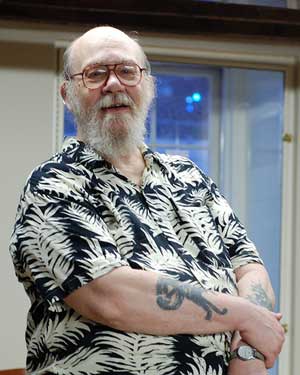
Photo credit: Flickr

(Please note: Due to current incompatibility between PodPress and WP 2.6, I have had to institute a workaround. If the player button does not work, then try the direct link to the MP3 below.)

BSS #219: Thomas M. Disch

The Bat Segundo Show, 2004-2008?

The Bat Segundo Show is going on indefinite hiatus. Which pretty much means that it’s over, unless some magical sponsor or benefactor can appear at the eleventh hour to save the show. But I doubt it.

I tried to keep the show running as long as I could, supporting it with my own money. A typical show took me about twenty to thirty hours to produce from start to finish. Segundo was a full-time job for which I received nothing but generous donations, including many of you who kindly chipped in during last year’s pledge drive. The hell of it is that the money required to keep the show going was peanuts.

But now that most of my freelancing income sources have dried up — in some cases permanently — I’m looking for a full-time job to make ends meet. And I only have so much time and energy to go around.

I feel tremendously sad about all this. I know that for some authors, Segundo was the only place they had to discuss their books. But I see no other option but to fold the show under the current economic circumstances.

Thanks to all the authors who took the time out of their busy schedules to talk with me. Thanks to all the publicists who went along with the crazy concept. And thanks, most of all, to the listeners. For four years, we offered a bona-fide alternative to the mainstream. And I’m extremely disheartened to abandon this. I never felt entitled to a living from this. But I do feel as if I’ve drowned a baby.

There are about nine shows left to be released, with a few more interviews I’ve set up that have yet to be conducted. I’ll be putting these shows up in the forthcoming weeks.

In the meantime, if you need a guy to write for you full-time or wait tables, please feel free to email me.

[UPDATE: I’ve added a question mark to the post’s title, since it seems possible to carry on the show in a severely reduced capacity. Perhaps through a seasonal special or two. Last night, I left a comment in the accompanying thread outlining some of the options. I conducted an interview this morning. Lots of laughs. Knowing that it would be one of the last ones (at least for a while), I appreciated it more than I usually do.]

L.A. Times Layoff Developments

L.A. Observed reports that publisher David Hiller has resigned. The site has posted his memo, which ends, “I’m sorry I won’t be here to pitch in, but I’ll be rooting for you.” Meanwhile, editor Russ Stanton announced today that editors will begin informing the 150 people who will be leaving. There is no word yet on how the books section will be affected by these layoffs, other than the previously reported merging of books reporting into the Calendar section once the Book Review/Opinion section is eliminated at the end of the month.

The State of American Literacy As Represented by Talk Show Hosts

From The Leonard Lopate Show, September 22, 2004, at the 14:04 mark on the RealAudio file, from a conversation with Terry Gross:

LOPATE: The question that people ask me the most is, “Do you read all of those books?” And I don’t know what to say. I do get help. And I usually say, “I get help.” But they don’t want to hear that. They want to believe that all I do, day and night, even on the air, is read books for tomorrow’s show.

GROSS: Well, what I say is that I read all the books. But I put — use my fingers to put quotation marks around the word “read.” ‘Cause what I do when I read the book is probably a closer approximation to skimming. ‘Cause I’m reading really fast and then slowing down for parts that I think will be relevant to the interview. And then taking notes on what I read.

LOPATE: Have you discovered that it’s ruined your personal reading? It’s hard for me to read a novel today or anything else just for pleasure. Because questions are always from it. I want to ask, “Well, Mr. Dostoevsky, why did you have Raskolnikov do that in Chapter 6?”

GROSS: That’s a really good question. You know, often, on vacations, I read — I intentionally read — a dead author. So that I’m not doing what you just said. So that I’m off the hook. So I can just read it. But this summer was one of the first vacations in a long time I did not read a whole novel. I read part of a novel. And then I found myself reading newspapers. It’s so hard not to read the newspaper right now. The newspaper itself is so interesting. And I feel like I can’t go a day without reading the newspaper. There are magazines that I wanted to catch up on. And I had to — I had to not read. I went to see one or two movies, or a movie and a concert, every day that I was on vacation. And I really felt I needed to spend a little bit of time not reading. Because I read so much.

LOPATE: When you’re putting together the questions you’re to ask, do you ever rely on those press kits? Their favorite question, which is, “Why did you write this book?”

GROSS: The part that I usually — I usually read the press releases because it’s a nice kind of frame before you start the book. When you’re reading at my pace, it’s nice to have a kind of brief overview of the book. So I’ll read reviews also. But I will intentionally not read the questions that the publisher gives. Because some of those questions are going to be good. Some of those questions are going to be questions that I would have asked anyways. But if I see those questions, it will make me think, “Well, I can’t ask that question.” Because that question has been put before me by a publicist and I’ll feel like I’m asking it because they told me to. So I feel like I can’t afford to look at it. So I’ll just, you know, do you know what I mean?

LOPATE: I know perfectly well. It’s almost a perversity, their pride that I have to do it all by myself. If I don’t want to rely on the publicity machine to tell me what to do —

GROSS: Well, you want to expect that your questions are independent of that. And yet a lot of the publicists are really smart. And they’re coming out with really good questions. So…

LOPATE: Well, they try to intrigue you into having the guest.

GROSS: Yes. So my technique is don’t read it.

The Bat Segundo Show: Andre Dubus III

Andre Dubus III appeared on The Bat Segundo Show #218. Dubus is most recently the author of The Garden of Last Days.

Condition of the Show: Plagued by decaying verdure and intrusive catering managers.

Author: Andre Dubus III

Subjects Discussed: The propinquity of Roman numerals after surnames, Richard Flanagan’s The Unknown Terrorist, Heinrich Böll, books being categorized as post-9/11 novels, on letting a book go after publication, political novels, writing longhand in cars, Tobias Wolff, the car as shared confessional experience, Flannery O’Connor, writing as a dreamworld, verisimilitude, getting an approximation of an outsider’s character or experience, “White Trees, Hammer Moon,” prison, capitalism, serial description in a declarative sentence, considering the reader, realism vs. postmodernism, self-indulgence in writing, Blaise Pascal, the dangers of the author pleasing himself, taking twenty-five years to write a novel, Dubus’s beverage motif, whether or not specific details in a novel are symbolic, the advantages that come from confined and sustained narratives, sensuality, writing in short sustained bursts, vicarious moral outrage, poems and Books on Tape, T.S. Eliot’s The Waste Land, an interruption by a catering manager, Dubus’s early life bumping around, the responsibilities of a novelist, honesty, novelists who impose endings on books, fiction as a pack of lies vs. fiction as truth, Picasso, sincerity, characters who become truer than real people, and the absence of fathers and husbands in The Garden of Last Days.

EXCERPT FROM SHOW:

Correspondent: I had to remark on the beverage motif throughout this book. We open this book with, of course, April having a plastic coffee cup with her legs. And then two hundred, three hundred pages in, we see the cop with the #1 GRANDDAD mug. And then we also have Virginia heating a cold cup of coffee in the microwave. So…

Dubus: Ho ho! This is brilliant, man. (laughs)

Correspondent: But the concern for coffee in this is rather extraordinary! Because coffee is almost this life force of good versus the drinking one sees from the antagonists in this book. All the antagonists tend to drink. Or they resist drink in order to be good. And so…

Dubus: Oh, this is fascinating.

Correspondent: So there’s a certain coffee-alcohol axis I had to ask you about.

Dubus: Well, God, it just sounds like a weekend in my life.

Correspondent: (laughs)

Dubus: Drink Friday night, drink coffee on Saturday morning. Fascinating. Wow. I hadn’t even known that. Listen, I do believe that we live in our bodies. Even those of us who live very ethereally from the chin up. And I truly believe that these central details shape us and guide us. You know, I had this experience a few years ago where my wife and I had a little spat over money the first thing in the morning. My coffee was cold, gone cold during the fight. I get in the car. It hardly starts up. And I’m worried about money and can I fix this clutch. I drive off. A guy cuts me off in his truck. And I’m telling you. If that car could go fast, I’d go down the road, rip him off the truck, and beat on him.

The next day, my wife and I were fine. We weren’t having a spat. My coffee was delicious. It was the perfect cup of dark French roast. Black. That I like. And it was just the right temperature. I had a little cup, driving cup. And it wasn’t spilling. The car started up. I pull out into the word and another guy cuts me off. And this time, Ed, I said, “Go in peace, my brother. You should be careful. You might hurt someone or yourself.” I had all this good will. And it had to do with my coffee being good. (laughs)

Correspondent: But I’m wondering how this…

Dubus: This stuff isn’t unimportant?

Correspondent: It’s important. But I’m curious. You have to be aware — since there is so much coffee in this book — that you’re repeating this symbol over and over again. So readers like me say, “Well, coffee. Might be a symbol.” Or as we’re suggesting here, it may not be a symbol at all. It may just be some aspect of the world you’re drawing from that just happens to repeat itself.

Dubus: But, Ed, man, I really believe that the reader tends to know more than the writer. At least, certainly in my case.