Posts by Edward Champion

Edward Champion is the Managing Editor of Reluctant Habits.

The Other Bald Man

Whenever I go to a party, particularly one with lithe lads and lasses who are a good five or seven years younger than me, I feel a great sense of delight when another bald man arrives. “Aha!” I cry. “One of my kind!” Any lingering nervousness lifts. And I often single out my bald compatriot with a cheery hello, sometimes offering a telling wink or a gentle, avuncular nudge. It is my hope to imbue any bald man with a sense that they could be as badass as Samuel L. Jackson or Patrick Stewart or Sean Connery if they really wanted to be.

I should point out that my thatchy crescent has not yet completely receded. It has remained, much to my shock, recalcitrant in some places and skin-abdicating in others. For example, there remains a small but stubborn patch two inches above the outer edge of my left eyebrow that does not wish to yield to the fleshy inevitability just over the hill. I have taken to shaving my hair off every few months just to see how much of the hair will grow back. And to keep things quite fun, I have also grown more beards in the past year than I have in all the years previously. (The beard growing/hair shaving gambit is also my way of adjusting to the pronounced shift in seasons, which I am truly unused to — this being my first year living outside of California.)

But the balding is slower than I imagine. A friend who hasn’t seen me in two or three years will often refrain from telling me how much hair I’ve lost. And while I’ve long accepted the fact that I’m balding and would not take offense, I’m honored by this politeness and hold my tongue.

But back to this business of the other bald man: sometimes, when the other bald man is younger than me and has balded more substantially than I have, there is something of a social impasse. Particularly when the other bald man is experiencing some crisis of confidence common to a young man in his mid-to-late twenties. And instead of returning my good-hearted cheer, the other bald man’s eyes dart upwards to the hairy isthmus at the top of my head and widen with a sense of fear and panic. And whatever words I have to say on the subject (“Don’t worry. I’m sure it will be gone in a few years.”) are nulled by the sense that I somehow got a better deal. When in fact, the degree of one’s hair loss has no real bearing.

A few evenings ago, I encountered another bald man of this type and began to conduct some social experiments. I would move to a corner of the room he was occupying and beads of sweat would appear on his forehead. He would then move away. I would shift again. He would move away again. I had never met this guy before. And he certainly didn’t know me. I was a bit boisterous, as I usually am at such occasions. But I was polite and did nothing out of the ordinary.

Since the other bald men wished to ignore me, it became necessary to take things to the next level. I began talking to several young ladies, determining which ones were single, and, for those who did not appear to have a date or a steady man, I started suggesting that they talk to this other bald men. I made oblique references to a great act of courage that I had heard about. I pointed to the other bald man’s wit, écalt, and other factors, and even managed to cajole a few of them to walk across the room and start talking with him. And I would watch the other bald man blow these opportunities in minutes.

I suppose I sympathized because I was that bald man once, before I snapped out of it. Regrettably, balding is one of those things that we’re expected to sneer down on. The same way shallow and myopic types concern themselves over those who are fatter, older, or some needless aesthetic qualifier that ends with -er, and feel the compulsive need to expend a good deal of time, money, and energy over this when it’s far simpler to accept others as much as one can.

Because of this, you’ll always find me saluting and encouraging the other bald man at a party. He may very well have his act together, but it never hurts to remind him that there’s a hell of a lot more going on than “Who loves ya, baby?”

Weekend Diversions: Lyrebirds

The lyrebird, most commonly found in Australia, is capable of mimicking an extraordinary range of sounds while singing to attract a mate. But as the below clip with David Attenborough demonstrates, humans aren’t always aware of the considerable impact they have upon nature. As reported in 2001 by the Register and in 2005 by the Hindustan Times, birds have also picked up an uncanny ability to impersonate ringtones. But perhaps the saddest part of this story is the possibility put forth by the National Audubon Society last year: noise pollution may be causing birds to lose their capacity to sing.

NYTBR: Bill Keller Can Do No Wrong

Just when you think the New York Times Book Review couldn’t get any sleazier, editor Sam Tanenhaus has proven yet again that there isn’t an unctuous pool he won’t dive into. The latest disgrace is Ruth Conniff’s review of Bill Keller’s Tree Shaker. Bill Keller, of course, is the executive editor of the New York Times and Conniff’s review is perhaps the most egregious conflict of interest in the NYTBR‘s entire history. Conniff isn’t critical one whit about Tree Shaker. The review may as well have recycled the book’s press release. But Conniff (or perhaps the editors) have no problem invoking these boilerplate plaudits:

With its striking layout, bright graphics and photographs on almost every page, Keller’s biography of Mandela vibrates with the feeling of history come alive.

This book does not condescend to its young audience, leaving readers to draw their own conclusions.

We learn that Keller, despite writing a children’s book, is “more a historian here than a biographer.” (Never mind that the book is a mere 128 pages.) We learn that he wrote “a thoughtful afterword.” The only thing missing in this review is a phone number for New York Times readers to confess their conversion from Christianity to the Church of Keller.

I’m still puzzled why Conniff didn’t declare Bill Keller “the greatest writer in the history of children’s literature” or “the most profound humanitarian since Gandhi.” Why didn’t Conniff demand that all literary people supplicate before Keller’s dais, declare Lord Bill the True Leader, and be prepared to sacrifice their babies to the volcano?

Tanenhaus doesn’t stop there. In addition to featuring a ten minute podcast interview with Keller on the Times website, he also offers the first chapter.

Of course, it’s just possible that Conniff really did love the book. But when one examines the first chapter, Keller’s writing deficiencies become self-evident. Grammarians will wince at the folksy use of “gotten” and the sloppy “past half a century.” A double “was now” has managed to escape the copy editor’s eye. We learn that Ahmed Kathrada is “a thoughtful man” because he “earned multiple college degrees while in prison.” We get awkward redundancies such as “Then we rode to their old cellblock, where Mandela posed for pictures in his cell…” (In his cell? No kidding?)

Beyond these flubs, there is nothing more here than dry generalized description that could have been easily cadged from the back of a travel brochure.

That such a book would be uncritically accepted and that such a review would be published in a section that purports to be a critical beacon are salient indicators that, when it comes to dealing with top brass, Sam Tanenhaus is nothing more than a literary lapdancer.

The Politics of Boasting

We don’t often look to electoral politics for sublime life lessons, yet sometimes the lessons are there. Rudy Giuliani and Mitt Romney, two popular Republican politicians, have dropped out of the 2008 presidential race. Both candidates exemplified an attitude that has been with us forever but seems to have a peculiar hold on our own time: the attitude of arrogance, or vain overconfidence. Perhaps voters wished to punish this attitude by refusing to vote for either man.

rudyfirsts.jpgRudy Giuliani’s smug self-assurance had been legendary during his long career as District Attorney and Mayor in New York City. But he revealed a more off-putting overconfidence to voters with his strange decision to not compete in the earliest GOP Primaries. He calmly assured his followers that he would sweep up victory in Florida, incorrectly guessing that no other candidate would excite voters in the prior contests. This was a bad strategy in several ways, but it may have backfired for one particular reason above all: it reminded voters of George W. Bush and Donald Rumsfeld’s flippant assurances that they would easily sweep up victory in Afghanistan and Iraq. In 2008, overconfident leadership is the polar opposite of what Americans want.

Mitt Romney’s arrogance — a relaxed square-jawed perfection excavated from an earlier age — has always been different from Giuliani’s. Unlike John McCain and Mike Huckabee, Romney rarely revealed any personal frailty or flaw, betrayed few complex emotions, and was never caught agonizing over a decision. In other eras of American politics, this politician might have been highly valued for his Teflon sheen, but again in 2008 we’ve had enough of slick impenetrability. After eight years of “stuff happens” (from Katrina to Pakistan, and stuff is still happening), American voters may need a long recovery period before we’ll vote for a politician with a self-assured, unflappable personality again.

Maybe this is why Hillary Clinton’s biggest rebound moment occurred after she teared up before a TV audience, or why the naturally intense and earnest Barack Obama is catching on with voters. But arrogance hasn’t always been a detriment for a politician. When George W. Bush first emerged as a Presidential candidate a decade ago, his cool arrogance was considered his best feature. It made him “Reaganesque.” Ronald Reagan’s easygoing charm was always rooted in a stern and unshakable confidence that people yearned to find again, and this was no small factor in the emergence of another ex-President’s wayward Texan son as a conservative politician. When the younger George W. Bush’s advisors, pollsters, and image makers assembled him in the laboratory, they marveled at the creature’s unflappable self-certainty.

bushpraise.jpgGeorge W. Bush was constantly referred to as “Reaganesque” in his earlier years, though this image seems so far away now that we easily forget it. It turned out that President George W. Bush did not have the leadership skills of President Ronald Reagan. Just the arrogance.
Of course, U.S. Presidents have been arrogant since the imperious George Washington, who demanded that his subjects kneel. There were perhaps none more blustery than the remarkable Theodore Roosevelt, whose effusive self-confidence is still fondly remembered today. Richard Nixon always presented a face of somber self-righteousness to the public, and a much deeper and insidious arrogance was revealed on the White House Tapes released during the Watergate affair. Jimmy Carter’s inability to rally his government behind his leadership appears to have been rooted in a principled rigidity. It’s probably the case that more US Presidents have been deeply arrogant than not.

It’s a more troubling fact that the United States of America is constantly described as an arrogant nation by many who criticize it, from Noam Chomsky books to Al Qaeda videos to countless casual conversations among concerned citizens. This, again, is nothing new. It was our arrogant Pacific Rim policy that frustrated Japan into attacking Pearl Harbor in 1941, for instance. So, is the United States of America actually arrogant? And what exactly does it mean to say this?

ar &#8226 ro • gance: (noun) offensive display of superiority or self-importance; overbearing pride.

Whether this shoe fits or not cannot be easily decided, but it does seem easy to understand how various American policies in Asia, the Middle East, Central America, South America, Africa and Europe can be seen as arrogant. Other world powers like Russia, England, China, France and Germany carry on similar legacies, and more generally it’s clear that a natural belief in the superiority of one’s nation, one’s religion, one’s ethnic group, one’s class, or one’s gender is universal in every society on Earth. It’s hard to imagine any influential nation of any size that has not acted arrogantly towards its neighbors.

Arrogance is as common as the air we breathe. You can’t walk down the street without slamming into it, usually coming at you from several directions at once.

It’s a strange fact that arrogance is not one of the seven deadly sins, while pride is. Dictionary.com defines pride as something much more positive than arrogance:

pride (noun): A sense of one’s own proper dignity or value; self-respect.

So how can pride be a sin if arrogance is not? The seven deadly sins were developed by a number of early Christian writers. One version was endorsed (and thus codified) by Pope Gregory I in the sixth century. I wonder if this pope might have chosen pride over arrogance as one of the seven deadly sins because pride denotes a certain secretive self-regard, while arrogance does not. Pride is a private feeling, whereas arrogance is essentially public and relational. You can only be arrogant in relation to others, and by being arrogant you are being honest about your true feelings. Several of the deadly sins revolve around secrecy, but arrogance is an honest expression of what you believe.

In 2008, the United States of America seems to be reeling from a trauma of arrogant and incompetent leadership, and there’s no telling what ripple effects this trauma may eventually cause. But even if American voters are turning towards more down-to-earth candidates in 2008, it’s hard to imagine that human nature is being fundamentally changed. We were designed to be arrogant, and to admire arrogance in others. We can’t defeat arrogance and we can’t erase it; perhaps all we need to do is avoid being blinded by it in the future and we’ll be okay.

Diary of the Dead

Diary of the Dead is going to split critics. The film snobs who can’t handle a populist movie with a brain will groan (as many did quite audibly at the screening I attended). The hard-core Romero fans looking for Savini-style gore will be disheartened by the film’s focus on the internal (although there is one glorious zombie moment involving a defibrillator).

diary3.jpgThis is a pity, because Diary of the Dead is a gutsy and energetic film that believes in its audience more than Land of the Dead ever did. Romero made something of a mistake going to the big studios. He’s always been a more instinctive and playful filmmaker when working the indie turf. Land‘s blunt gas nozzle through the windshield has been replaced by more intriguing symbolism, such as a deaf Amish farmer now giddily grenading the dead and an overturned American flag hanging from a dormitory wall.
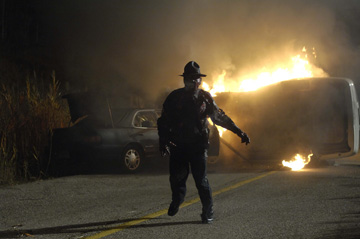
One of the film’s opening shots, taken from a television camera just as the dead are coming alive, is masterful satire. The camera zooms in on a driver chewing on a sandwich and crew voices mutter snarky comments over this private moment. A crew member asks an ambulance to move out of frame because it’s blocking the shot. Never mind that the camera is set up in front of a hospital.

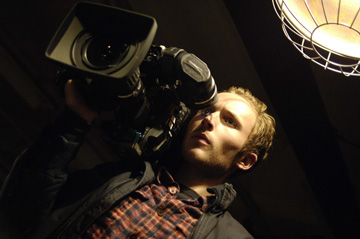
diary2.jpgTold from the perspective of college filmmakers who see the (again unexplained) rising of the dead as an opportunity to record “a part of history,” Diary is a claustrophobic assault on media culture. “I just want to record it,” chants Jason Creed like a creed. He’s the director of the film-within-the-film, The Death of Death. And while his fellow students are initially uncomfortable, they become distressingly accustomed to having cameras in their faces. Some may decry the “amateur” acting, but when Romero has his actors mug for the camera, it’s symptomatic of a disease more pervasive than the zombies. At one point, just before entering an abandoned house, Creed tells his cadre to stop so that he can get a good wide angle shot. The voice of reason (so dissolute that he clings to a first edition of Dickens and seems, like Abigail’s Party‘s Laurence, more taken with the cover) is an alcoholic professor named Maxwell, named perhaps after the mathematician who proved that light was an electromagnetic wave and who thus made cinema and DV possible. Maxwell’s weapon of choice is not a gun, but a bow and arrow, which suggests that Romero’s affinity for chivalry — seen most prominently in his underrated film Knightriders — still holds.
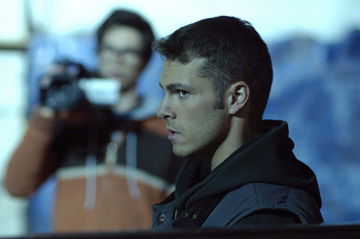
Sharing a confined miasma similar to Day of the Dead, Diary champions cramped interiors over dystopic vistas. The only way of relating to fellow humans is through text messages and YouTube videos. The only real safety is a sealed panic room in a gated manor, a more socially isolating milieu than Dawn of the Dead‘s shopping mall. Its characters access the Internet not to check in on loved ones, but to upload footage. And why the need to promulgate information? As one of the filmmakers explains, “News is always horseshit. That’s how they sell soap.”

One gets the sense that Romero has been building up his fury for quite some time. His fiery stance suggests that an act of rebellion has less to do with improving human conditions and everything to do with seizing an alt-media fief. His characters prefer fully loaded cameras over the assurance of escape. “I can’t leave without the camera,” says Creed, who willfully keeps himself plugged into the wall to charge his battery while pals battle zombies. But Romero hasn’t quite abandoned his hippie idealism. The filmmakers find a number of National Guardsman — “all the folks without suntans” — who have holed up in one town with a stockpile. There’s a righteous and palliative solution to gentrification when the head points out, “We got the power,” and is even munificent with supplies when one of the students stands up to him. But in the face of chaos, honor, like all civilized tenets, goes south. Another faction shows up later, but its commander is wild-eyed and predatory, but still honorable enough to leave weapons.

diary1.jpgAdam Swica’s cinematography favors crisp and steely digital blues. The visuals remain cold and rampant even when a camera is shoved in the face of a young woman trying to remain calm after driving over a number of zombies. “How do you feel?” asks Creed, unable to discern the tangible trauma.

At times, Romero overplays his hand. While I could accept the double entendre of “shooting” that comes near the film’s finale, montages of catastrophe with Full Metal Jacket-style narration were unnecessary, particularly when nestled with such hokey lines as “It’s interesting what we find out what we’re capable of becoming.” One character even escapes with the line “Don’t mess with Texas” and needless musical accompaniment, an overly cornball tone at odds with the film’s more serious questions.

Nevertheless, Romero’s reboot (along with the forthcoming movie, The Signal) suggests that independent horror may very well be the only place where filmmakers are likely to kick against the hypocrisies of media. If Diary is not quite a masterpiece to rank up with Night or Dawn, it does signal a fantastic return to form.