Posts by Edward Champion

Edward Champion is the Managing Editor of Reluctant Habits.

Racist Restaurants

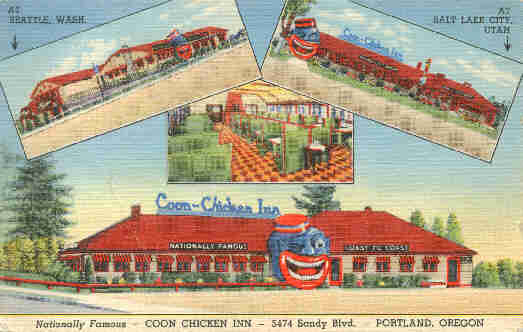
coonchicken.jpg

Here’s one of the more disheartening and rarely discussed moments in American cultural history: A restaurant chain called Coon Chicken Inn, alluded to in the films Ghost World and C.S.A., actually existed between the 1920s and the 1950s. Diners would enter through the doors of a ghastly racist caricature. It was one of Portland’s most popular restaurants, in part because there was a small African American population in Portland and in part because the food was cheap.

The restaurant chain was opened by Maxon Lester Graham and Graham’s descendants has issued a wholesale disapproval of the Coon Chicken Inn. This descendant reports that the racist logo was on every dish, piece of silverware, menu and paper product.

Interestingly, a few weeks ago, the Oregonian reported that the former Coon Chicken Inn has been purchased by an African American man named Ernest Clyde Jenkins III.

While Coon Chicken is now gone, it was by no means the only racist American restaurant. If you visit Santa Barbara, you can find the original Sambo’s restaurant, based on Helen Bannerman’s racist children’s book, The Story of Little Black Sambo. There were once as many as 1,200 outlets. Now there is one. Says restaurant critic John Dickson, “So when are you going to go nationwide AGAIN?” Presumably, Mr. Dickson is also fond of golliwoggs.
Five Television Intros

I encountered this list of the ten best television intros and I was a bit underwhelmed. So here’s an additional list of intros to add to the pile:

1. The Prisoner: When was the last time that you experienced a television series intro that was this cinematic? Everything from the great match editing of McGoohan walking down the corridor, with the shadow passing over his face cutting to the shadow passing over his tapping heels, to the retro typewriter Xing out McGoohan’s photo throws you into the intricate allegory that The Prisoner dared to bring to its viewers.

2. The Muppet Show: If you examine The Muppet Show‘s premise (a bunch of puppets running a variety show) from a hard rationalist’s perspective, the show is pretty damn absurd. So what better way to set the mood then unleashing a mad torrent of Muppets singing and dancing?

3. Six Feet Under: Whatever one’s feelings on Thomas Newman’s theme, one must admire the deft stop-motion animation, the unusual angles that the coffin is pulled out of the hearse, and the great match cutting (such as the gurney wheel turning on cue).

4. The Drew Carey Show: My feelings on The Drew Carey Show are mixed, but I did greatly enjoy the show’s intro, in large part because I’m a sucker for anachronistic urban dancing.

5. The Six Million Dollar Man: It was a pretty lame show, but there’s a reason why this intro remains indelible. Starting off with a straight-faced summation of Steve Austin’s accident, we are then given all manner of superimposed graphics, followed by that indelible narration. It’s too bad the writing on the show wasn’t this effectively melodramatic.

BSS #94: Stephen Graham Jones & Scott McKenzie

segundo94.jpg

Condition of Mr. Segundo: Not sacrificing time for horror.

Guests: Scott McKenzie and Stephen Graham Jones

Subjects Discussed: Approachable authors in the frozen food section, the implementation of pre-2000 references into narrative, the lineage of horror films, screenplay terminology, the relationship between Demon Theory‘s top text story and the footnotes, movie references, protagonists vs. ensemble casts, horror novels, drafting vs. editing, the influence of real-life horror, girls in bras, Jones’ unintentional academic life, trepidations towards New York, refraction and contemporary “science” novels, Against the Day, small town writing communities, Jones’ influences, how the trilogy structure changed the footnotes, the difficulties of writing screenplays, drive-by urinals, and the major stylistic difference between the Demon Theory hardcover and paperback.

(A co-production of the LBC, Pinky’s Paperhaus and The Bat Segundo Show)

EXCERPT FROM SHOW:

Jones: I just discovered that footnote function in my Microsoft Word, I guess. And I was writing Demon Theory and having a ball with the screenplay terminology and all that. But then maybe, I guess fifteen pages into it, if that, I started dropping footnotes. They were meant to be deleted later. I was dropping them. Like I was calling myself names. Like “You obviously stole this from Halloween.” “You stole this from here.” You know. But then they just kept snowballing and snowballing until everything was stolen from something. And that kind of just became one of Demon Theory‘s conceits, I guess.

BSS #93: Nick Mamatas

segundo93.jpg

Condition of Mr. Segundo: Introspective about his long lost lawn gnome.

Author: Nick Mamatas

Subjects Discussed: The X+Y book formula, H.P. Lovecraft, Jack Kerouac, Aristophanes’ The Acharnians, telepathy, garden gnomes, radioactive fallout, conspiracies, Elián González , Littleton, Under My Roof as allegory, the influence of current events upon narrative, Cthulhu as muse, Lovecraftian poetry, crazy tenants, writing short novels in a “big book”-friendly environment, working with Night Shade and Soft Skull, Skybars, the downside of product placement in the future, pursuing an MFA, health insurance, narrative ideology, character testimonials, the influence of Animal House, micronation novels, George Saunders’ The Brief and Frightening Reign of Phil, Duck Soup, and life-changing YA novel experiences.

EXCERPT FROM SHOW:

Mamatas: Well, at first it was going to be a lawn jockey.

Correspondent: Really?

Mamatas: Yes. In an early draft, I had it as a lawn jockey. But I figured that was too unctuously petty bourgeois. I thought a garden gnome was more down market. And also, they’re bigger. So you can put more nuclear stuff inside a garden gnome.

Correspondent: But at the same time, there’s also a certain kind of suspension of disbelief on the part of the reader. Because if you actually go ahead and try to produce a nuclear device in a garden gnome, there’s going to be some radioactive fallout. The FBI guys kind of show up and like — I’m thinking the FBI would immediately sort of seize this family. And yet they don’t. I was wondering if this kind of realism isn’t of concern for you, or is it meant to be more of a meditative kind of…

Mamatas: Well, partially it’s meditative. Partially, people get away with things, you know. 9/11 — people got away with it, even though there were many people watching these terrorists and keeping their eye on them. But they all managed to get through and carry out this attack. There’s almost a nationalist type of myth that the FBI and the CIA are super-competent and that we always know what’s going on. That’s part of why we have the 9/11 denial movement, or conspiracy movement.