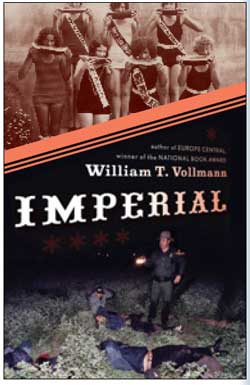
 William T. Vollmann’s Imperial, which has been in the works for years, now has a publication date. It’s slated to be released by Viking on April 16, 2009. For those who have scratched their heads in disbelief over Vollmann’s svelte volumes in recent years, don’t worry. The book runs 1,296 pages. And this time, it’s a history of the Imperial County region, chronicling the labor camps, migrant workers, and contemporary day laborers. The book promises to take us into “the dark soul of American imperialism,” with the catalog further informing us:
Known for his penetrating meditations on poverty and violence, Vollmann has spent ten years doggedly investigating every facet of this binational locus, raiding archives, exploring polluted rivers, guarded factories, and Chinese tunnels, talking with everyone from farmers to border patrolmen in his search for the fading American dream and its Mexican equivalent.
Well, this all sounds dutifully proletarian. But the great irony here is that most of the workers who Vollmann talked with are probably not going to be able to afford this book. Imperial, listed in the Winter 2009 Viking catalog, is planning to retail for $55.
This is a surprising price, given that Penguin (under the Penguin Press imprint) also released the hardcover Thomas Pynchon’s Against the Day, which ran a hefty 1,085 pages, for $35. (Consider also Roberto Bolano’s upcoming 2666, running close to 1,000 pages in a three-volume set by FSG. It’s available this November for $30.) And while Imperial also contains “28 photos; 20 pieces b&w line art; 5 maps,” I fail to see how any of this supplemental material justifies a dramatic increase in printing costs (in this case, a good $20 per unit).
The book can also be pre-ordered at Amazon at 40% off, with the book selling for $34.65. But I can’t help but wonder how this twenty dollar difference may affect independent bookstores featuring the title on the stacks. Will Vollmann readers abandon their trusted indie bookstores for Amazon because the price point here is too high? Is this a grand ruse designed to get Vollmann signing the least number of books possible at a signing?
Maybe the $55 book is just a simple capitalist experiment. But if it is, it reminds me more of the troubling science perfected by concert promoters in the late ’90’s. I have no idea if Vollmann’s head has grown heavy and his sight has grown dim (let us hope not), but The Eagles, rather famously, were the first band to charge $100 a ticket. And when the Eagles were able to get away with this, other big acts followed suit. So if Vollmann and Viking want to blindside consumers with such an outrageous price, I may be tempted, despite my frequent championing of hardcovers, to jump aboard Levi Asher’s dysfunctional pricing bandwagon.
In the meantime, I intend to perform a few inquiries to find out why Imperial is going for $55. If I learn anything, I will certainly report it here.