For the purposes of this list, some of the more oblique cultural references have not been included, nor have references to networks (CBS or CNN), newspapers (The New York Times), institutions (King’s fictitious Shawshank State Prison is frequently referenced), brand names (Slurpees), or the Bible. I have also done my best not to reveal character names, except when absolutely explicit (Ploughshares, for example) or references in relation to plot reveals.
 Alas, Babylon: “Yep, see you that and raise you Alas, Babylon.” (155)
American Family Physician: “thumb through the latest issue of American Family Physician.” (285)
America’s Most Wanted: “I saw that on America’s Most Wanted.” (619)
Bernstein, Leonard: “He was halfway through the third daddy and still conducting like Leonard Bernstein….” (790)
Blitzer, Wolf: “Wolf Blitzer took Anderson Cooper’s place,” “she called him ‘my Wolfie,'” and various lines from Blitzer. (89) “expected either Anderson Cooper or her beloved Wolfie” (760) “Better be Wolfie from CNN, that’s all I can say.” (763) “Lookin good, Wolfie! You can eat crackers in my bed anytime you want.” (765) “Reynolds Wolf (no relation to Rose Twitchell’s Wolfie)” (801) Also p. 961.
Blunt, James: “He struck the barrier at fifteen miles an hour, while listening to James Blunt’s ‘You’re Beautiful.'” (34) (This is my personal favorite.)
Bradbury, Ray: “That’s from Ray Bradbury. You ever read Ray Bradbury?” (671)
Braver, Rita: Appears on p. 766.
Brown, Sandra: “‘Nora Roberts? Sandra Brown? Stephenie Meyer? You read this stuff? Don’t you know Harry Potter rules?'” (282)
Bush, George W.: “His hair looked as if it had last been cut while Bush II was riding high in the polls.” (187) “Big Dubya’s fuck-a-monkey show.” (340)
Car and Driver: “was deep in an issue of Car and Driver, reading a comparison of the 2012 BMW H-car and the 2011 Ford Vesper R/T.” (706)
The Cat in the Hat: “The hat was like the one the cat wore in the Dr. Seuss story.” (733)
Clark Sisters: “This town needs some Mavis Staples. Also some Clark Sisters.” (798)
Clinton, Hillary: “remembered getting drunk the night Hillary Clinton cried in New Hampshire” (893)
Como, Perry: “playing ‘Good Night, Sweet Jesus’ as interpreted by that noted soul singer Perry Como.” (315) “Perry Como had given way to something instrumental.” (316)
Cooper, Anderson: “Wolf Blitzer took Anderson Cooper’s place.” (89) “Anderson Cooper, almost life-sized, looked like he was doing his standup on Castle Rock’s Main Street.” (316) “expected either Anderson Cooper or her beloved Wolfie” (760) (He is also the CNN anchor whose reporting is halted by the military.)
Creedence Clearwater Revival: “I fucked her until she sang ‘Hail to the Chief’ and ‘Bad Moon Rising.'” (875)
Dancing with the Stars: “sometimes watching shows like The Hunted Ones (a clever sequel to Lost) and Dancing with the Stars” (694)
The Dead Milkmen: “bearing the logos of long-gone punk bands like Stalag 17 and the Dead Milkmen.” (836)
Die Hard: “Yippee-ki-yi-yay, motherfucker.” (306)
Earnhardt, Dale: “And although the autographs people noticed when they were invited into his home study were inevitably those of Tiger Woods, Dale Earnhardt, and Bill ‘Spaceman’ Lee…” (445)
50 Cent: “one was a stocky young fellow wearing baggy shorts and a faded 50 Cent tee-shirt.” (328)
Ford, John: “against the smudged skyline like Indians in a John Ford Western.” (961)
G.I. Joe: “Almighty GI Joe” (501)
Girls Gone Wild: “most of em probably watching Girls Gone Wild on pay-per-view.” (432)
“Hansel and Gretel”: “Hansel and Gretel minus the happy ending.” (309)
Harry Potter: “‘Nora Roberts? Sandra Brown? Stephenie Meyer? You read this stuff? Don’t you know Harry Potter rules?'” (282) “she had settled for Harry Potter’s chum, Hermione.” (858)
Holt, Lester: “Lester Holt from NBC shot to his feet.” (766)
Howlin’ Wolf: “He had given up on the blues music that had been so important to him in his Phil Bushey stage of life — B.B. King, Koko, and Hound Dog Taylor, Muddy and Howlin’ Wolf, even the immortal Little Walter.” (320)
Iron Butterfly: “sounded suspiciously like the organ solo from ‘In-A-Gadda-Da-Vida.” (316)
The Invisible Man: “Barbie’s fist, blurred impression was that he was about to be attacked by the Invisible Man.” (532)
Jett, Joan: “she looked like the middle-school version of Joan Jett; she wouldn’t know who he was talking about.” (329)
Jolie, Angelina: “Great mouth. Angelina lips.” (303) “with her head in the cover of a People magazine — Brad Pitt and Angelina Jolie frolicking in the surf on some horny little island where waiters brought you drinks with little paper parasols stuck in them.” (672)
The Jordanaires: “Thurston turned it on and got nothing but Elvis Presley and the Jordanaires, trudging through ‘How Great Thou Art.'” (305)
Kennedy, Bobby: “the paisley headband Thurse had worn to the candlelight memorial service for Bobby Kennedy.” (627)
Kenne Highland & The Vatican Sex Kittens: “the memorable New Year’s Eve show in 2009 featuring the Vatican Sex Kittens.” (337)
King, B.B.: “He had given up on the blues music that had been so important to him in his Phil Bushey stage of life — B.B. King, Koko, and Hound Dog Taylor, Muddy and Howlin’ Wolf, even the immortal Little Walter.” (320)
LCD Soundsystem: “LCD Soundsystem was playing — ‘North American Scum’ — and Jack was singing along when a small voice spoke his name from behind him.” (35)
Led Zeppelin: “He was wearing filthy chinos, a Led Zeppelin tee-shirt, and old slippers with busted backs.” (187)
Lee, Bill: “And although the autographs people noticed when they were invited into his home study were inevitably those of Tiger Woods, Dale Earnhardt, and Bill ‘Spaceman’ Lee…” (445)
The Little Mermaid: “so it could hold an entire town prisoner as well as broadcast The Little Mermaid to your television via Wi-Fi and in HD.” (734) “hadn’t been able to persuade Jackie with an Ariel mask” (857)
Little Walter: “He had given up on the blues music that had been so important to him in his Phil Bushey stage of life — B.B. King, Koko, and Hound Dog Taylor, Muddy and Howlin’ Wolf, even the immortal Little Walter.” (320) (There is also a character named Little Walter.)
The Lord of the Rings: “What was it Gollum had said of Bilbo Baggins?” (890)
Lost: “What did the Scottish guy say on Lost? ‘Don’t mistake coincidence for fate?’ Maybe that had been it. Maybe it had. But Lost had been a long time ago. The Scottish guy could have said Don’t mistake fate for coincidence.” (285) “sometimes watching shows like The Hunted Ones (a clever sequel to Lost) and Dancing with the Stars” (694)
Lovecraft, H.P.: “the pony in this case was not terrorists, invaders from space, or Great Cthulhu” (179)
Lynyrd Skynyrd: The song “Sweet Home Alabama” factors into the plot.
Mantovani: “He could hear the swooping violins of Mantovani coming through” (780)
Masters of the Universe: “also known as King of the Geeks and Skeletor” (177)
McGruff the Crime Dog: “Big Jim listened to McGruff the Crime Dog for a while.” (512)
McKinley: “He might not know that there was a president as well as a mountain named McKinley…” (909)
McMurtry, James: Epigraph. “It was from an old James McMurtry song…” (93) “What he remembered most clearly about last summer was the James McMurtry song that seemed to be playing everywhere — ‘Talkin’ at the Texaco,’ it was called.” (242) “it was probably why the James McMurtry song had been so popular.” (543)
Mellencamp, John Cougar: “Accompanying the idea came the title of Phil’s old record albums: Nothing Matters and What If It Did.” (35)
Meyer, Stephenie: “‘Nora Roberts? Sandra Brown? Stephenie Meyer? You read this stuff? Don’t you know Harry Potter rules?'” (282)
Mighty Clouds of Joy: “He turned on the radio, got the MIghty Clouds of Joy on WCIK…” (729)
The Mist: “‘Exactly like in that movie The Mist,’ one blogger wrote.” (179)
“Moon River”: “Twitch had juggled half a dozen Indian clubs while singing ‘Moon River.'” (178)
Mr. Sardonicus: “Mr. Sardonicus, a movie that had scared him as a kid.” (727)
Nightly News with Brian Williams: “Rory saw his smiling (but of course modest) face on the cover of USA Today; being interviewed on Nightly News with Brian Williams…” (208)
Night of the Living Dead: “In the Bible, people sometimes returned to life like the zombies in Night of the Living Dead.” (104)
1984: “revoked tenure, 1984, thought-police” (301)
Noriega, Manuel: “A kind of Downeast Manuel Noriega?” (613)
Oasis: “yanking her beloved Oasis poster off the wall and tearing it up.” (385)
Obama, Barack: Never named, but referenced throughout the book.
On the Beach: “‘On the Beach,’ Barbie said.” (155)
O’Reilly, Bill: “that half-bald no-spin yapper from FOX News” (762)
Penthouse Forum: “Menagerie a trois, as they said in the Penthouse Forum.” (273)
People: “with her head in the cover of a People magazine — Brad Pitt and Angelina Jolie frolicking in the surf on some horny little island where waiters brought you drinks with little paper parasols stuck in them.” (672)
Pitt, Brad: “with her head in the cover of a People magazine — Brad Pitt and Angelina Jolie frolicking in the surf on some horny little island where waiters brought you drinks with little paper parasols stuck in them.” (672)
Plath, Sylvia: “Maybe meeting a few interesting men and discussing Sylvia Plath in bed.” (850)
Ploughshares: “and guest editor for the current issue of Ploughshares” (299) “‘I edited the current issue of Ploughshares,’ he said. His voice quivered with indignation and sorrow. ‘That is a very good literary magazine, one of the best in the country.'” (366) “I edited the current issue of Ploughshares.” (409)
Pol Pot: “It’s the progression to Pol Pot I’m worried about.” (613)
Presley, Elvis: “Thurston turned it on and got nothing but Elvis Presley and the Jordanaires, trudging through ‘How Great Thou Art.'” (305)
Reader’s Digest: “although certain offshoot sects — and The Reader’s Digest, I believe — disagree.” (563)
The Road Runner: “The noise was similar to the one Roadrunner [sic] makes before speeding away from Wile E. Coyote in a cloud of dust.” (728)
Roberts, John: “unless you counted CNN’s John Roberts” (778)
Roberts, Nora: “‘Nora Roberts? Sandra Brown? Stephenie Meyer? You read this stuff? Don’t you know Harry Potter rules?'” (282) “The words kept squirming around on the page, sometimes even changing places with each other, and Nora Roberts’s prose, ordinarily crystal clear, made absolutely no sense.” (427)
Serling, Rod: “They’d hear the Rod Serling voice-over anytime now.” (305)
Sherlock Holmes: “It’s the Sherlock Rule: When you eliminate the impossible, the answer, no matter how improbable, is what remains.” (442)
Song of the South: “Did Br’er Bear maybe die of rabies too?” (720)
SpongeBob Square Pants: “long enough to plaster three SpongeBob Band-Aids along the gash.” (356)
Stalag 17: “bearing the logos of long-gone punk bands like Stalag 17 and the Dead Milkmen.” (836)
Staples, Mavis: “This town needs some Mavis Staples. Also some Clark Sisters.” (798)
The Staple Singers: “the Staples Singers [sic], kicking holy ass with ‘Get Right Church.'” (821)
Starr, Barbara: “but it was Barbara Starr, the network’s Pentagon correspondent.” (760)
Star Trek: “‘Just like on Star Trek,’ Barbie said. ‘Beam me up, Scotty.'” (152) “If I can put it in Star Trek terms, help us make it so.” (765)
Star Wars: A file containing dirt on Big Jim is named VADER. “In a galaxy far far away, Clover.” (413) “Darth Vader mask was behind the seat” (858) “in a galaxy far, far away” (898)
The Situation Room: “Rose had a crush on Blitzer and would not allow the TV to be tuned to anything but The Situation Room on weekday afternoons….” (89)
Suarez, Ray: Appears on p. 766.
Sullivan, John L.: “his fists held up like John L. Sullivan.” (244)
Taylor, Hound Dog: “He had given up on the blues music that had been so important to him in his Phil Bushey stage of life — B.B. King, Koko, and Hound Dog Taylor, Muddy and Howlin’ Wolf, even the immortal Little Walter.” (320)
Taylor, Koko: “He had given up on the blues music that had been so important to him in his Phil Bushey stage of life — B.B. King, Koko, and Hound Dog Taylor, Muddy and Howlin’ Wolf, even the immortal Little Walter.” (320)
The Twilight Zone: “The whole world had turned sideways and slipped into a Twilight Zone episode while she was asleep.” (305)
The Upper Room: “One was a devotional, The Upper Room.” (314)
Vaughan, Brian K.: “He was addicted to computers, the graphic novels of Brian K. Vaughan, and skateboarding.” (504)
Warhammer: “I still haven’t been able to beat Warhammer.” (543)
Waters, Muddy: “He had given up on the blues music that had been so important to him in his Phil Bushey stage of life — B.B. King, Koko, and Hound Dog Taylor, Muddy and Howlin’ Wolf, even the immortal Little Walter.” (320) “He went his rounds humming ‘Big Leg Woman’ very softly under his breath.” (627)
Wayne, John: “said in a passable John Wayne drawl” (977)
When Harry Met Sally: “‘Check it out, Junes,’ Frankie DeLesseps said. ‘It’s When Horny Met Slutty.” (301)
Wile E. Coyote: “The noise was similar to the one Roadrunner [sic] makes before speeding away from Wile E. Coyote in a cloud of dust.” (728)
Winslet, Kate: “Not that I’ll ever be mistaken for Kate Winslet.” (785)
The Wiz: “Dr. Ron Haskell — The Wiz…” (198)
The Wizard of Oz: “…Dr. Ron Haskell, whom Rusty often thought of as The Wonderful Wizard of Oz.” (77)
Wolf, Reynolds: “Reynolds Wolf (no relation to Rose Twitchell’s Wolfie)” (801)
Wonder Woman: “I pray to Wonder Woman.” (500)
Woods, Tiger: “And although the autographs people noticed when they were invited into his home study were inevitably those of Tiger Woods, Dale Earnhardt, and Bill ‘Spaceman’ Lee…” (445)
Zevon, Warren: “He’s wearing an old tee-shirt of mine with a Warren Zevon quote on it—” (904)
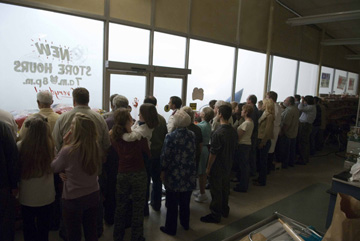 Whatever the circumstances, The Mist may very well be one of the most quietly subversive movies of the year.
 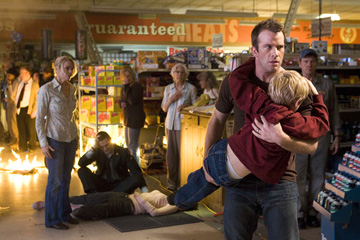 I was also impressed by the attention to the mist monster ecosystem. Large and beautiful insects affix themselves to the supermarket window, attracted to the glass the way that moths flock to light, only to be snapped up ruthlessly by gargantuan winged beasts. Nothing here is quite what we expect, which is saying a good deal in light of the fact that the story is essentially a familiar one.