This morning’s New York Times features some disingenuous reporting about the oil crisis from Peter Maass:
One of the industry’s most prominent consultants, Daniel Yergin, author of a Pulitzer Prize-winning book about petroleum, dismisses the doomsday visions. ”This is not the first time that the world has ‘run out of oil,”’ he wrote in a recent Washington Post opinion essay. ”It’s more like the fifth. Cycles of shortage and surplus characterize the entire history of the oil industry.” Yergin says that a number of oil projects that are under construction will increase the supply by 20 percent in five years and that technological advances will increase the amount of oil that can be recovered from existing reservoirs. (Typically, with today’s technology, only about 40 percent of a reservoir’s oil can be pumped to the surface.)
As Paul Roberts argued in The End of Oil and James Howard Kunstler railed against with jaded fury in The Long Emergency, what technological advances? Where will these come from? What are they? Do we pull these out of the hat and get a crummy raffle prize?
I particularly like the way that Maass not only allows Yergin to get away with this criminally general statement (thus underplaying the oil crisis), but prefaces the statement with “one of the industry’s most prominent consultants” and “author of a Pulitzer Prize-winning book,” failing to point out that Yergin never singled out any tech specifics in his article.
So what was the point of this ridiculousness? To provide “fair and balanced” journalism? To throw in a credentialed naysayer without actually calling up Yergin and ask him to elaborate on his views? That’s lazy journalism — the kind of misleading context that I expect from some priapic warblogger.
 One can make the same case for Sarah Boxer’s columns. A healthy dose of skepticism is one thing. But Ms. Boxer’s columns are, for the most part, large dollops of bitter reactionary bullshit. She’s about as flexible to culture as hardened doss sticks. I’ve yet to see Ms. Boxer crack so much as a smile or let down her guard in any way. I suppose this is because, in the Boxer universe, all forms of DIY or independent culture are essentially bullshit. The people who try something different are no less than crazed dilletantes. Ideally, these upstarts should be mowed down by machine guns, lest they tango with the status quo or, even worse, disrupt Ms. Boxer from the west wing in her seculded estate. Damn these artists! They’ve deigned to force Ms. Boxer to actually think and write a column!
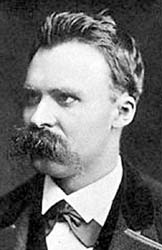 Leiter suggests that Vollmann “bizarrely ascribes” a “realism” to Nietzsche and suggests that Nietzsche does not hold the view that “cruelty is innate,” complaining that Vollmann fails to cite a specific passage. I’m fairly certain that Vollmann was suggesting one of Nietzsche’s most infamous statements from Thus Spake Zarathrusta, something that a certain Austrian perhaps took too much to heart: “Man is the cruelest animal. Whatever is most evil in his best power and the hardest stone for the highest creator.” Far from a “People magazine speculation,” Vollmann is willing to give the NYTBR readership the benefit of the doubt, presuming that they are familiar with Nietzsche’s basics. Further, Vollmann framed the “realism” within quotes, leaving little question to the reader that this was a speculation on Nietzsche’s capacity to tell the truth about the human race. This commonality, of course, what separates Vollmann’s work from many of his contemporaries on both the fiction and the nonfiction fronts.
 With such inevitability and the persistent strain of soccer moms fearing that the terrorists could firebomb the small-town high school fields they regularly frequent at any second, some of the most ambitious novelists are not only addressing this climate of fear but going a bit hogwild in their depictions, leaving a legacy that is not only quite silly but good for drawing