Forgotten Statue, Forgotten Spirit

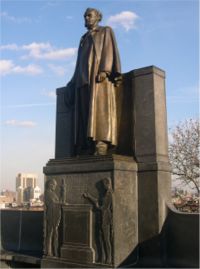
schurz.jpgLike many statues nestled along the rectangular trestles of Manhattan’s parks, Karl Bitter’s bronze depiction of Carl Schurz — situated at the corner of Morningside Drive and 116th Street — is regularly overlooked by many New Yorkers. They walk their dogs. They chat on their cell phones. They rush to important appointments or set out to beat a jogging record. But they rarely stop to observe this rather tall and intriguing figure who remains memorialized.

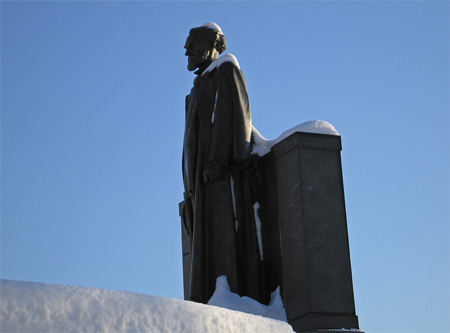
That’s saying something, considering that Schurz is quite vertical in design (he stands nine feet tall), his left foot juts a mite forward, and his portly girth, disguised by a thick and definitive bronze coat and cape, demands attention. To look over the promontory where Schurz is propped, you must walk up three stone steps to get an unoccluded view. But no matter what building your eyes settle upon, Schurz will remain in dogged peripheral vision. Maybe pedestrians are vexed by Schurz’s hatless and Germanic form — for what it’s worth, he does politely hold his hat in his right hand — invading Harlem’s horizontal vista, which, like every Manhattan neighborhood, is now undergoing terminal gentrification. Perhaps to live in New York, the New Yorker cannot look upon the past, but must continue contending with the swift-paced momentum of the present. And if that means accepting glass monstrosities in lieu of charming brick buildings without remonstrance, so be it. But this willful acceptance also extends to figures like Schurz, who reminds us that there was indeed a New York before the present one.

The Schurz statue is unsullied by the verdigris now eating away at another of Bitter’s sculptures — that of Franz Sigel residing on West 106th Street and Riverside, currently earmarked for renovation. Schurz and Sigel both have parks named after them. (Karl Bitter, alas, does not. New York reserves its laurels for its heros, not the artists who render the legacy.)

We know that Schurz was a military man, a political reformer, and a journalist. He spent the majority of his life outside of New York, served as Secretary of the Interior for President Rutherford Hayes, moving to the city in 1881, ostensibly to retire. But a man of his insurmountable energies could not settle down. He had twenty-five years left in his life to make a name. And he did. Starting with his immediate rise to editor-in-chief of the New York Evening Post in 1883 and followed by becoming one of the Mugwumps supporting Grover Cleveland the following year. He spoke out against Tammany Hall, drawing enthusiasm for his remarks even as a fife and drum corps passed by.

The first fact that, in our efforts for good government, stares us in the face is the existence of an organization — Tammany Hall — whose very purpose it is to give the city the worst government it dares, to the end of making money out of it. And this organization has been for years, and is now, in full possession of the municipal power.
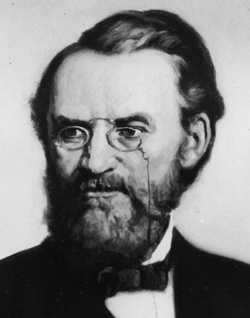
schurzreal.gifSchurz spoke these words as two friends of his were the top mayoral candidates. He would not let friendships get in the way of principle. Likewise, he did not think much of William Jennings Bryan and also campaigned against him.

As the New York City Department of Parks & Recreation is proud to announce, he was an adopted New Yorker and was often unpredictable with his political choices. Schurz was gleefully antagonistic, and on September 22, 1900, he resigned his Presidencies of the National Civil Service Reform League and the Civil Service Reform Association of New York, observing, “I frankly confess that on account of my position of antagonism to other policies of the Administration, the performance of my part of that duty is especially unwelcome to me.” But he could not quite give this ghost up and was elected the following year as President of the Civil Service Reform Association.

When Schurz was buried in Sleepy Hollow in May 1906, he had an audience both rich and poor. Andrew Carnegie and Joseph H. Choate stood beneath one umbrella. The Times described Schurz as “a publicist and patriot.” The funeral was attended only by relatives and close friends, but policemen had to stop many who hoped to get a view of Schurz’s coffin. It was Choate who ensured that the statue now standing in Morningside Park was completed.

Schurz had a reformist ebullience scarcely seen in the present political age. We now seem to settle for charisma and monoglot messages about hope. Those who do stand out are censored or declared too lunatic for the political arena. This stands in sharp contrast to the words Choate unfurled during the statue’s unveiling, “As a leader he did what is so seldom seen and yet so necessary in the upholding of the best in public life. He put expediency above personal and party advantage. He never allowed party to lead him in the wrong direction, and for years he stood alone, an independent figure in party and public life.”

At the pedestal before Schurz’s form are the words: CARL SCHURZ Defender of Liberty and Friend of Human Right.
schurz2.jpg

Today, who knows Schurz’s name outside of hard-core history buffs, fans of The Who, and curiosity seekers? Not long ago, when I visited Schurz’s statue, I observed a broken bottle of Gilbey’s upon the faded ornamental brick. The bottle had apparently been thrown at Schurz, and the glass shards glistened more resolutely than the brick. While the bottle, in all likelihood, had been hurled by a cavalier youth, I couldn’t help but contemplate whether there was a rejection of Schurz’s spirit in the air. History was apparently the work of others. But it seemed to me that it was the other way around.

First Year’s Snow

To say that I was a gleeful and spellbound little monkey this morning upon seeing the first year’s snow in New York City would be an understatement. My first impulse upon catching a glance of familiar landscape transmuted overnight into a wintry wonderland was to race outside and jump up and down and feel the steady crunch and glorious slippage of sneakers hitting as yet unsalted sidewalks. I improvised a bipedal method of sledding down a Central Park slope and cheered on kids who had the foresight to haul out sledding equipment for use upon this beautiful white stretching scape. The snow made strangers in the distance more pronounced and the white expanse was a natural bounce card to highlight the glorious brick and urban beauty. In short, I was happily six years old, if only because I was making up for three decades of mostly snowless California weather. Yes, later in the afternoon, there was the slush and the pungent marshmallow smell of decay that penetrated even my clogged nostrils. But this was snow! Magnificent snow! As wondrous a meterological ingredient as San Francisco’s fog!

For East Coasters, this is no doubt all old hat. I am indeed a wild-eyed rube when it comes to this sort of weather. But the New York population had been bifurcated into those who embraced the snow with great ardor and those who wished to hole themselves up until the snow had passed. I wondered about these shadowy figures bunkered in apartments. When did snow lose its appeal for them? When did the first drop of winter become something to be dreaded? Yes, it’s all new to this California native. But surely even new joys can be discovered within the familiar.

I am also saddened to report that A Public Space was beaten by the New York Review of Books this afternoon in a game of literary trivia. A cadre of litbloggers — including the effusive and good-natured proprietor of Wet Asphalt, who I was fortunate to meet today for the first time — was assembled to cheer on APS, but ended up heckling and applauding both teams, while also conspiring together to determine the answers. I am happy to report that Tim Brown adeptly got in touch with his inner Alex Trebek, providing very funny and very deadpan emcee work. Apparently, we were so unintentionally vociferous that not only did the three A Public Space members run away from us when it was all over, but the trio suggested that we come up there to replace them (“Sure!” we replied). At one point, I even observed Brigid Hughes, sitting a row in front of us, covering her head with her hands.

Further, I was shocked to see APS not taking the opportunity to plug its recent subscription offer. I was so distressed by this that, at one point, I loudly mumbled, “*cough* Helvetica **cough**,” and thankfully the balance was rectified. (And if you think that’s bad, the NYRoB team couldn’t even get its URL right.)

I came away with respect for both teams, who played well under pressure and displayed a hearty sense of humor.

Nevertheless, the NYRoB‘s victory did not stop us from laying down the gauntlet. We approached the NYRoB trio, boldly declaring that the Litblogging Army would challenge them anytime, anywhere for any contest of wills. Let it be literary trivia or let it be Twister or mini golfing or bowling. I handed Edwin Frank my card, figuring that our common first name might prove beneficial in arranging a future matchup. Whether Mr. Frank will take it upon himself to deploy his able team against ours, I cannot say.

I’ll have more to report on the 2007 Indie & Small Press Book Fair quite soon, including a lengthy report on the Ian MacKaye presentation. For now, I have a few modest deadlines to beat.

[UPDATE: Eric has a report, including some pictures of Brown and the litbloggers in action.]

The NYPD Cracks Down on Human Decency

New York Times: “In fact, all three items had been planted by police officers in plainclothes during the previous six weeks. And the three people who picked them up were arrested, and now face indictment on charges that could land them in state prison…. Unlike the initial program, in which the props were worth at most a few hundred dollars, the bags are now salted with real American Express cards, issued under pseudonyms to the Police Department. Because the theft of a credit card is grand larceny, a Class E felony, those convicted could face sentences of up to four years. The charges in the first round of Operation Lucky Bag were nearly all petty larceny, a misdemeanor, with a maximum penalty of one year in jail.”

I wonder just what kind of atavistic mind would come up with something like this, where a good deed of turning in a purse is transmuted into a criminal action. Is it the same type of person who would replace vanilla extract with white-out on Free Ice Cream Day? The type of person who would tell you that you need to file your taxes on April 16th instead of April 15th and then audit you for being a day late? The type of person who would tell a two year old that, when using a knife, it’s the blade you hold and the handle you cut with?

Along Central Park’s Perimeter

Saturday morning’s walk extended, to my surprise, across six miles in Manhattan. Mammoth bleachers for the Thanksgiving Day Parade were settled and half-unpacked by imposing tractors, stretched in sequential array upon the western edge of Central Park from West 81st to somewhere in the seventies, more no doubt to follow in the forthcoming days. There were numerous dogs — one unduly burdened by a carriage attached to his hind legs, as if he were a miniature Ben-Hur steed in service to his owner. I had thought that this poor dog had suffered an injured leg, and that the owner had attached the carriage to provide locative succor. But the contraption appeared more in the service of the owner, who didn’t seem to be aware that dogs could perambulate as fast, if not faster, than mere humans. A boy no more than seven years of age observed this rigged dog and thought him special by way of the wheels, but I felt sad for the dog, who was pressed to move faster by his master.

The bleachers were something of a burden, for they impeded steady foot traffic and we were forced to cross the street, contending with oppressive red lights, which we defied by jaywalking, and pedestrians who didn’t shuffle down sidewalks with our celerity. Certainly, they had the right to saunter. But when you get into the groove of walking, it’s hard not to go hard-core and we weaved like cars desperately careening across lanes to make an appointment. But we had no particular destination in mind.

The poor pedicab drivers, mostly African-American, shiver in the cold along 59th Street, waiting for desperate fares. They are the modern rickshaws, but the tourists prefer the horses. The statue of poor General William Tecumseh Sherman — at 59th Street and Park, in considerable disrepair, with a fading gold sheen — is largely ignored by the tourists, who settle for the horse drawn carriages at $37 per half hour, when they can have this needlessly abandoned historical figure for free. Perhaps they disapprove of the general’s march or Trump’s gilded endowment from not long ago. I find myself commiserating with the forgotten historical figures interspersed throughout the five boroughs, sometimes addressing them directly. “Who are you?” I ask a statue with an unfamiliar name. I then begin to apologize to them personally for not knowing the history and start asking these bronzed and iron representations questions, for the plagues which depict their histories are often unsuitable. I never seem to receive answers, nor do I receive strange looks from other New Yorkers. Perhaps inquiries along these lines are a common practice, or perhaps nobody is as interested in the past as I am. I am forced to Google the info later.

Concerning Trump, easily the most wretched buildings along the southern edge of Central Park are the Trump condos, which are as inventive as an accountant taking on architecture as a hobby with their flat rectilinear exteriors and banal facades.

Near the end of this peregrination, I stepped into a Men’s Wearhouse just to time how long it would take for a salesman to approach me. Total interval: nine seconds. And I was besieged with endless questions about my suit size, the smart sartorial items I was presumably pining for, and the suggestion of smart pants. But I left the store, not particularly surprised at the aggressive sales tactic. At least the Men’s Wearhouse staff have the decency to stand away from the door, which is not the case with the Madison Avenue men’s clothing stores, who hound you within two to three seconds with pathological fervor. They stand right by the doors and one considers applying for a restraining order.

Generally speaking, no clothing was purchased, I’m afraid to report. But if you have nothing to purchase or nothing to see as a tourist, it’s often a defiance of other’s expectations when you randomly walk through the streets of New York.

Six Years Later

It is just a day. Why don’t they understand this? Yes, it’s a Tuesday. The same third day of the week it was when it happened. But this doesn’t mean that it will happen again. And it doesn’t mean that we shouldn’t live, goddammit. It doesn’t mean that we should deny our collective essence, our great possibilities, our joie de vivre, our healthy skepticism, our intolerance for bullshit. Six years, neighbors! How much longer do you need? Why do you silently cling to something that was terrible but that is sufficiently enough in the past? Why do you use this day to skirt human accomplishment? To do something kind, to do something amazing, to give someone a beneficial kick in the ass.

I’m new to this sullen ritual. I wasn’t here when it happened. Now, I suppose, I am a New Yorker. Or maybe not. Perhaps one becomes a New Yorker after a year’s residency. I haven’t yet received the glittery certificate in the mail. I don’t know. The only city that I ever sufficiently attached myself to was San Francisco. That was a hard town to leave. But what does place really mean in the end? I was in Hamburg, Germany when the planes hit the towers.

That young lady who knocked over a cup of coffee on our table twice in five minutes. Naturally clumsy? I don’t think so. She’s doing her damnedest to divagate her wiry body into her seat. Did she not apologize or acknowledge us this morning because today was The Day? I’ve found that New Yorkers thank me more than San Franciscans (perhaps because holding the doors open for strangers and the like might be something of an exotic etiquette around here). When even a minor solecism in etiquette goes down, there is often nobody more vocal than a New Yorker.

But not today. Silence. As if expecting the inevitable.

Today, in New York, we all subscribe to John Donne’s maxim, subsisting in frightened bubbles. New Yorkers are reluctant to talk. They are on guard. In case it happens again. In case the collective empathy that they keep inside must come out, because the city and those that live in it must heal, must persevere.

But I am not afraid. Because I know damn well that there aren’t any guarantees in life. Not afraid of the increased police presence in my neighborhood. Not afraid of any bastard, within or without, trying to strike us down. And I will stand defiantly against this fear, remaining as vigilant and as vocal as I can about my country’s countless indiscretions and remaining as happy as I can about life.

As to my fellow neighbors, well, I don’t know. Perhaps tomorrow the spirit of New York will return.