Have at it in the comments section, but I’m psyched and I’m speechless… where do they go from here?
Category / Uncategorized
Tom McHale, novelist
Here’s how The Literary Encyclopedia’s entry on Tom McHale begins:
In the 1970s, Tom McHale established himself as one of the most promising American novelists of his generation. In a little more than a decade, he produced more than a half-dozen novels that were widely reviewed. Most of those reviews were enthusiastically–sometimes wildly–positive. But even those reviewers who were more guarded in their responses to the individual novels acknowledged the originality of McHale’s darkly comic vision, the engaging energy of his style, and the evidence of a considerable talent in the growing body of his work. Reviewers compared his novels to those of Joseph Heller, Kurt Vonnegut, Jr., John Updike, Philip Roth, and Bruce Jay Friedman. In 1972, McHale’s second novel, Farragan’s Retreat was named a finalist for the National Book Award, and two years later McHale was the recipient of a Guggenheim Fellowship for Fiction. A New York Times article on the current literary scene placed McHale with Don DeLillo in the vanguard of those novelists who were most influential in terms of the directions that the American novel would take in the 1980s.
I always want to remember Tom McHale as that dashing young guy on the back cover of my much thumbed-through Literary Guild hardcover copy of his second novel Farragan’s Retreat, the one I first read when I was still a teenager. I was blown away by the black humor and Tom’s elegant style.
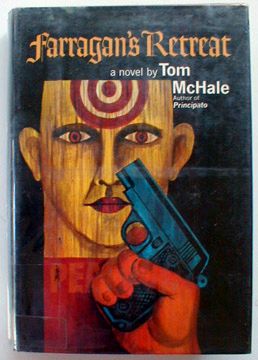
Here’s how the Time Magazine review from March 1, 1971 begins:
The old motto, “Power perfected becomes grace,” could have been invented to describe Tom McHale’s novels about Irish and Italian Catholics in America. Humor is his forte—not satire but farce. No aberration is too grotesque to be included, no character too minor to be lampooned. McHale’s comedy waves over chaos like luxuriant grass over a grave.
There are many young writers with healthy reserves of rage and chaos, some indeed with little else. What distinguishes McHale is not only the fertility of his invention but the humanity—remarkable in a writer of 28—that penetrates even his crudest caricatures.
After I finished Farragan’s Retreat, I went to the library to find Tom’s first novel, Principato. (Thanks to Matt St. Amand for the review. Matt knows Tom’s work better than just about anyone.) I loved it as well.
Then I read Farragan’s Retreat again. I copied out passages. In the first story I ever wrote for my MFA program, I stole Tom’s description of “the hilltop hulk of the art museum along the Schuykill” for a section where my protagonist, a Penn student, takes her morning jog. (People “jogged” in the 70s.)
Later I’d meet Tom McHale at The Book Group of South Florida, founded in the early 1980s in what was then something of a literary wasteland. I can recall how astonished Tom was when we first met and I could quote his work back to him. I suppose he hadn’t recently encountered people who knew his work.
The last job Tom had before he died was was night assistant at the $1.50 Holiday movie theater in North Miami Beach. He got fired for absenteeism; Tom drank a lot at the end, maybe for years. It never occurred to me that he was an alcoholic, but then I’ve never had a drink im my life and am bad at recognizing drunks.
On Matt St. Amand’s website, he quotes from a rather inartful and self-serving letter from me:
Do you know that after he committed suicide in his sister’s garage about two miles from where I am sitting, I was asked to speak at his memorial service because, the person said, “You were his best friend, weren’t you?” when in reality, I was just an acquaintance of Tom. It was so sad. Tom and I met, I guess around 1981, as part of the Book Group of South Florida. Most of the people there were old ladies who’d been in publishing. Tom was amazed I’d read all his books and could quote lines from Farragan’s Retreat. He’d had a really rough time of it by that time, and he finally had another book coming out. I remember his publication party at the tony Bay Harbor Islands. I always feel uncomfortable at these things, and it was clear to me that most of these people were just society types or people on the make who had no idea who Tom was or his place in American literature. I left early, stopped off for a couple of errands, and then went to a Burger King to get a Whopper. I was shocked to see Tom sitting there alone, just after he’d been the guest of honor at his publication party. I guess at that moment I sensed how lonely he was, and I sat with him, and I guess it was really the only time I really talked to him, and even then, he was pretty stoic and reticent.
He got a horrible review from Ivan Gold, who’d had his own problems with writer’s block and alcohol, in the Sunday NY Times Book Review, and I know that depressed him. But I don’t know what caused him to take his life. His very Catholic family (siblings) were, I suspect, always somewhat uncomfortable with Tom. I never talked to his sister. The newspapers asked me for comments about his death, and I said stupid things. A year later, I had a book reviewed in the NY Times Book Review, also by Ivan Gold, and it was a mostly nice review, but the niceness was spoiled by how Gold’s review had hurt Tom.
We never did have a Book Group memorial service. Tom was 40 when he died, in the garage of his sister’s house in Pembroke Pines.
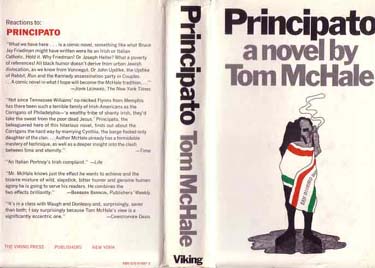
Here’s how “Portrait of a Writer as a Young Suicide,” a July 4, 1982 Miami Herald article by Cathy Lynn Grossman ends:
Nedda Anders, founder and president of the Book Group and editor-publisher of Andiron Press Inc. in Tamarac, introduced the subject of McHale:
“At the last meeting there was a post-mortem on our lovely party for Tom McHale. Now, this meeting, we have a post-mortem on Tom himself. His sister asked us to do nothing more.”
It was the group’s regular meeting, complete with sandwiches from the deli. They sat on plastic chairs at fake wood tables in the Community Room of a pillbox branch bank building dropped incongruously into the scrub brush along University Drive in Lauderhill. All that could be seen from the windows were cars shimmering in the heat, transplanted trees and transient commerce.
“I know I told you it was a heart attack,” Anders said. “That’s what his sister said. I guess, for reasons of her Catholicism … she told me that and I told you that it was a heart attack, but anyone who commits suicide has had heart failure so I wasn’t really lying.”
They passed around a copy of the paragraph in Time magazine, mentioning the death of the author “by his own hand” and a short obituary from a newspaper. Everyone said,”tsk-tsk.”
Everyone: A retiree who has established himself in Hollywood as a literary consultant. Some delicate older women writing articles for magazines or the story of Davie. A librarian. Several one-person publishing companies producing books on health, astronomy or local memoirs and history. A short-story writer, Richard Grayson, who succeeded the late McHale as the most famous member of the group, which was then planning a party for Grayson’s second book, Lincoln’s Doctor’s Dog.
People each said how they met McHale, how little they knew him, adding the few facts they had.
“There seemed to be no barriers in Tom,” Anders said. “He was crisp and charming. … We are trying to cope.”
Literary agent Myra Gross remembered that he had landed “a real plum” of a teaching job for next September at the University of Pennsylvania.
Anders interrupted, saying, “He seemed so perfectly equal to life, so absolutely rational. It’s hard to think that somewhere in him was hidden something irrational. … Myra’s son used to call him a ‘cool guy.’ ”
“Cool dude,” Myra Gross corrected her.
During lunch they talked about Mchale’s funny books on guilt, his angry, anti-religious attitudes and the irony of his Catholic funeral in a faith that denies its rituals to suicides.
“It is so terribly difficult to know what drives people, especially writers,” said the author of romances.
“Gee, I wish he’d talked to me,” said the retired consultant.
“His books were getting increasingly less attention,” Grayson said. “Ten years ago you could write literary books and make money. Not now.
“After Tom’s publication party, when I was driving home, I said that I felt luckier than Tom. I know nothing is going to happen with my book. My book is going to sell 20 or 50 copies, and I accept that.”
They talked about art and the bottom line and youth today. They speculated on whether McHale had a contract for a seventh book. Someone said yes.
Publisher Rosemary Jones looked up impatiently.
“It is awful to have this be reduced to gossip,” she said.
A jocular health book publisher who took photos –later lost — of the publishing party said, “Let’s just remember the smiles.”
Later, Myra Gross recalled quiet times with McHale, funny stories he told while monopolizing the conversation. She didn’t mind. A single woman, a working mother, a writer, she knows something of what McHale faced — something about being alone and afraid, about art and rent. Here in these same suburbs she lives on as best she can.
“Maybe I’m more practical,” she says. “Maybe I learned to compromise along the way.”
I Got Two for a Dollar*

Just a reminder that you can get your official Save the Litblogs! Maggot Gear at this exclusive online shop. Impress your friends, impress your relatives, make your whole neighborhood jealous. We’ve got clothing, hats, buttons, steins, posters, coasters, stickers, and most importantly, WE HAVE TOTES! So get to shopping!
All proceeds go to the Auto Parts Dealers Literary Guild. A few bucks might be spent on me.
*Not really.
Note to Publicists
 PLEASE PLEASE PLEASE do not send me any books to any San Francisco addresses you have for me. I am now in the painful process of ruthlessly scaling down my books to a handful of boxes, feeling a bit like Sophie or Schindler and sobbing to friends on the phone and trying to remind myself that I can get new books.
What are you talking about? That book was purchased at the old Chelsea Books store on Irving Street, and was the subject of a forty-five minute cafe conversation with that girl you briefly dated in 1999. Thus, it has sentimental value! Boy, you thought you were pretty hot shit back then!
Shut up! The past is the past! Why would I read that book again? And what does 1999 have anything to do with it?
Yup, it’s pretty much like that around here these days.
So if I received your book in the last few weeks, I’m sorry. Can’t look at it. Can’t even pack it.
Please use the new Brooklyn address at the right for any and all ARCs or galleys.
Now if you’ll excuse me, I’m going to tear my hair out over prioritizing W. Somerset Maugham over Sinclair Lewis.
You never would have done that in 1999!
Shut up, neurotic bastard! Go away and worry about Iran’s nuclear arsenal or something. This is hard enough without your interruptions!
Gotham Book Mart Auction
The famed Gotham Book Mart (“Wise Men Fish Here”) has sold off books to pay its landlord.
The line outside the Gotham Book Mart in Midtown snaked down the block yesterday morning. Several dozen eager bargain hunters, book dealers, art collectors and former employees of the storied shop waited to bid on a piece of literary history.
They had each put down a $1,000 deposit for the privilege of attending the auction. Books signed by John Updike. Letters from D. H. Lawrence and Anaïs Nin. Andy Warhol’s wig rack. All were up for sale.
In the end though, all the property that was auctioned went to the building’s landlord for $400,000.
The auction was ordered after a judgment last fall evicting the store’s owner, Andreas Brown, over a claim of more than a half-million dollars in rent owed. Now the landlord plans to sell the property.
Yesterday, Mr. Brown, 74, got teary while removing books from the shelves in his office. He left before the auction began.
“It’s a bit like interviewing me at my own funeral,” said Mr. Brown, who has a penchant for quoting Mark Twain.
The back room of the Gotham was where I used to find the little magazines I submitted to and appeared in during the 1970s and early 1980s. The Gotham’s former owner, Frances Steloff, then in her nineties, used to have a desk back there and we chatted sometimes. She knew everyone, it seemed, from Tennessee Williams to Norman Mailer and Mary McCarthy. Miss Steloff is a character in “An Irregular Story” in my book Highly Irregular Stories.
I remember once attending a Coordinating Council of Literary Magazines award ceremony upstairs. We all stood around, listening to the MC, poet and former Senator and Presidential candidate Eugene McCarthy, announce and hand out the awards. When the poet Siv Cedering (Fox) had to go up to collect her award, she gave me — standing next to her — her handbag to hold, but she forgot to retrieve it so I spent fifteen minutes in a crowded room walking around with a woman’s handbag trying to give it back.