This week, The Bat Segundo Show will cross the 200 episode barrier. A future program will feature a conversation with the writer Tobias Wolff, whose most recent book, Our Story Begins, is a short story collection containing previously collected tales — including the classics “Bullet in the Brain” and “Hunters in the Snow” — and more recent offerings like “A White Bible,” a gripping narrative that takes the notion of entitlement to task, but leaves judgment to the reader. In the New York Times Book Review*, Liesl Schillinger wrote, “To read a story is to sink into the soft seat of your grandfather’s strong, modest old Buick and let yourself be carried through an America of small towns, small joys, small struggles and small despairs — a landscape so familiar as to be invisible, the landscape of homeland.” Wolff’s stories are certainly a place to recognize readily identifiable qualities, but what makes him a fabulous writer is the way in which these quotidian moments are charged with import without coming across as overtly portentous.
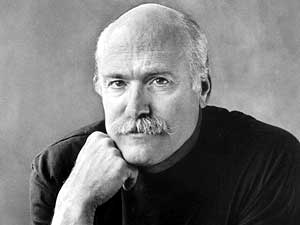 I got the chance to talk with Wolff last week when he was in New York. He was a confident figure beating a bad cold. And while he was interested in how readers interpreted his stories, he had no desire to offer explanations. But I did pry further. And I was able to unfurl some of the science Wolff brings to his tales. What follows is a partial transcript of our conversation.
Correspondent: This idea of first-person narration that is somewhat removed — maybe this is more of a classical sense of the short story, in the sense that today, contemporary short stories are, as you point out, more of a gushing therapy session. Maybe that’s what we’re talking about.
Wolff: Well, I don’t know. Again, when I think, for example, of Philip Roth’s first-person narrators, they are interested in the world at least as much as they are interested in themselves and interested in other people. And that shows up in the narration. It would be a pretty boring story that was so — if I could put it this way — narcissistically defined if you didn’t get a sense of the world beyond the narrator or of other people beyond it. I would think that, unless it was deliberately taking on the pathology of narcissism, it would be a deficiency of the story. Some stories, of course — some first-person stories — rely on a very heavy colloquial. And that may be something that you’re noticing with some of the stories. Like the one I just quoted from, “Next Door,” is quite colloquial. In other stories, you get the sense that the narrator is telling the story not in the immediate moment of the story, but perhaps from a distance. Which also would give you a wider vision of the circumstances and the people involved. And also perhaps a more articulate voice. A more capacious voice. So it isn’t just a Catcher in the Rye, moment-by-moment narration, but something that would open up a little more in the way of Philip Roth or William Trevor. The way their first person stories work.
Correspondent: I’m wondering if it’s something similar to Nabokov’s idea — that he had to know the lay of the land before he could write any particular novel or short story or what not. Maybe this is your concern.
Wolff: Well, by the time I write the last draft of a story, which — well, when Nabokov wrote his first drafts, they were like the last drafts of anybody else’s. By the time I write the last draft of the story, I certainly do know more than I can ever tell about my characters’ situations. So you’re just seeing a part of it.
Correspondent: I wanted to ask about the very subtle use of symbols throughout these stories. They are essentially straightforward realism. But you have, for example, in “A White Bible,” the attention to Frontage Road. You have the light shutting off at the end of “Say Yes.” And also, I really love the tule fog at the end of “The Rich Brother.” So these are really symbolic. But also, at the same time, they come from this realism. And I should also observe that, particularly with these endings, these symbols pop up often when you have a concise story.
Wolff: Well, they’re not symbols in the way that a high school English teacher teaches symbols. They are features of the story that a reader can probably sense some consequence without being able to define it. Yeah, at the end of “A Rich Brother,” Pete’s in a bit of a fog. But it’s also a very real fog. If you drive through that valley in California — the Central Valley, that time of night — you’re going to be in a fog. So what symbolism there is simply what life itself gives us. I mean, we actually navigate our lives by symbols. That is, by the outward signs that lead us in one direction or the other. Nature is filled with these things. And, of course, writers make use of them.
Correspondent: Well, in terms of endings, I think also of “Powder” and “Say Yes,” which have endings before the endings. In the sense that we think it’s going to end at a particular point, but, in fact, it ends before that point. And we are then forced to speculate upon where these characters are going. I mean, again, this supports the theory I’m throwing out at you that these concise stories have more going on or the action needs to be stopped at intervals.
Wolff: Well, the ending of a story, I think, contains all that the reader needs to have an intuition of how the story might continue. And they shouldn’t necessarily spell those things out, as some readers do. Tolstoy, for example, writes short stories as if they were novels. But to make a contrast, Chekhov draws enough of an arc that you imaginatively complete the circle yourself. You’re given all you need to do that. And my own practice as a short story writer has tended to gravitate toward that. One of the things I like about the story form is how much it can imply. Not as a kind of guessing game or some cute riddle you’re playing on the reader, but in the way that situations in life imply other situations. I mean, we actually, in our daily lives, become quite adept at intuition, at teasing out implications of present situations in order to get a sense of how the future might unfold. When we go out with a girl on the first time, we’re doing that. We have our first week at a new job, we’re doing that. We meet a new friend. We’re just constantly in these. It’s a very natural and emotional exercise that we do. And I try to find a way of expressing that in the forms of my stories. I don’t close things down because they aren’t closed down in life. The way that Tolstoy closes things down is that he has his characters die at the end. And that is a pretty neat way to do it. But they’re not going anywhere then. I love his stories, but they aren’t the kind of stories that I write.
* — One must point to good fiction coverage in Tanenhaus’s rag from time to time, with the unrealistic hope that such plaudits will correct unpardonable oversights elsewhere.