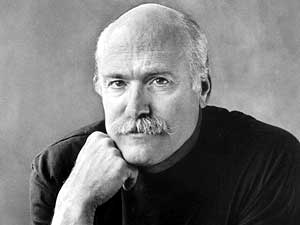
Tobias Wolff appeared on The Bat Segundo Show #208. Wolff is most recently the author of Our Story Begins.
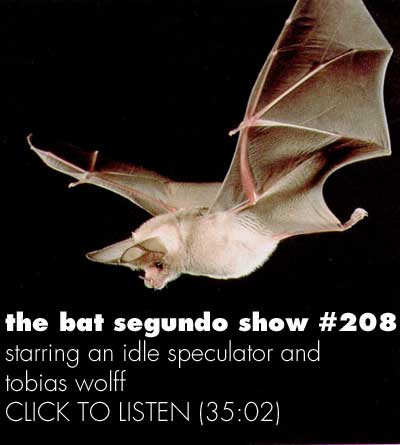
Condition of the Show: Speculating upon Mr. Wolff’s unknown powers.
Author: Tobias Wolff
Subjects Discussed: Writing first-person stories that don’t seem like first-person stories, the use of the word “I,” contemporary short stories and therapy sessions, fiction and narcissism, William Trevor, knowing the lay of the land, the symbols of the everyday universe, tulle fog, writing endings before the endings, Tolstoy vs. Chekhov, whether “Bullet to the Brain” had any specific literary critic in mind for its premise, dog stories, conversations in cars as the common American confessional, the open road, the consciousness of dogs, straying from realism, stories that end with an italicized line or a whisper, the precise and imprecise details within a sentence, arranging the short story order within a collection, “Best Of” vs. “Selected” stories, psychology and the skillful lack of overt specificity within “The Rich Brother,” hiding a story’s design, Flannery O’Connor, and how Wolff contends with variegated reader reactions.
EXCERPT FROM SHOW:
 Correspondent: This idea of first-person narration that is somewhat removed — maybe this is more of a classical sense of the short story, in the sense that today, contemporary short stories are, as you point out, more of a gushing therapy session. Maybe that’s what we’re talking about.
Wolff: Well, I don’t know. Again, when I think, for example, of Philip Roth’s first-person narrators, they are interested in the world at least as much as they are interested in themselves and interested in other people. And that shows up in the narration. It would be a pretty boring story that was so — if I could put it this way — narcissistically defined if you didn’t get a sense of the world beyond the narrator or of other people beyond it. I would think that, unless it was deliberately taking on the pathology of narcissism, it would be a deficiency of the story. Some stories, of course — some first-person stories — rely on a very heavy colloquial. And that may be something that you’re noticing with some of the stories. Like the one I just quoted from, “Next Door,” is quite colloquial. In other stories, you get the sense that the narrator is telling the story not in the immediate moment of the story, but perhaps from a distance. Which also would give you a wider vision of the circumstances and the people involved. And also perhaps a more articulate voice. A more capacious voice. So it isn’t just a Catcher in the Rye, moment-by-moment narration, but something that would open up a little more in the way of Philip Roth or William Trevor. The way their first person stories work.
(A lengthier excerpt from the show can be found here.)
© 2008, Edward Champion. All rights reserved.
Listen: Play in new window | Download
[…] the mobile version of the Google Reader, when I spotted Ed Champion’s link to his latest Bat Segundo podcast. Oh goody, I thought, now all I have to do is go back inside, hook up my iPod to my computer, wait […]
[…] of boring, Ed throws some good questions at Tobias Wolff but Wolff’s voice was not made for the radio […]