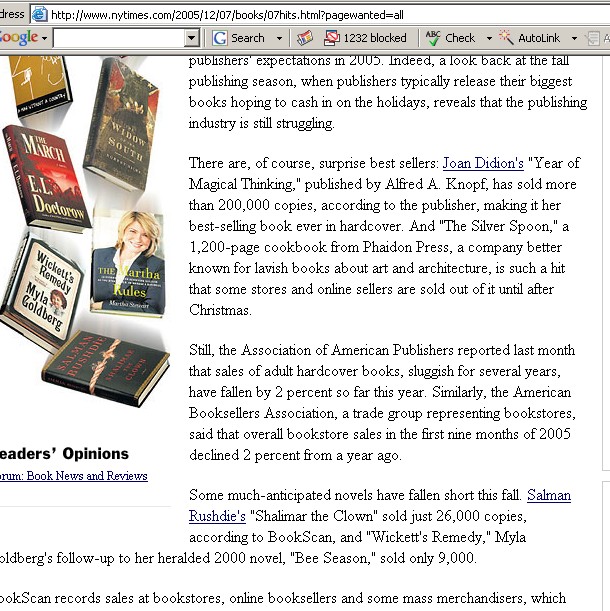
As the Literary Saloon points out, Salman Rushdie’s Shalimar the Clown has sold only 26,000 copies, despite a massive publicity blitz. M.A.O. suggests that this is because nobody is really interested in reading Rushdie.
But I think the answer is simpler. Who, outside of hard-core literary geeks, can really remember a title like Shalimar the Clown? And are clowns really all that sexy? Perhaps in small doses, such as between acts at a circus. But not throughout the duration of an entire novel. (Which is not, incidentally, how Shalimar is structured, but we’re talking about impressions here!)
If I were Rushdie’s publisher, I would have urged Rushdie to come up with a title that didn’t involve clowns at all or that included words with no more than two syllables. Midnight’s Children? Sure. The Satanic Verses? Absolutely. Rolls off the tip of the tongue and cements itself into your head. But Shalimar the Clown? Not really a lot of enigma there. You may as well call the book Joe the Barber.
Besides, name a book or a film with the words “the clown” in it that has actually sold well. Not even a Robin Williams cameo in 1992 could save Shakes the Clown from losing dinero.
The moral of the story: If you want to make money, don’t include the words “the clown” in your title.
[UPDATE: OGIC notes that the Times may have the figure wrong and that the actual number is closer to 80,000. If this is indeed the case, then this is a serious journalistic mistake that deserves more than a mere “correction,” particularly since the article went out of its way to suggest that Rushdie sales fell dramatically short of publisher expectations, imputing that fiction sales were in a slump. (An image of the specific paragraph, if the Gray Lady corrects it, can be found here. Perhaps someone with a Bookscan account can contribute Shalimar‘s true sales here.]
© 2005, Edward Champion. All rights reserved.
I don’t care that it wasn’t a big hit. Shakes the Clown was the best. clown movie. ever.
But the good part of the title is “shakes” — far better than “shalimar,” which makes me think of cheesy 70s perfume commercials.
What about the day Shalimar the Clown cried?
Hey, I liked “Shakes the Clown” too. But then I’m a sick bastard. Besides, we’re not talking about artistic merit here, but payola. Since that’s ostensibly what the Gray Lady’s concerned about.
Good point. And it’s not for nothing that controversy sells books too. So perhaps Rushdie would have been better off having titled the book “Shalimar the Faux Jihadist Who Is Driven by Satan” or somesuch. Which would have been perfectly demonstrative of the story within. But then all of us litbloggers would have to type that whole title into our hyperlinks and perhaps we wouldn’t have blogged it’s impending realease so much. Of course, by blogging it, we drove impressive sales of 26,000 copies, to your point. And since there are 24,365 litbloggers out there, that translates to an actual 1,635 copies sold to the reading public, or somesuch. Hmm. Problematic at least.
Guess I won’t be naming my first novel “Fondle the Clown” after all.
What about that infamous never-released Jerry Lewis movie about the clowns in the concentration camp? Surely now is the time, no?
I have it on good authority that 26,000 is in error & the actual number is closer to 80K. Look out for a correction from the Grey Lady.
Wasn’t Shalimar the Clown that guy in Breakin 2: Electric Boogaloo?
One night I was recruited to pick a movie and, I can’t say why except that maybe when I was a kid I liked M*A*S*H, I chose “To Kill a Clown,” starring Alan Alda. Oh god that was embarrassing. It really really sucked ass.
But Shalimar the Clown, as a title — is it really that bad? I mean, maybe the clown part, yeah. But it kind of reminds me of Gimple the Fool.
26,000 is correct. All the numbers they quoted were from Bookscan, and Wyatt’s rule of thumb on what Bookscan misses is boradly the industry consensus.
The one thign he failed to do was note that the Didion number of 200K was the publishers’ estimate. The Bookscan number is 140K units. (Though the publisher was applying the correct rule of thumb metric to estimate actual sales…they weren’t massaging the number…it was just Wyatt being a little inconsitent with his apples and oranges)
So if the Times does issue a correction, it won’t be because they misstated the Bookscan numbers.
Maybe I just have low ambitions, but I would love to sell 26,000 in hardcover.
[…] has over 200 hold requests for her new book. Its 300,000-copy first printing is reportedly from four to twelve times the sales of Rushdie’s last book, depending on which figures you believe. No […]