The Rake has called for Eggers to offer an explanation for his critical flip-flop on Infinite Jest and, having failed to hear back from Pynchon for $49, he’s pledged to send a $49 check to 826 Valencia if Eggers responds (the check is pictured below).
In fact, I’ll go one step further. I’m in San Francisco. Eggers is in San Francisco. I will be happy to facilitate Mr. Eggers for an appearance on The Bat Segundo Show to talk about his book, What is the What, for a polite and civil conversation.
Except on one point.
At the end of the interview, he must respond on audio to the DFW question and he must respond to any followup questions by me, however tough and challenging, relating to this subject.
Come on, Mr. Eggers, this is easy money for a good cause. All you have to do is explain yourself. Or are litbloggers beneath your munificence?
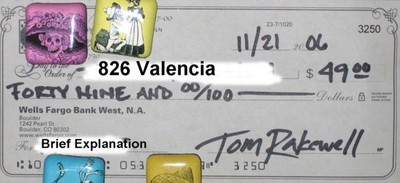
[UPDATE: Matthew Tiffany has pledged another $49. That’s $98, Mr. Eggers, and an opportunity to promote your book. All for an explanation!]
[UPDATE 2: The Rake has upped his sum to $109. Hell, this is starting to feel a bit like Jerry Lewis.]
[UPDATE 3: Dave Eggers has declined to appear on The Bat Segundo Show.]
© 2006, Edward Champion. All rights reserved.
Eggers is not my thing, but…are you serious? You’re demanding answers as to why he gave a conflicted review to something he later decided had stood the test of time? This is the most ridiculous attempt at stirring up a scandal I’ve seen outside of an election cycle. It makes all the bloggers involved look like a bunch of high school kids. Please, stop.
The scandal is being stirred up for a good cause. C’mon. Does one need a license to be ridiculous for charity? Don’t be such a humorless tightwad.
Now that I’ve had a chance to read the reivew and the intro, I don’t know why people are seeing them as so different. The review is a bit mixed, but it also calls the book “brilliant” and says it’s well worth any frustration.
The intro puffs things out a bit, but all the things Eggers finds praiseworthy in the review are reiterated in the intro. It’s like Dazed & Confused. The first time I saw it, I like it, but I also thought it came off like amateur hour, glacial pacing, terrible dramatic structure and some wretched editing.
Years later, those flaws look like virtues to me and it’s a movie I could watch over and over.
Who hasn’t had criticisms of something melt away in the face of time?
If I thought these guys were having a lark, I wouldn’t see them as so pathetic, but they’re not. It’s meanspirited. It’s an attempt at a takedown, a way to be able to shame Eggers no matter what he does because that’s what they’d like to do, take the popular and successful kid down a notch. I love the voices of the blogosphere and can’t imagine a culture without them anymore, but this is one of those cases where the worst parts of the phenomenon are on display.
May, you’ve expressed it perfectly. I enjoy a takedown as much as anyone, but when people start demanding that the subject respond to the takedown, it becomes a little bit of a persecution thing. I prefer Ed in his more impish mode.
I don’t really think it needs to be called a takedown or a persecution. I would call it a curiosity. People are interested. They want to understand. It may benefit the literary community to understand how one’s take on a work of art, naturally, changes over time.
Does Eggers really need a facillitator to get on a podcast? I’ll have him on NY public access and won’t demand he respond to anything, except how to rebuild a 72 Nova engine.
[…] with reading I kept stumbling across pieces, well, making fun of Eggers, e.g, this (follow up here and here), this, etc. [all via Edward Champion’s Return of the […]
ARe you joking? If I thought these guys were having a lark, I wouldn’t see them as so pathetic, but they’re not. It’s meanspirited. It’s an attempt at a takedown, a way to be able to shame Eggers no matter what he does because that’s what they’d like to do, take the popular and successful kid down a notch.Assignment