What We Do Now
I was very interested to see that Melville House has assembled a collection entitled What We Do Now. The book is a collection of essay from assorted people: Steve Almond on getting tough, Maud Newton on tax law, and Greg Palast on voting fraud are just some of the interesting people who turn up. But what impresses me about the collection is how it’s collated several disparate responses in reaction to the current political clime. More importantly, with only a few hours left in 2004, flipping through the book has provoked me into thinking about the same subject. Because What We Do Now‘s very unity and provocative smorgasbord structure has had me thinking about what currently ails the Left. Dennis Loy Johnson and Valerie Merians may be able boosters on the publishing front, but it’s a pity that this approach can’t extend to the Left’s everyday actions.
It may seem an obvious point, but unity has eluded progressives of radical and centrist stripes over the past decade. The Left is either unwilling or unable to cast off its idealistic dregs, all too eager to engage in useless in-fighting over petty details. Instead of campaigning and pulling together for the pragmatic choice (i.e., the candidate or the goals that will get us closer to the marvelous possibilities of representative government), the Left is all too willing to quibble.
I can’t support Kerry because he’s part of the Democratic machine.
I’m for the death penalty. And while I agree with everything else the Green Party stands for, I can’t abide by that point.
These sentiments aren’t the problems of the people who express them, but the mark of an ideology that is inflexible and non-inclusive. Because the truth of the matter is that we need those centrists, if only to call us on our shit from time to time and perpetuate a unifying yet inclusive dialectic. They’d respect us more if we actually stood proudly on our two feet.
The problem isn’t one of politics, but confidence. We need an image, a mentality and a demonstrated series of actions that is confidently and uncompromisingly progressive, but that is simultaneously open to many political stripes.
Here in San Francisco, we had a series of political rallies in 2003. Before they escalated into a war against the police and fulfilled the psuedo-Kent State fantasies of priapic reactionaries, everyday Americans and their families went to these rallies in droves. I know. Because I was there and I talked with more than a few. Some of them had attended these rallies for the first time. And oh how they were disappointed! Let us not forget that before the rallies were driven by mob mentality, despite the insufferable pamphlet-slinging of pro-Palestine supporters and enraged Wobblies, the rallies were places that appealed to a meaty faction of everyday people. They brought people together and had the potential to be a forum for mobilization and a long-term commitment that could extend well into November.
Politiical demonstrations might make twentysomething Free Mumia supporters feel better, but I would argue that, so long as they adhere to a general message without a realistic effort to change government (and most of them do), they are useless. For some, the endless dirge of insensible rhetoric and uninformed opinions might boost egos. But that mentality belongs elsewhere: say, an Elks Lodge meeting. Until rallies are purged of their splinter opportunism and they appeal to the people at large, they will not have much use to anyone outside of cranks and militant nihilists.
This may not be what the Left wants to hear, but the unity problem is so hopelessly embedded that even populist poster boys like Michael Moore are incapable of flexibility. In an interview with Playboy, Moore described an early meeting with Howard Dean:
My wife and I went to meet him with the idea of supporting him. We brought our checkbook. But we weren’t in the room with him five minutes when we thought, Geez, this guy is kind of a prick. We didn’t write the check. I was not surprised the night of the Iowa caucus. He had spent the better part of two years in Iowa, letting people meet him. To meet him is to be turned off by him, so I wasn’t surprised that he lost. The concept of Dean was incredible. The movement behind him was a revolution. It was exciting to see, but Dean imploding was no surprise.
Well, if you ask me, Michael Moore’s kind of a prick for failing to identify politics as a business that involves the occasional tango with snakes for a long-term solution. Moore failed to use his base or his films to pull for John Kerry early in the year. While he quite wisely hit upon a winning formula to get a message out to the people (the mass medium of cinema), his inability to offer a game plan or even some scintilla of hope made his efforts useless.
Meanwhile, the Religious Right, having honed their organizational abilities through the so-called “Republican revolution” in ’94, have taken their battle directly to the American people. They have used a mobilized drive of bigotry and fear to convince the heartland that Bush is the man for the job. The unfortunate reality is that they wanted it more than we did.
The time has come for us to want it more than they do. We have two years of mobilization in store for the midterm elections in 2006. And we must never underestimate that our everyday actions, whether it involves a kind gesture, building up connections with political officials at the local and state levels, or our purchasing decisions, all contribute more effectively to winning than we can possibly measure.
We can be bold and accessible at the same time. The only thing stopping us is hopelessness, inaction, and giving up. And that’s silly. Because from where I’m sitting, we’re only just getting started.
Slow News Day
- OPTR has the goods on how to check out the first five chapters of Murakami’s latest, Kafka on the Shore.
- Carrie has done a fantastic job compiling the overlooked books of 2004.
- Less than a year after writing a steamy novel, Jimmy Carter has a slim memoir, Sharing Good Times, in the works. After the unexpected titilation found in The Hornet’s Nest, the former President had initially planned to go off the deep end again, largely because Clinton’s memoir was so plodding. But Carter persuaded to change the original title, Sharing High Times, and excise a lengthy chapter about the benefits of THC, a pleasure that has assisted him in his negotiations throughout the past ten years.
- Stuart Jeffries predicts 2005’s bestsellers. He’s hedged his bets on Pablo Tusset’s The Best Thing That Can Happen to a Croissant and, like myself, is hoping that Martin Amis’s new novel will live up to its name.
- The Times talks with Leslie Klinger about The New Annotated Sherlock Holmes. “I bought 300 books from a collector $3,500 in 1976, and I’ve never looked back,” he says. That kind of sociopathic obsession has us convinced that Klinger’s the right man for the job.
- And it seems that anyone can sell a memoir, including ex-Justice Roy Moore. Moore, you may recall, was the crazed man who tried to set up the Ten Commandments in the Alabama courthouse. In So Help Me God (I wish I were making that title up), Moore described that night as “the completion of a lifelong mission to use his position as the state’s highest judge to publicly acknowledge God.” Well, it’s nice to know that today’s judicial system is dedicated to impartiality!
[8/11/05 UPDATE: Looks like Stuart Jeffries was about as accurate as a blind dart shooter.]
Homer Simpson to Develop Into Middle Management Loser?
Ricky Gervais is writing an episode of The Simpsons. (via J-Walk)
Also TV-related: The great Dana Stevens pens a Jerry Orbach obit.
Statement from the White House
8:37 A.M. CST
THE PRESIDENT: Good morning. Laura and I were greatly inconvenienced by all this talk of generosity. You see, we could care less about this tsunami mess. We’re busy fighting a war. Can’t you leave us alone?
Nevertheless, there were 60,000 people or so who lost their lives and the last thing we want to do is send you mexed missages. I won’t even try to pronounce “Sri Lanka.” I spent three hours this morning trying to wrap that damn three-letter word around my tongue and failed miserably.
So let’s just say that our prayers go out to the people who had to pay for their passports. We apologize for the inconvenience. This country is committed to spending the next four years searching for its heart and its soul. Our embassies are having a grand old time, coming back to the homeland in their first-class passenger seats in time for the Haliburton new year’s party. I understand there will be ribs.
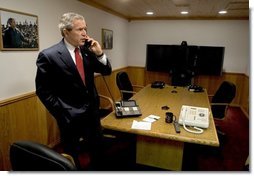 This morning, I spoke with the leaders of India, the nation that ends with Lanka, Thailand (where I told them to stop with the pad stuff, which is too spicy for a Texan’s stomach) and Indonesia, and expressed my condolences while trying to suppress my own personal laughter. And if you don’t believe how manly I was or that I actually made these telephone calls, I invite you to look at this picture. Do you see how in command I am? There are not one, but two phones on the table. And there are some papers too that I’m using to get that whole Lanka thing down. You see? I’m presidential.
Make no mistake: the tsunamis are either for us or against us. Through federal matching funds and the cutting of one $20 million plane, we have upped our figure to $35 million in aid to deal with this thing. (And besides, we’re too busy spending $40 million on my second inauguration.) Why, that’s enough to give these nations 35 million Popsicles. And that’s a good thing. Because when I was a boy, a Popsicle really brightened my day. And these people sure need bright’ning.
It’s hard work. Secretary Powell is working very hard. And we know that the other countries are working very hard. But when people are working very hard, it’s difficult to send a wire transfer. But we need to clamp down on our budgets and let the world know that, even when we deliver a chump change contribution, this tsunami conflict is about us. We are the most generous nation in the world. We have evidence that links the tsunamis to weapons of mass destruction. And we will prevail.
Thank you.