[This is the sixth part in an open series of reports from the New York Film Festival.]
Film adaptations of the Russian literary greats have, for the most part, been disastrous. One counts Martha Fiennes’s wretched 1999 attempt to transform Pushkin’s Eugene Onegin and King Vidor’s bland 1959 version of Tolstoy’s War and Peace as two primary offenders. (For my money, the campy Dostoevsky transmutation, Crime and Punishment in Suburbia, with its superficial teen angst and a chunky Michael Ironside cast slightly against type was, for all of its considerable flaws, far more engaging than these two turkeys. And that’s saying something.) And when one confines this relationship to the problematic Anna Karenina, discounting the protracted television adaptations (some not bad, but one 1985 version preposterously casting Christopher Reeve as Count Vronsky), it should be observed that not even the talented and literary-minded Bernard Rose could make a worthwhile Karenina in 1997. Perhaps Anna Karenina is, like Don Quixote, not really intended to be adapted. And while the fates have tilted against those tilting at windmills (including Orson Welles and Terry Gilliam), they have kept a more laissez-faire with regard to this Tolstoy masterpiece.
Filmmaker Darezhan Omirbaev, however, has no such qualms attempting to beat the rap with Shuga. With the deck firmly stacked against him, he tries to tackle Tolstoy in a mere 90 minutes, which is the creative equivalent of the All-England Summarize Proust Competition. He chops whole sections of exposition, but in the process he also chops much-needed moments for character development. As a result, Alexei Karenin appears here as a laconic and gloomy man who smoothly picks up his cell phone at the coat check and casually orders thugs to beat up Vronsky (the violent suffering here in lieu of the steeplechase). This simplistic character might have worked if Omirbaev was working the yakuza genre. But for a film with such narrative heft to live up to, one is left here with superficial strands. The country that Shuga and Vronsky leave here is actually Paris. And while there’s an interesting undercurrent involving how cameras capture reality (Kostya here is a budding photographer and, at one point, the happy adulterous couple pass by a film crew shooting a scene in which a man sings his heart out into an apartment building’s buzzer) and children of all ages are often parked in front of televisions and GameBoy Advances, none of these thematic possibilities can atone for the film’s considerable blandness, perhaps best summarized by Omirbaev’s endless concern for birch wall paneling and a bland visual palette suggesting a close attention to the flooring section of the Home Depot catalog. “Fate will always win out,” says a philosophical pal of Kostya’s. But fate was much better captured in Tolstoy.
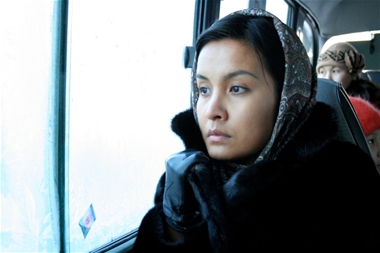
It also doesn’t help that Alnur Turgambayeva’s Shuga — the Kazakh Karenina — is about as interesting as a dessicated cucumber thrown into a tasteless salad. The smooth-cheeked Turgambayeva comes to us not with that allure and complexity that would make a man leave his betrothed, but with a bag of tricks that includes one ineptly commanding glare and an ability to turn her head while wearing colorful sweaters (for those curious, these sweaters come in purple and orange). Now this talent might get you somewhere if you need to grab someone’s attention at a cocktail party, but if you’re a canonized romantic figure that a film needs to hang its weight on, you probably should step aside and let someone else handle the job. Aidos Sagatov is not much better as Vronsky. He wears an isthumus-like soul patch to impart some nobility. And Omirbaev’s idea of wealth is talking on a fax machine from 1987. (For all I know, fax machines from 1987 may very well be cutting-edge in Kazakhstan. But if this is the case, what of the GameBoy Advance?) One naturally expects this douchebag to attempt suicide, as he does in Tolstoy’s book, but the closest he comes to self-oblivion is watching a video made by “friends” of the three thugs who beat the tar out of him.
There is one section right before Chuga’s inevitable trip to the train station where Omirbaev has the principal characters involved with Chuga closing a door and staring at the camera. And while again, there’s something here to be said about Omirbaev’s concern for how the camera sees, without that pivotal human behavior that Tolstoy wrote about so well, even a heavy-handed theme along these lines is useless.
I was far from the only one who grumbled about this movie. Most people after the screening were not happy at all, although I did encounter one friendly gentleman in the industry who was blown away by it. (As it turned out, our cinematic tastes were diametrically opposed.) When I pressed him on why he had enjoyed this film, his affinity was predicated largely on the film’s technical qualities and the motifs that I have outlined above.
And while I can appreciate technical qualities as much as the next film geek, I nevertheless demand emotion and engagement from a film of this type. And I think it’s safe to say that Omirbaev’s film did not cut the mustard with me. Omirbaev’s camera may be interested in walls, doors, and a blue sky painted on a ceiling dome in an opera house. But these are not the places that a camera should drift when dealing with the tortured hypocrisies of the human spirit.