The Bat Segundo Show: Markos Moulitsas

Markos Moulitsas appeared on The Bat Segundo Show #236. He is most recently the author of Taking on the System.

Condition of Mr. Segundo: Refusing to cut and run from Kenny Loggins and company.

Author: Markos Moulitsas

Subjects Discussed: Speculation on the effectiveness of protests, influencing the gatekeepers, Amy Goodman and other journalists arrested in St. Paul, small-time bloggers, Cindy Sheehan, “Free Mumia” promoters and promoting a message of unity, isolating activist sectors, Peter Dauo’s triangle of influence, Vietnam, whether or not Daily Kos has become a gatekeeper, getting media attention, Sheehan’s run as an independent candidate against Nancy Pelosi, Kucinich and the impeachment option, Ned Lamont vs. Sheehan, political narrative, the aborted Democratic presidential debate on FOX News vs. Obama’s appearance on The O’Reilly Factor, Sarah Palin, getting through to the other side, Moulitsas’s conclusions about FOX News viewers*, spreading misinformation and conjecture vs. open source journalism, why Moulitsas hasn’t employed a fact checker for Daily Kos, whether Moulitsas considers himself a journalist, and doing anything to win for politics.

EXCERPT FROM SHOW:
Correspondent: I wanted to actually ask you about your site. I mean, the Daily Kos was responsible for spreading the rumor that Sarah Palin’s son, Trig, was her daughter’s son. Howard Kurtz at the Washington Post actually asked you about this. And you said to him, “Our people are doing the vetting. Even if some of it is hitting dead ends, other ones are striking direct hits. My role is to sit back and let the citizen journalists do their job, and I amplify the stuff that shakes out.”

But I’m wondering, if this is misinformation or conjecture, what is this doing to increase the level of political discourse? Or to even help the credibility of Daily Kos? I mean, aren’t you essentially doing the exact same thing as the people who looked to Al Gore and said, “Oh, he invented the Internet.” Even though, as you pointed out in your book, well, it was intended as a joke. It was completely misconstrued. I mean, what of this? I know you have an engineer who you’ve hired. Why not hire a fact checker? Why not try to get it right? Why not actually go ahead and push the levels of reason higher than the mainstream newspapers who sometimes get things wrong?

Moulitsas: So you’re talking about me becoming the ultimate gatekeeper online by stifling anything that hasn’t been vetted by the great and mighty Kos. It is open source. It is a community. People are talking. They’re having a chat. It’s like the corner of — it’s like a sports bar. People get together and they talk about things. And, yeah, some of them are — some misinformation happens. But as a whole, the community shakes things out. This guy, who wrote the one diary, which is now infamous, right?

Correspodent: Yeah.

Moulitsas: Eventually he took it down. Because enough people at Daily Kos pointed out the flaws in the argument. And so the community was self-policing and finally realized, okay, this was a dead end. Now, of course, there was a lot of irregularities about that pregnancy that still are pretty much unexplained. I don’t think they’re explained by the original theory. But there’s some weird stuff. I mean, you don’t have your water break and then you wait ten hours to go the hospital. Because you give a speech and you go on a commercial flight to Seattle, and sit around, and take a commercial flight to Anchorage, and take a one hour drive to your hometown, and then have a baby when your water breaks. Especially a special needs child. Like Trig was. But that said, it’s her choice to make those decisions. You know, I’m a progressive. I’m assuming a doctor said it was okay for her to do that. You know, it’s between her and her doctor.

I am not Sarah Palin. I’m not trying to inject my morality into the public space. But there are some weird things that led people to ask questions. I think that’s perfectly natural. And they led to the reality that Bristol was pregnant. Which normally wouldn’t be relevant. Except that her mother (1) is a fierce opponent of sex education, is all about abstinence-only, and (2) she vetoed funding for a halfway home for pregnant teenagers. Right? So it actually matters when you legislate morality how that will affect your family life. I mean, the hypocrisy and everything else that’s attached to it.

Now that said, there’s also a great deal of investigative stuff that came out of Daily Kos that is now part and parcel of the confirmed background of Sarah Palin. Like her association with the Alaska Independence Party. The separatists.

Correspondent: Sure. But I’m talking about this misinformation here. I mean…

Moulitsas: Well, it’s all…

Correspondent: People are going to catch wind of this early part and then they’re going to look to you and say, “Well, I don’t know about Daily Kos. Sometimes, they get it right. Sometimes, they get it wrong. And I have to constantly fact check on top of this.”

Moulitsas: No, no, no. Good. I want people to look at media with a skeptical eye. Are you kidding me? If people did that, would we have rushed to war in Iraq so quickly? If people didn’t just blindly trust Judith Miller in the New York Times reporting?

Correspondent: Even at the expense of your own credibility?

Moulitsas: It’s not. The question isn’t credibility. Not my own. I didn’t write the stuff. Daily Kos people. I mean, this author’s credibility might be impacted. I don’t know. I didn’t write that stuff.

Correspondent: But the fact of the matter is that “dailykos.com” is in the link.

* Note: The specific report that Moulitsas may be referring to is this 2003 PIPA study which pointed out that FOX News watchers more most misperceptions than those who watched other networks. But there is a significant difference between FOX News watchers experiencing misperceptions and Moulitsas claiming that this audience is “the most reliable Republican constituency in the Republican party.” [sic]

BSS #236: Markos Moulitsas (Download MP3)

This text will be replaced

The Bat Segundo Show: Daniel Levitin

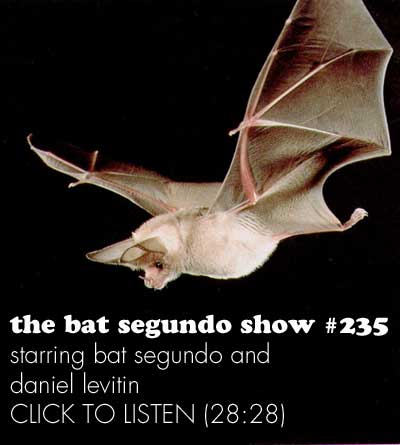
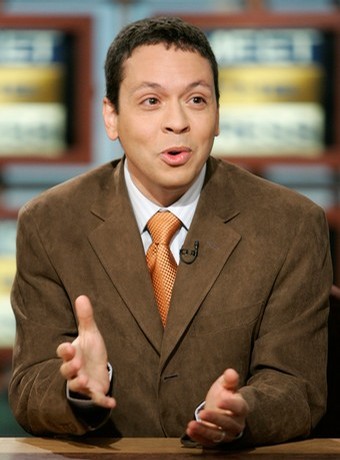
Daniel Levitin appeared on The Bat Segundo Show #235. Levitin is most recently the author of The World in Six Songs.

Condition of Mr. Segundo: Recalling a traumatic musical episode from his marriage.

Author: Daniel Levitin

Subjects Discussed: Songs that straddle multiple categories within Levitin’s taxonomy, neurological response vs. societal perception of a song, the original eight categories, oxytocin, “I Walk the Line,” Nine Inch Nails, hypothetical subspecies of comfort songs, angst and emo, Janis Ian, social comparison theory, joy songs and advertising jingles, chemical levels rising in relation to specific musical genres, serotonin levels and music, cortisol, responding to Steven Pinker’s “auditory cheesecake” controversy, Steven Mithen’s The Singing Neanderthals, the evolution of language and music, David Huron’s “honest signal” hypothesis, attempts to predict hit music, advertising and music, insincere pop music, smart audiences, the pernicious use of music, the use of Van Halen’s “Panama” to get Manuel Noriega out of his bunker, music used to torture people in Abu Ghraib, and using music in ways that it wasn’t originally intended.

EXCERPT FROM SHOW:

Correspondent: We have six categories. Can you name a single song that can be applied for all six categories? Have you considered examples along these lines?


Levitin: I’m sure if you gave me enough time, I could.

Correspondent: You have thirty seconds. (laughs)

Levitin: (laughs) Well, I’m going to go with “I Walk the Line.” Because I think it’s a very rich song. In the book, I make the case that it crosses two categories.

Correspondent: It really walks the line here.

Levitin: Right. At the surface level, I believe that it looks like a love song. A guy singing to the woman he loves, “Because you’re mine.” There’s a “you” in it. “Because you’re mine / I walk the line.” I’m not cheating on you. But the point I make in the book is that really I think at a deeper level, he’s not really singing it to her. He’s singing it to himself. It’s like a musical string around his finger reminding me of all he has at stake here. “I find it very, very easy to be true / I’m alone when each day is through.” I don’t think so. I don’t think you’ve been alone every night. And I don’t think that you find it that easy to be true. I mean, I think it’s a struggle. And he’s reminding himself of all that he has at stake. That’s a knowledge song. Self-knowledge.

Now at the same time, I think that you can argue that there’s an element of comfort here. People who have been in a similar situation take comfort in hearing it expressed this way. I listen to music often because the songwriter helps me to understand feelings that I haven’t been able to articulate. The right song comes on. Aha! That’s how I feel. And I find that comforting.

Correspondent: I’m wondering also if identifying song by the six categories is a matter of identifying perhaps a dominant and a recessive category for each particular song. Perhaps a stronger song is more likely to have at least two categories attached to it. Or maybe some songs are utterly simple and just intended to serve one purpose. I mean, it all depends on any number of factors. Maybe you can talk about this a little bit.

Levitin: Well, I think the other aspect of it is that it’s not that the songs themselves fit into six categories. It’s that these are the six ways that people use music. The six ways that people have had music in their lives. The six ways that they use to communicate with one other.

Correspondent: I wanted to ask you about comfort songs. You cite specific personal examples. But I wanted to give you a personal example that I had as a teenager. I had a tendency to blast Nine Inch Nails quite loud. It was a comfort song to me largely because I would listen to this man who was utterly depressed. And I’d say to myself in a sad state, “Oh, you know, there is someone who is worse off than me.” And it was a way for me to corral my emotions with reason. However, the examples that you use in the comfort chapter tend to be people who are looking just for emotional comfort, but not this association between reason and emotion. And I was wondering if it’s very possible that we could be talking about two subspecies of comfort songs.

Levitin: What do you mean? The connection between reason and emotion?

Correspondent: Well, by listening to Trent Reznor, I would be able to immediately understand that my own particular emotions were somewhat folly in some sense. And the rational part of my teenage brain would kick in. And I’d say, “I’m beating myself up here for no reason.”

Levitin: Kind of like listening to Morrissey.

Correspondent: Yeah, exactly!

Levitin: “I want to kill myself.”

Correspondent: Any of the emo.

Levitin: “Everything’s bad tonight.” (laughs)

Correspondent: Yeah, exactly. I mean, should we draw two types of distinctions in comfort songs along these lines? I mean, we have to factor in emo. We just do.

BSS #235: Daniel Levitin

This text will be replaced

The Bat Segundo Show: Courtney Humphries

Courtney Humphries appeared on The Bat Segundo Show #234. Humphries is the author of Superdove

Condition of Mr. Segundo: Severely underestimating the carnivorous impulses of pigeons.

Author: Courtney Humphries

Subjects Discussed: Eating squab, pigeon dining options in restaurants, Robert Dunn’s pigeon paradox, urban forms of nature, pigeons as an ineluctable aspect of the city, people’s attitudes towards wildlife, the pigeon’s place in the food chain, pigeons as the garbage disposal of Mother Nature, feral pigeons, interbreeding, when baby pigeons fend for themselves, distinguishing pigeon types, corpulent vs. svelte pigeons, individual variation, Daniel Haag-Wackernagel’s efforts to reduce the pigeon population in Basel, Switzerland, synanthropy vs. symbiotic relationships, the human failure to consider other species within our current habitats, being a social synanthropic animal, cooing sounds, birds imitating urban sounds, the difficulties of raising funds to study pigeons, Richard Johnston’s Feral Pigeons, artificial selection, General Mills’s funding of B.F. Skinner’s Project Pigeon, the folly of the pigeon-guided missile, overstating the cognitive potential of pigeons, Robert Cook’s experiments at Tufts, and Charles Walcott and pigeon homing.

EXCERPT FROM SHOW:

Correspondent: You’ve actually dined on squab. You allude to the fact that it’s delicious, that it’s dark meat. But as a carnivore and somewhat of a curio, I had to ask whether it tasted like chicken or like duck or like turkey. I mean, you didn’t go into specifics here. And I’m wondering if the experience was possibly unsettling or you couldn’t convince yourself completely that it was delicious. Because you also sympathized with these birds. But what of this?

Humphries: Yeah, I was a little bit nervous about eating them. At the time, I had been looking at pigeons for a long time and was working on this book. And so I was very interested in them. So I was a little worried about eating a pigeon, how I’d feel about it. But it was really good. Because it’s dark meat. They’re small birds. So you’re not getting huge pieces of meat. But it’s kind of a dense meat. It’s not fatty like duck is. But it’s good. And I had it again recently in Chinatown — in Boston, where I live — and it was crispy fried squab, where they didn’t deep-fry the whole bird. And they serve it to you cut in pieces including the head. So that was a little more.

Correspondent: With the head included, yeah.

Humphries: That was a little unnerving to me to have the head just lying there.

Correspondent: But you ate it anyway.

Humphries: I did. But I have to admit that I didn’t feel as great about it as the first time I had it, which was a very nice upscale restaurant. They just served some pieces of the squab sitting on some rice.

Correspondent: So that’s twice you’ve had pigeon?

Humphries: Yes.

Correspondent: Have you had it any other time?

Humphries: No, well, for one thing, it’s very expensive when you go to the nice restaurants. It can cost you a lot. You know, I wouldn’t mind trying more different varieties. I do feel that if I was eating pigeon all the time and talking about how great they are, maybe I wouldn’t. I’d feel strange.

Correspondent: You’d be branded in some sense.

BSS #234: Courtney Humphries

This text will be replaced

The Decline of Editorial Standards: The Crimes of Nick Nadel

We all make mistakes. Grammatical gaffes have been committed on these pages, dutifully pointed out by readers. I am grateful for these corrections. This helps me to write better and reminds me again just how much I still need to learn.

But there comes a point when one must ask why those who commit a surfeit of mistakes remain consistently employed as writers. I’m sure that these people are nice, that they’re probably good lays, or that they are dutiful drinking buddies. But at the end of the day, one’s work is what counts most.

I have seen a marked increase in basic editorial standards being abandoned and/or disregarded by today’s “journalists.” It is a scenario that simply drives me crazy. If any of these young whipper-scriveners had committed these same mistakes a decade ago, these journos-come-lately most certainly would have been belted across the face by a pugilistic copy editor. And they would have deserved it.

In lieu of chasing these vandals off the grass with a pump-action shotgun and a crazed look in my eyes, I shall instead upbraid one of these editorial felons here.

Nick Nadel is an alleged “comedy writer who has worked for HBO, The Onion, Fuse, VH1, and others”. And I certainly hope that he wasn’t paid money for this embarrassing blog post at AMC TV. (A Google search turns up two editorial names at AMC: Carolyn Koo and Clayton Neuman. But I cannot find emails for them. Typical of corporate sites, there simply isn’t a shred of accountability here. Presumably, Koo and Neuman are too busy cooing their nomina to each other to pay attention to basic grammar.)

Let us count the ways in which Mr. Nadel, a purported professional, has committed an epic fail.

1. Mr. Nadel’s lede begins, “Much has been made over the years of the rivalry,” when he should really be writing, “Much has been made over the rivalry….” Unless, of course, he means to suggest that people have been contemplating the number of years over the rivalry? While I remain a dutiful counter, I don’t think this is the case, seeing as how the post purports to be about a feud between Bette Davis and Joan Crawford.

2. Mr. Nadel begins his second sentence suggesting that the subject is “two strong-willed legends.” But his true subject is the feud. This is sloppy. The sentence should begin, “The infamous feud between these two strong-willed legends….” Clarity.

3. The word “duo” is not a plural noun, but a collective noun. But don’t tell that to Mr. Nadel. He seems to believe that English speakers write phrases like “the water were flowing” and offers us, “The volatile duo were set to reprise….”

4. Mr. Nadel doesn’t understand that when you end a sentence with a question mark (in this case, a sentence containing the film title), there is no need for a period.

5. Mr. Nadel is terrible with his commas, failing to separate “illness” and “causing” to make these two clauses clear to readers.

6. Mr. Nadel writes that “Davis and Crawford had bad blood that dated back to 1935’s Dangerous.” But he has phrased this in a way to suggest that Davis and Crawford were more in need of constant venipuncture.

7. Mr. Nadel depicts “a cooler of Pepsi products.” Surely, he means a cooler with Pepsi products. To my knowledge, there wasn’t a machine in the early 1960s that cooled Pepsi products while discriminating against other bottles. Later, Mr. Nadel writes, “It’s unclear whether or not Davis was behind the machine.” He’s right. I don’t know if Davis was standing or hiding behind the machine either. But I do know that she might have been behind the installation of the machine.

8. Mr. Nadel writes, “she was rumored to have toasted eventual Crawford’s departure.” I’m unaware of eventual Crawfords, but I’m almost certain that they eventually depart.

And so on. And so on.

How did this get past the editor’s desk? Sheer laziness from the writer and the editor. Mr. Nadel’s inability to take the assignment seriously. Mr. Nadel’s unprofessionalism. He probably banged this out in ten minutes and didn’t think that anybody was going to look at it. And how does this reflect upon AMC TV’s blogging presence? A visitor like me stumbles upon this post by accident and I know immediately that this is a blog that is neither serious nor worth my time.

Then again, AMC TV brass may have considered that most of its readers don’t care about language. After all, this is a film and television crowd. Therefore, the audience should be regaled with the worst writing possible. But if we insist on poor and incompetent writing, is this not an insult to the audience’s intelligence? And if we insist on Mr. Nadel mangling his sentences for an interesting piece of gossip in film history, is this not a missed opportunity for context and conversation? And others to leap forward with other observations? If the Nick Nadels of our world write so badly, how will others get passionate about Joan Crawford and Bette Davis?

Incidentally, a more cogent article about the rivalry can be found here, which is considerably more interesting than Mr. Nadel’s lazy cut-and-paste from Wikipedia.