New York Sun critic Adam Kirsch stunned a young literary couple in the Upper East Side when he was observed attempting to crack a joke to a Starbucks barista. The couple, knowing of Kirsch’s humorless writing, were especially astonished to see Kirsch actually converse with someone in a class beneath his station.
“He didn’t act as if she didn’t exist. The way he usually does,” said Gloria Reynolds, a 35-year-old stay-at-home mother and Caitlin Flanagan fan. “He actually asked her how he was doing, and then he tried out a zinger!”
“It was a knock-knock joke,” said Harold Bentley, a 32-year-old investment banker. “Nothing great, mind you. But it was a start.”
Sources at the New York Sun reported that Kirsch entered into an argument with a copy editor. Kirsch threatened that he would leave the paper if his piece did not include a sentence that began “You might be a redneck if….” The copy editor was then fired without severance pay by New York Sun management.
“There may still be a chip on his shoulder,” said the Sun‘s books editor, David Wallace-Wells. “But at least it’s now a funny chip.”
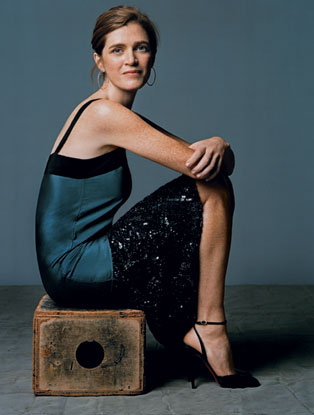
Samantha Power, author of A Problem from Hell and Chasing the Flame, has announced that she will turn her attentions to “more entertaining, less challenging” books in the wake of recent developments. Expressing dismay that her thoughts on weighty matters were overlooked by off-the-record remarks, and that she was now being relegated to the Fashion & Style section of the New York Times, Power pledged that she would now “give the people what they want.” And if that meant abandoning important probings into American foreign policy that the people needed to know about, this was simply how the cookie crumbled.
Power also showed less reticence to more base endeavors.
“I’m 37,” said Power in a telephone interview. “I still go to the gym. I still have a body. And if the American people prefer my body to my mind, then who am I to argue? I’d rather just move forward and put the Obama incident behind me.”
Power reported that her third book would be a meticulously researched biography on Beyoncé, with the working title, Dreamgirl: A Woman’s Only Choice in America.
“I’ve already talked to hundreds of people close to Beyoncé. Only a handful grew uncomfortable at the mention of Raphael Lemkin.”
Expressing approval for these unexpected developments, Larry Flynt offered Power $500,000 to pose naked in a future edition of Hustler. “That’s the great thing about America,” said Flynt. “Even when a woman’s as sharp as Samantha, she still has anatomy.”
Power did not offer an answer as to whether she would take this offer. But she did say that it was good to have some insurance “if the Beyoncé book tanked.”
Apologies for the slack content here. It’s been busy. But things should be more or less back to regular prolificity tomorrow. Four more podcasts have been released at The Bat Segundo Show, including a return appearance by LBC-nominated author Jeffrey Ford that pertains to his latest book, The Shadow Year. Three more podcasts are forthcoming in a few days, all of them return appearances — including two authors who were nominated by the LBC. As time permits, I’m hoping to check in with many of the authors who the LBC once championed as they put out more books and come through New York, while also keeping the floodgates open for emerging and overlooked literary talents.
There are also some lengthy FH pieces coming from other authors. Keep watching the skies.
Darby Dixon points to a troubling new trend among today’s cultural tastemakers. Today, a professional writer can now be employed to write about reading about writing or reading about writing about reading, with several nots thrown in at random intervals, if we assume the writers to be keeping track. I must confess that all this gives me a headache. The silence is not pillowy exactly. But it is certainly quite silly and possibly Freudian.
I feel that I have contributed to this atmosphere with lengthy blog posts responding to reviews of books, and therefore exhort all to point to my culpability in the matter. In my defense, I should note that I never suggested to an editor that I should collect a check for writing such a piece. But now I am writing about writing about writing about reading, thereby adding a fourth layer of self-reference. And should you, dear readers, decide to comment upon this post, you will be writing about writing about writing about writing about reading. And how then can we live with ourselves?
All this sets a bad precedent for meta, dutifully putting the Quine in quinine. (Quite literally.) Or does it? Is there no limit to the onion?
Of the three paragraphs I have now written, I think the first one is probably the best, although I’ll probably change my mind when I approach this sentence’s period.
I am still unaware of how one “stabs over” to an online bookstore. This suggests that the online bookstore is a carapace to be pierced. And perhaps it is, assuming that it possesses the corporeal qualities of reference. Perhaps the preposition is the dagger I see before me or just a creepy beast caught in the morphological undertow. So I’ll see your self-reference and raise you with evidence to the contrary:
Before the days of Sesame Street and The Muppet Show, Jim Henson was an independent filmmaker in New York, making experimental films between commercial gigs. It was the mid-sixties. According to John Bell’s Strings, Hands, Shadows: A Modern Puppet History, Henson was sharing a workshop space for a few months in the basement of a New York City library with a German sculptor and choreographer named Peter Schumann. Schumann specialized in avant-garde performances, entertaining crowds with masks, puppets, and postmodern dance, often employing these for political demonstrations.
In watching 1965’s “Time Piece,” seen above and recently unearthed by Metafilter, it’s difficult to consider it without Schumann in mind. The film played in New York theaters on a double bill with Claude Lelouch’s A Man and a Woman and concerns itself with a man (played by Henson) being examined in a hospital. As the clock ticks away, a grand surrealistic array of experiential memories overtakes his existence. Gorillas bounce on pogo sticks. There is the quiet Kermit-like plea of “Help!” Chickens emerge in strip clubs. And all this is intercut with optically printed pixellated squares.
The film is set to a intermittent drum rhythm that echoes the heartbeat of time. What’s particularly intriguing is that, according to David P. Campbell’s The Complete Inklings, “Time Piece” so captured Campbell’s imagination that the film was shown at an a seminar at the Minnesota Statewide Testing Program annual conference, with Henson’s film projected on one screen and the test results of a random individual projected on another. The idea was to show Henson’s film, with Campbell announcing to the students, “We should always remember that there is a person behind each of these test scores; to make that point dramatically, here is one person’s test scores and here is a product of his considerable imagination.”This permissive cultural climate permitted Henson to make “The Cube” in 1969, a teleplay that independent filmmaker Vincenzo Natali appears to have handily pilfered from.
A protagonist, known only as “The Man in the Cube,” is trapped inside a cube of white rectangular panels, with strange individuals who enter and exit through other doors. This premise gave Henson the opportunity to explore a wide variety of topics: racism, sexism, the realm between reality and fantasy. There is even reference to the fourth wall. At one point, a professor addresses the man, pointing out that he is in a television play.
Believe it or not, “The Cube” was commissioned for a television series called Experiment in Television, a now forgotten program that aired on NBC between 1968 and 1971. This series came about because NBC needed filler material to provide late Sunday afternoon programming when the football season had ended. And they decided, quite amazingly, to provide a venue without commercials for documentaries and experimental films.
In the end, it was public television that secured Henson’s rise to fame. But today, unless you’re as squeaky-clean as Ken Burns, your prospects for national exposure are slim. Now that the first season of Sesame Street has been issued on DVD, it’s been issued with a parental advisory reading, “These early ‘Sesame Street’ episodes are intended for grown-ups, and may not suit the needs of today’s preschool child.” The idea of children running around an inner city, looking to learning as a way out, is apparently too threatening a concept.
Given this drastic shift in priorities — the unusual idea of commissioning an experimental film for a testing conference, the now antediluvian notion of creating a space on national television where filmmakers can pursue alternative ideas, and the censure on anything slightly offensive to “suit the needs” of children — one is forced to contemplate the current media atmosphere. Certainly, there is YouTube and the Internet. But this online landscape increasingly values views — and thereby advertising revenue — over notions that are not popular or lucrative, and one wonders just how tomorrow’s Hensons will thrive. Of course, any artist who feels compelled to create will not let any obstacle stop him. But by hindering the spectrum of expression with our priorities (what sells, what’s safe, et al.), I’m wondering if we’re closing the floodgates to those who might have new and innovative ways to get a mass audience excited about the world around us.
 New York Sun critic Adam Kirsch stunned a young literary couple in the Upper East Side when he was observed attempting to crack a joke to a Starbucks barista. The couple, knowing of Kirsch’s humorless writing, were especially astonished to see Kirsch actually converse with someone in a class beneath his station.