Roundup
- The Millions’ Garth Risk Hallberg offers “an attempt of a review” for Against the Day.
- Orhan Pamuk is not pleased with “being secure.” Accordingly, Pamuk has spent much of his spare time combing through the DSM-IV for ways to be insecure. In addition to isolating a large chunk of his friends by revealing TMI at cafe sitdowns, Pamuk has adopted an awkward gait, hunched shoulders, and has started to pen confessional essays similar to Jonathan Franzen’s.
- Clive Cussler inflating book sales? The next thing you know, he’ll inflate his literary worth!
- Be sure to drop by the Litblog Co-Op this week for discussion on Ngugi wa Thiong’o’s The Wizard of the Crow, which also made my top ten books of 2006.
- Poet John Hewitt is set to become a “Statue of Liberty man.” But the more important question, still unanswered, is whether Hewitt was a breast man or an ass man.
- Norman Mailer: “I’m not as interested in fights as I once was. I used to enjoy a fight. Now I look at (a fight) as something that’s going to use up a lot of the little working time I probably have left. I don’t want to get to the point where I’m frantic about the working time.” Well, then how will the old man get out all that aggression so that he can feed his ego? Cross-stitching? Bocce?
- Ed Park on PKD’s Voices from the Street.
- Michael Chabon on McCarthy’s The Road. (via Bookdaddy)
- Embarrassing books, including Bill O’Reilly’s Those Who Trespass: A Novel of Television and Murder. (via Bookshelves of Doom)
- Revolutionary Road: the movie? I don’t know about this. With Sam “I’m About As Subtle as CG Petals” Mendes at the helm, I can’t see Richard Yates’ classic novel being given the hard realism treatment it deserves. (via Matthew Tiffany)
- To those who have asked me to respond to the Gavin Newsom scandal, I truly could not care less. I’m more concerned with, say, affordable housing, the homeless, the social impact of Proposition F, MUNI’s failures, and at least four thousand other issues pertaining to San Francisco. And I’m appalled at how I have been asked nearly every day during the past week to engage or joke on the matter, when what happened is between the involved parties and is frankly none of my business. And for those who might impute that I’m a Gavin apologist, I should also note that I voted for Matt Gonzalez, not Gavin, in the last election.
Tanenhaus Has Shortcomings, To Be Sure
Sam Tanenhaus: “Shortcomings, to be sure. But so what? Nature doesn’t owe us perfection. Novelists don’t either. Who among us would even recognize perfection if we saw it?”
With these five simple sentences, Sam Tanenhaus has spelled out why the New York Times Book Review is a publication hostile to penetrating insights on fiction. Literary criticism, as I understand it, is not the quest for perfection, nor should one expect a single volume to yield near universal plaudits from all who read it. (Unless, of course, like the old Saturday Night Live sketch suggested, you liked Cats and you’d see it again and again.) One of criticism’s vital functions is to present doubting Thomases who cast aspersions on a book’s greatness and brave critics with cogent arguments explaining why a universally derided book is worth reading.
I happen to believe Rupert Thomson’s The Book of Revelation to be a near perfect novel, but while attaching a melodramatic modifier might be good for blurbs, it doesn’t tell you anything about why I believe it to be a near perfect novel. I can tell you in very specific terms why I believe it to be one one of the best novels of the past ten years, but I would not deny another critic her right to express why it fails, using supportive examples and reasonable terms.
Literary criticism is certainly not a matter of bullshit lists. It is not a matter of declaring an author above a single reproach, as Tanenhaus has done. Literary criticism is a quest for understanding, a way of playing booster to authors who are maligned or misunderstood and skeptic to the critical darlings.
Edmund Wilson once described the situation this way:
No matter how thoroughly and searchingly we may have scrutinized works of literature from the historical and biographical point of view, we must be able to tell good from bad, the first-rate from the second-rate. We shall otherwise not write literary criticism at all, but merely social or political history as reflected in literary texts, or psychological case histories from past eras.
It is not enough for the critic to describe a book as first-rate. The critic has the duty to explain why this is so while considering the blind partisanship of her enthusiasms. A good book review editor will cultivate these critical impulses in his contributors, instead of penning a 2,000 word love letter that could have just as easily read:
I LOVE SAUL BELLOW. SAUL BELLOW IS GREAT. DO NOT PICK ON MY AUCTORIAL HERO. (rinse, lather, repeat ad infinitum)
Racist Restaurants
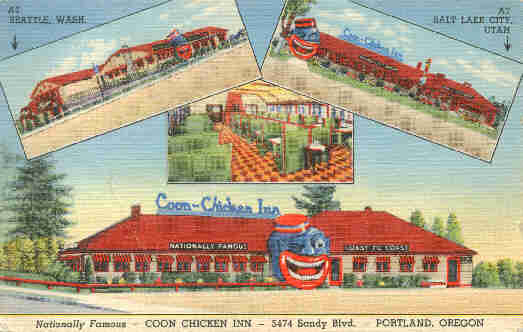
Here’s one of the more disheartening and rarely discussed moments in American cultural history: A restaurant chain called Coon Chicken Inn, alluded to in the films Ghost World and C.S.A., actually existed between the 1920s and the 1950s. Diners would enter through the doors of a ghastly racist caricature. It was one of Portland’s most popular restaurants, in part because there was a small African American population in Portland and in part because the food was cheap.
The restaurant chain was opened by Maxon Lester Graham and Graham’s descendants has issued a wholesale disapproval of the Coon Chicken Inn. This descendant reports that the racist logo was on every dish, piece of silverware, menu and paper product.
Interestingly, a few weeks ago, the Oregonian reported that the former Coon Chicken Inn has been purchased by an African American man named Ernest Clyde Jenkins III.
While Coon Chicken is now gone, it was by no means the only racist American restaurant. If you visit Santa Barbara, you can find the original Sambo’s restaurant, based on Helen Bannerman’s racist children’s book, The Story of Little Black Sambo. There were once as many as 1,200 outlets. Now there is one. Says restaurant critic John Dickson, “So when are you going to go nationwide AGAIN?” Presumably, Mr. Dickson is also fond of golliwoggs.
Five Television Intros
I encountered this list of the ten best television intros and I was a bit underwhelmed. So here’s an additional list of intros to add to the pile:
1. The Prisoner: When was the last time that you experienced a television series intro that was this cinematic? Everything from the great match editing of McGoohan walking down the corridor, with the shadow passing over his face cutting to the shadow passing over his tapping heels, to the retro typewriter Xing out McGoohan’s photo throws you into the intricate allegory that The Prisoner dared to bring to its viewers.
2. The Muppet Show: If you examine The Muppet Show‘s premise (a bunch of puppets running a variety show) from a hard rationalist’s perspective, the show is pretty damn absurd. So what better way to set the mood then unleashing a mad torrent of Muppets singing and dancing?
3. Six Feet Under: Whatever one’s feelings on Thomas Newman’s theme, one must admire the deft stop-motion animation, the unusual angles that the coffin is pulled out of the hearse, and the great match cutting (such as the gurney wheel turning on cue).
4. The Drew Carey Show: My feelings on The Drew Carey Show are mixed, but I did greatly enjoy the show’s intro, in large part because I’m a sucker for anachronistic urban dancing.
5. The Six Million Dollar Man: It was a pretty lame show, but there’s a reason why this intro remains indelible. Starting off with a straight-faced summation of Steve Austin’s accident, we are then given all manner of superimposed graphics, followed by that indelible narration. It’s too bad the writing on the show wasn’t this effectively melodramatic.