You’re Seriously Asking Me for My View on “The English Patient?”

A good number of Charlie Rose interviews are now available through Google Video. (They had previously been available for $1.00 per view, but Google has since added video ads, making them free, and helpfully demarcated these ads through blue dots on the timeline.)
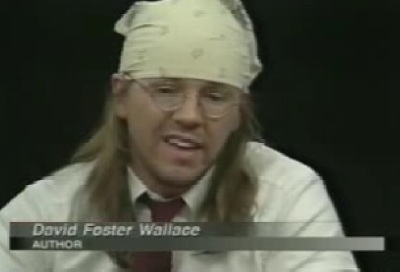
dfwcharlierose.jpgWhat this means, of course, is that the infamous DFW interview is now available. If you haven’t seen it, this is the interview in which Rose, who doesn’t seem to have read much of DFW’s work, asks DFW (wearing, believe it or not, a bandanna and shirtsleeves) about everything but his books. DFW comes in at the 23:17 mark.

It’s the telltale indicator of how low the literary journalism bar has fallen (compared with, say, the Dick Cavett shows of the 1970s, where Cavett or his researchers actually read the damn books) — a veritable train wreck and a true revelation of Rose’s illiteracy. A visibly uncomfortable DFW is bullied by questions that pertain to David Lynch, with Rose boasting about interviewing Lynch instead of talking about DFW’s work. Rose’s ignorance is astonishing, particularly as DFW educates Rose about the history of postmodern literature.

And this was only ten years ago.

[RELATED: Here’s Dave Eggers from 2000 (at the 25:38 mark), just as A Heartbreaking Work of Staggering Genius became a success and in the early stages of developing the humorless temperament we all know him for today. Early on, Eggers remarks, “I thought [the title] would anger the right kind of people.” Eggers angering people? Who would have thought? That’s not what McSweeney’s is about!]

[MORE FUN: David Foster Wallace, Mark Leyner & a very young Jonathan “I consider myself my own reader” Franzen (1996, all interviewed at the same time, 36:26), Ian McEwan (2005), Toni Morrison (2003), David Halberstam & Bret Easton Ellis (1999), Ian McEwan (2003), Victor Navasky (2005), Jonathan Safran Foer (2002), John Updike (1998), Martin Amis & Gore Vidal (2003), Richard Ford (2005), John Updike (2003), and Jhumpa Lahiri (2003).]

Believe It or Not, There’s Someone Lazier Than Dave Itzkoff

What Jenny D said. It strikes me as anti-intellectual to waste time in a review bemoaning the length of a book (and in this case, it isn’t even the book being reviewed), and it reveals just how much of a mousy barnacle Allan Sloan is, who may very well be perfectly fit to report on business but is wholly incompetent to publish work in a book review section.

The other asinine statement from Sloan: “As with the Bible or Moby-Dick, you don’t have to be familiar with the entire work in order to grasp its essence.” What next from Tanenhaus? Championing SparkNotes over the text itself?

Apologists can defend Tanenhaus for his Whittaker Chambers biography all they want, but this kind of recidivist attitude has no place in a weekly book review section.

Absolutely no brownies for Tanenhaus. In fact, he should be baking us some.

As for the drive-by assault on Anthony Burgess (which comes courtesy of Paul Gray), the only thing “comfortably ho-hum” here is the flagrant vacuity within Mr. Gray’s head. Gray’s noggin clearly hasn’t entertained a curiosity about literature in quite some time.

Reason #142 Why Dave Itzkoff is a No-Nothing Assclown

New York Times: “All science fiction has some element of titillation — a strategy of taking known facts and stretching them to the limits of credulity, for the purposes of both entertaining and enlightening.”

Gee, I thought the purpose of speculative fiction was, much like many other novels, to provide a narrative that reflected the human condition: sometimes using provocative ideas or meticulous atmosphere (a la China Mieville) and, in the case of hard sf, sometimes employing rigorous scientific justification to explain the imaginative scenario (and thus pushing the narrative well past “the limits of credulity”) (a la Robert Charles Wilson’s excellent Hugo-award winning novel, Spin). That Itzkoff sees science fiction from a failed English major’s dichotomous mind set (“entertaining and enlightening,” but not challenging, humanist or literary) is a great indication that he should probably recuse himself from literary criticism. His work for the NYTBR reads like a Strom Thurmond-like politician trying to use States Rights Democratic Party rhetoric (circa 1948) to run for President in the 21st century.

[RELATED: Levi Asher points out that Tanenhaus’s team can’t even get basic Beat history right. Maybe they truly are operating as if it’s 1948 at the NYTBR.]

AMS Bankruptcy Links (1/6/2006)

Here are the most recent developments:

  • Some folks have a sense of humor about PGW.
  • Violet Blue has offered her thoughts on the meltdown, noting how the impact affects Cleis Press and pointing to a former AMS exec’s prison sentence. (The charge: falsifying earnings.)
  • Soft Skull’s Richard Nash puts the catastrophe in perspective.
  • Dan Wickett shares some ideas on how publishers might want to pick up some cash to make up for the lost revenue. The inspiration? An idea first put out there by Richard Nash.
  • Scrivener’s Error has a helpful legal breakdown. The news ain’t good.
  • Paul Collins: “Innumerable small publishers working with AMS and their subsidiary PGW — just about every good small publisher you’ve ever heard of — woke up in the street on New Year’s morning with their clothes missing and a pair of black eyes.”
  • No further news as of yet from the San Diego Union-Tribune, but I don’t think we’re going to see any major action until the creditors committee meeting on January 12.
  • I’m experiencing some technological issues with my main computer (hence, scant email replies from me for a while; apologies). But I’ll have more for you on Monday.
  • [Sunday morning item]: Nick Mamatas reveals some inside information. Soft Skull (and perhaps others) has held off on inventory until forming a short-term strategy. There was apparently a lengthy conference call with 55 publishers and 6 lawyers conducted on Friday. (I have confirmed with an independent source that there was indeed a conference call, with over 70 publishers represented.) The consensus was that these publishers decided to ship the books to the PGW Indianapolis warehouse, despite the risks, and hope that revenue would come right in. So we know that stock for some of the 150 publishers will continue to be offered for the time being. Let’s just hope that PGW will come through on the revenue front.
  • [Additional Sunday item]: Critical Mass observes that Pages Magazine was operated by AMS.