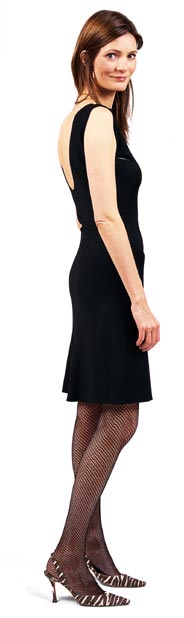
 Your new novel, “Bergdorf Blondes,” have created some disgraceful and unintentionally hilarious Q&A sessions which demonstrate that you are a Tina Brown in the making.
I have a new disease, which I’ve called glitteratitis. I want Bret Easton Ellis to use me as an object in his next novel, preferably as a footstool.
As a writer for Vogue, you have ideas, right?
I’m too beautiful to be concerned about the human condition.
You’ve used “blonde” as a verb and every time you open your mouth, people have been actually lost brain cells listening to you.
You’ve got to keep the English language fun. Have you ever known an English teacher aware of this season’s fashion designs? I haven’t. Perhaps if these teachers paid attention to the way they dressed, English classes wouldn’t be so square.
How can you justify writing a book about these kinds of women with all that is going on the world?
After 9/11, I finally had the excuse I needed to open up my secret stash of candy. And I thought to myself that Jonathan Franzen needed to write a history of candy rather than these long novels about human behavior. He made my head hurt. Who really wants to pay attention to that sort of thing? This age is about comfort and self-entitlement. If you look at this lady with the cigarette in her mouth, she’s simply not in fashion. And besides, we have cheerier photos at Vogue.
What did you study at Oxford?
I wrote my thesis on the frizzy hair movement of the 1970s, drawing particular attention to the Farrah Fawcett feathering movement. It was well received.
P.T. Barnum once said, “Never underestimate the stupidity of the American public.” Would you say that you could apply this to being born in London?
How brilliant. Can you pick up lunch?
© 2004 – 2005, DrMabuse. All rights reserved.
And the irrational hatred grows further and further…
Many attempt it, but no one can replace Tina Brown. Not even Tina can replace Tina.
Irrational hatred? I don’t hate my targets. I just mock them.
Thorough and incisive as usual, Ed. I had a few follow-up questions about her pubic hair, though. Guess I’ll have to wait for the movie.
So when does that Sarah Jessica Parker novel hit the streets?
Also, her elbow weirds me out. To be specific: It looks like there is a frowning pair of lips at the back of her elbow. Or maybe her elbow is grimacing, not content to be called literature of any kind? I’m not sure what kind of expression her elbow is attempting — maybe it’s simply trying to get out of frame — but it’s disconcerting.
If this comment is overly shallow, I comfort myself that I remain a rather deep pool in comparison to its subject.
Damn you, Carrie, now I’m going to dream of elbows tonight…
Ya know, if you grafted some T&A onto this Sykes fella, he’d make an attractive woman.
Perfideous Princesses, Cont’d
This interview in the NYT Magazine with “Bergdorf Blondes” author Plum Sykes made me gag, as I’m sure it did for any reasonable individual reading it: “These girls are quite serious about finding an A.T.M. An A.T.M. is a rich…
On Meaning and Stuff
We’re not much for the author as celebrity concept. Mostly because most authors we know are not well suited to public life. Our instinctive wariness of Bergdorf Blondes doesn’t come from the words on the page as much as the hoopla surrounding the aut…