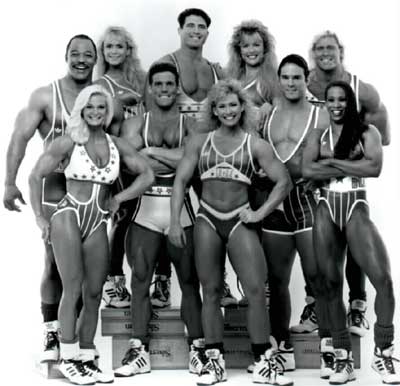
They are the new Davids.
Granted they are not singularly recognizable –- they are remarkably generic –- but the bodybuilders slash athletes on American Gladiators represent the ideal male appearance. At least I think so, having had my ideal male physique built on a foundation of images of professional wrestlers and action movie stars.
My sole reason for watching NBC’s new incarnation of American Gladiators was the Gladiators. All twelve of them, including the women, have boring if not humorous names: Titan, Wolf, Justice, Militia, Toa, Mayhem, Venom, Fury, Stealth, Crush, Siren, and of course, Helga. The majority have a cartoonish quality to their appearance: the people in the gym you think you saw last fighting super villains in a comic book, or the people in the gym you think you saw pulling needles out of each other’s asses.
My appreciation of the male Gladiators’ physiques isn’t some gay fetish. Young and old males, straight or not, watch wrestling and mixed-martial arts partly because of the look most fighters foster. The man who is the strong, dangerous type, is the man most admired; it creates envy and the desire to be him. The Gladiators and people like them are the reason some weekend warriors exist; they pump away, mostly foolishly, trying to grow mirror muscles.
But as much I am mesmerized by Gladiator muscle, I think that there must be a steroid buffet set beside the crafts table backstage. The side-effects of toxic livers, bitch tits, tiny testicles, maybe cancer, and some rage issues are all just minor hazards of the job. Not to worry, you look good. No, you look fucking great.
Thank goodness NBC allayed my fears that this crop of Gladiators was juicing. The network says they were tested for steroids. How rigorous the testing was — did NBC follow WADA’s International Standard for Testing? — isn’t known. But tested they were, so Titan’s “nearly godlike strength” is all clean, no needles required.
If I worry that the muscle I see on American Gladiators is the unnatural type, it’s because of the world depicted in last fall’s Steroid Nation, written by Shaun Assael, an investigative reporter for ESPN The Magazine. While Assael provides a distilled history of steroid and performance enhancing drug use — a good start for someone with a casual interest in the subject — he fails to provide the sociological examination promised on the inside jacket.
Assael is at his strongest when he profiles Dan Duchaine, a convicted drug dealer and co-author of the Underground Steroid Handbook. Duchaine’s appetite for experimentation included the use of the industrial chemical Dinitrophenol:
DNP, as it is known, was employed in the early 1900s to ignite explosives. But German researchers found that it led to drastic weight loss when swallowed because it caused the body to burn calories as heat instead of storing them as fat. By turning the internal thermostat way up, DNP, which is similar in structure to TNT, can increase one’s metabolism by as much as 50 percent. It is literally like playing with fire and users can incinerate their insides if they take too much. (155)
But when Assael moves away from reporting Duchaine’s life we realize that the author’s information has been reported elsewhere. Assael’s BALCO reporting, which makes up a large portion of the backend of the book, borrows heavily from several books, most notably Game of Shadows by Mark Fainaru-Wada and Lance Williams.
 Assael should have devoted more time to original reporting and answering the question of why he sees steroids as America’s True Drug Addiction. In the presence of only anecdotes about users and the absence of a definitive answer to this question, Steroid Nation atrophies into a 300-page summary of doping scandals in sports dating to the 1980s.
A point Assael makes clear is that if an athlete appears more than human, then it’s likely he or she does not suffer from belonephobia. The answer of why is obvious: the desire for perfection in performance and physique suffers no boundaries; experimentation with drugs is okay if it helps an athlete achieve an impossible feat when it had been attempted minus the manipulation of chemicals.
That doesn’t lead to a “Steroid Nation,” but it does ramp up steroid use. Perhaps Assael is saying that by not madly protesting the latest athlete exposed as a cheater that we become complicit in the Circle of ‘Roids. We ask for the most from our athletes, and if it means they have to cheat, we don’t care as long as we’re entertained. But when the Mitchell Report was released last December, people did care to know who was juicing. Sure, there was no widespread outrage, but I didn’t read about rallies in support of drug use either.
When I watch American Gladiators, I know what’s on the screen is hardly natural. The men wear mikinis, which no self-respecting guy would wear unless he was manipulated, chemically or financially. Are the Gladiators juiced up freaks? Freaks, yes. Juiced up? You know what NBC says. Do I care? Not really. Does this mean I am willfully blind and part of a “Steroid Nation?” Shaun Assael would say, well, he never really does say one way or another. My answer is no.
© 2008, Edward Champion. All rights reserved.
Far more disturbing to me is steroid use among police officers. Especially here in San Francisco, where the police culture fostered by cops who don’t live in The City is that the residents — especially the petty criminals, substance abusers and mentally ill — are savages, and cops refuse to walk beats even though they are armed to the teeth.
The potential for harm on the line of duty would make it easy to justify bulking up to take down perps, and I wonder how much of the (racially tinged) brutality they exhibit is the result of ‘roid rage.
Why do you have a picture of the old American Gladiators? I don’t think Gemini appreciates being dragged into this steroid fracas.
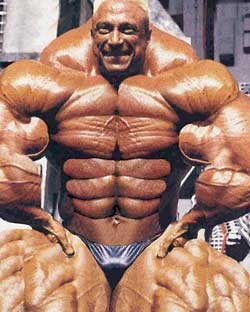
Please tell me that photo is fake…
BTW, Terry Gilliam made this hilarious sketch about bodybuilding back in 1969/1970:
a href=”Monty Python: Charles Atlas”>http://www.youtube.com/watch?v=0uXhmgqaf1U
(How’s that for early trendspotting?)
I am the older gentleman in the second picture in your post, and I’m writing here to protest its appearance. I have not granted you OR this site permission to post a picture of myself. Especially not in this context. My body is genuine, a result of enduring hard work that a keyboard-tapping pip-squeak like you cannot comprehend. Take it down immediately or face legal action.
Thank you
You got paid to work in the media, your picture will always be owned by the public now one way or another, that’s what you and every other celeb signed up for.
You don’t know that the writer of this article is a pip squeak old man.