The Bat Segundo Show: 2008 National Book Awards
Written by Edward ChampionPosted on November 24, 2008
Filed Under Bat Segundo, National Book Awards
Our reports from the National Book Awards previously appeared in piecemeal on these pages, and have also appeared on The Bat Segundo Show #252.
So far as we know, the National Book Awards has not authored anything aside from programs and informational pamphlets. The people that Our Young, Roving Correspondent talked with on that fateful night, however, have authored a few books. Or at least, this is what they have told us.
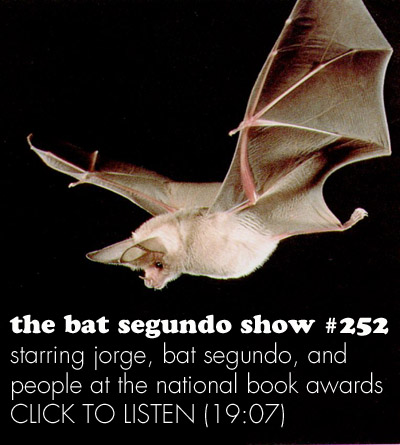
Condition of Mr. Segundo: Deeply suspicious of Harold Augenbraum.
Authors: Joan Wickersham, Annette Gordon-Reed, Salvatore Scibona, Mark Doty, Candace Bushnell, and Richard Howard.
Subjects Discussed: The difficulties of writing a memoir in straight chronological order, the paradox of suicide, having a handrail to guide you through the writing of a book, the Hemmings family, endnotes, the perils of plunging into research, working on a book for nine years, narrative arcs, attempts by finalists to describe a book in 100 words, planning a book for ten years, writing and throwing things away, typewriters and distractions, mixing up Cs and Ds, the difficulties of selecting poetry for a volume, wrestling with Walt Whitman, why Candace Bushnell reads what she reads, attempting to get an answer on how one exudes glamor at the National Book Awards, and how long it takes Richard Howard to write a poem.
EXCERPT FROM SHOW:
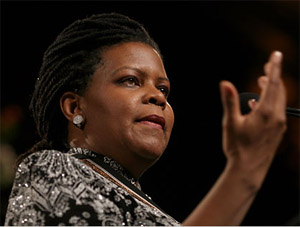
Correspondent: How are you wrestling with Whitman exactly?
Doty: Well, I want to think about the common ground that I share with Whitman. A real interest in the relationship between the individual — the single self — to the community. Whitman is always trying to figure out where the margins of himself are, and often he feels like he doesn’t have any. That’s been an obsession of mine too. He’s a person who was so interested in affirming the body, and the pleasures of sex and of physical life. And at the same time, he was a person who was absolutely obsessed with mortality and the end of physical life. So those are all things that matter to me. And I love the way that he really thought his poems could change the world.
Correspondent: And you’re here for the National Book Awards specifically in what capacity? To exude glamor or what?
Bushnell: To celebrate books. This is the business that I’m in. Publishing. I’ve written five novels. And this is about publishing. So it’s always a treat for writers to come out and see other writers.
BSS #252: 2008 National book Awards (Download MP3)
Comments
Leave a Reply

Beyond Heaving Bosoms by Sarah Wendell and Candy Tan. The famed writers behind
Alice Fantastic by Maggie Estep. This wild and highly enjoyable narrative involves two sisters (presumably, the third one was still being rented out by Chekhov), a hippie ex-junkie mother who lives with seventeen dogs, a murder, gambling, and libidinous Hollywood actresses who live in Woodstock. But this is the wonderful Maggie Estep we're talking here. And what seems at first like a quirky yarn becomes something unexpectedly moving about connectivity. What I love about Estep's work is the way that she'll juxtapose an extremely astute observation (now that you mention it, why do cab drivers always have somebody to talk with on the phone past midnight?) with an often outrageous story development.
Generosity by Richard Powers. It doesn't come out until September 29th, but Richard Powers's latest will have anyone committed to books reconsidering their literary fervor. I foresee some animosity from the vanilla critics hostile to idea-driven novels, but book bloggers, YouTube chroniclers, and MFAs would do well to plunge into this chance-taking narrative, which introduces vital questions about what the reader's relationship is with media, scientific dissection, and "creative nonfiction." Are we rats fleeing to happy cities? Or can we find the humanism within the purported plague?
Pieces for the Left Hand by J. Robert Lennon. Lennon is one of the most underrated fiction writers working today. Much as On the Night Plain proved that Lennon had a lot more in the toolbox than heartfelt (and often very funny) suburban satire, this slim but fascinating volume juxtaposes 100 small-town anecdotes -- arranged by category -- in a manner that reads, at times, like Nicholson Baker's passions for minutiae and, at other times, Stewart O'Nan's concern for psychological detail. The result is fiction that makes us wonder about whether one person's subjective view of particulars can entirely be trusted. This book never found a publisher in 2005. But thankfully, Graywolf has released it in the United States, along with Lennon's latest novel, The Castle.
Wonderful World by Javier Calvo. This wonderfully raucous volume has been completely ignored by the Washington Post, the New York Times, and the Los Angeles Times. But it's probably one of the most delightful reading experiences I've had this year. Calvo cavalierly mashes up multiple genres and manages to mix up familial subtext with larger-than-life, almost cartoonish characters. (Indeed, one might argue that one mobster's penis is a character of its own in this sprawling novel.). This is not an easy thing to pull off, but Calvo makes it work. And it's helped immeasurably by Mara Faye Lethem's idiom-specific translation. (
The Means of Reproduction, Michelle Goldberg This thoughtful book tackles the complicated (and little discussed) subject of reproductive rights from numerous angles, which includes a number of unpleasant but necessary ones. The upshot is that there isn't a quick fix solution for declining birth rates and fundamentalist abuses. Just about every political faction has contributed to the friction. But you'll want to read this book anyway to refamiliarize yourself with the topic, but also to understand just what's occurred during the past several decades to get us where we are today. (