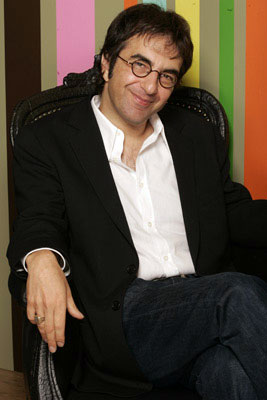
Atom Egoyan appeared on The Bat Segundo Show #283.
Atom Egoyan is most recently the writer and director of Adoration, which opens in limited release on May 8, 2009. He is also a very friendly and interesting Canadian who does not bite people, but who somehow frightens the MPAA.

Condition of Mr. Segundo: Pondering whether he is adored.
Guest: Atom Egoyan
Subjects Discussed: Scenes in airports, custom lines, airport security interrogations, passage within cinematic narrative, literal and figurative baggage, detonation devices, comparisons between Adoration‘s Simon and Ararat‘s Raffi, the video camera as a suitcase for memories, family confessions captured on video, making an experience substantial, technology in Egoyan’s films, closed-circuit vs. open-circuit technology, the lack of emotional filtering on the Internet, creating a chat room prototype hat doesn’t exist in reality, Nezar Hindawi, drawing from real-life incidents for ideas vs. cinematic invention, whether a narrative filmmaker needs to be responsible to history, finding the meaning in creches, the violin as a permanent artistic symbol, suggestions that we are now living in a cultural Roman Empire that is now crumbling, embracing an order to a material world, victims and mourning subcultures, the inheritance of tradition vs. new traditions, the excitement of interpretation vs. meaning to interpretation, teaching vs. primordial instinct, giving substance to the gaze of obsession, being driven to trauma, decorative masks and drama, concerns for class, role-playing and therapy, “democracy” and the Internet, shooting in natural locations vs. constructed sets, Chloe, and abstracting characters in a designed space.
EXCERPT FROM SHOW:
 Correspondent: I had a rather funny question. But it’s one concerning your films that I have been obsessed with for some time. And I was pleasantly surprised to see the motif crop up again in Adoration. And that is your propensity to have shots set in airports or custom lines. We have them in the beginning of Exotica. We have them in Ararat with Christopher Plummer.
Egoyan: Felicia’s Journey.
Correspondent: Well, yes, Felicia’s Journey. But I noticed that from Exotica onward, every one word film title of yours has an airport security scene or a custom lines scene. I’m wondering if this is Egoyan house style for a one word title. I’m wondering if it’s a scenario in which you have a particular preoccupation or a concern or an anxiety for airports. What of this?
Egoyan: Well, I think that, first of all, they are the borders where someone asks you, “What are you doing?” And how do you define yourself. And to me, it’s such a fundamental question. I love that idea of having to prove who you are. And I also think it probably has to do with the fact that, at a certain age in my formation, I went through a major airport. The family moved into a new country. And so we must have been grilled by some customs agent. I must have seen my parents break down in the process. I’m just assuming all this. Because it’s obviously is something that has left such a huge impression on me. I actually have gone through some pretty nasty interrogations too at airports. Where you try and answer a question with a joke. Which is never a good idea. And I’ve been whisked away and gone through more intense procedures. So I do think that there’s this moment where, if you take that question really seriously — when someone says, “So what are you doing? And why are you coming into this country?” — you can actually provoke a whole series of responses. Which may not necessarily be helpful or fruitful to getting you into the country, where a very simple response is required.
I can’t really explain it any more than that. It’s just that — and in this film certainly — it’s very stylized. And the whole environment of it is quite dreamlike. But it’s a huge part of the beginning of the film.
Correspondent: I should point out that the very beginning of Next of Kin features suitcases at the airport.
Egoyan: Absolutely.
Correspondent: I mean, is the airport for you what the bathroom was to Kubrick?
Egoyan: Uh, that’s a really interesting way of putting it. I would say that somehow, if I could combine a bathroom with an airport, that would probably be the best place I could situate any scene.
BSS #283: Atom Egoyan (Download MP3)
© 2009, Edward Champion. All rights reserved.
Listen: Play in new window | Download