Just in time for Election Day! David Rees appeared on The Bat Segundo Show #248. Rees is most recently the author of Get Your War On: The Definitive Account of the War on Terror: 2001-2008.
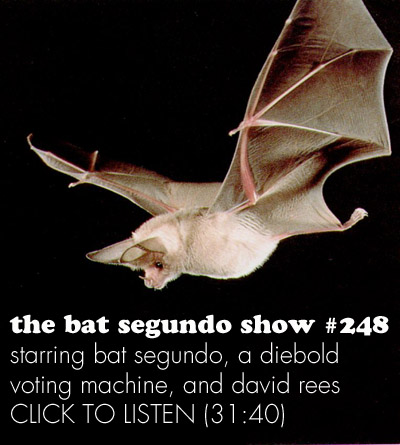
Condition of Mr. Segundo: Struggling to cast his vote.
Author: David Rees
Subjects Discussed: [List forthcoming]
EXCERPT FROM SHOW:
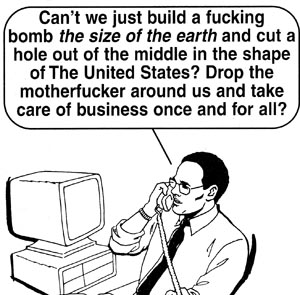 Correspondent: I wanted to also ask about the use of white space, and often the lack of white space, with some of the panels that have this extraordinarily long rant that one of the characters is conducting versus using the clip art and shifting it to the right hard edge of the panel or the left hard edge of the panel, or what not. What is your criteria in terms of white space and filling up the panel? Is it contingent upon the words you have to deliver for any particular strip?
Rees: You probably don’t know this, but the U.S. government allots all political cartoonists a given amount of white space in a year, and a lot of budgetary issues. If you don’t use your white space in a year, you don’t get it back the following year. There’s no rollover white space.
Correspondent: Yeah, yeah, it’s the appropriations and the earmarks I’ve heard.
Rees: So you have to really challenge yourself every year to use just enough white space, so that they’ll give you more white space next year. You have to submit this form. A white space form. Form JKL-202. And you submit this form. And they will give you more white space. And so as a political cartoonist — I mean, if you’re registered with the government, which I am, which all political cartoonists are supposed to be, if you find yourself at the end of the year that you haven’t used enough white space, then you go on a big rant. So there isn’t much white space around. You know what I mean?
Correspondent: Sure. Sure.
Rees: Because you don’t want to go over your limit immediately. Because you’ll be penalized.
Correspondent: But with all the “fucks” within the rant, that can be very problematic. I know you’ve gotten into trouble based off of that. Because of the specific requirements of this act.
Rees: Right. You’re referring to the Left Wing Political Cartoonists Profanity Allotment Act of 2003?
Correspondent: Yeah, yeah, I am. The number of “fucks” are quite frenetic. Exactly.
Rees: Well, I trade on the gray market. I trade — you know, cap and trade with carbon emissions? They set up the same thing for cartoonists, where you get a given amount of profanity. Fuck, goddam, asshole, shit, cocksucker, bitch, all that stuff. And then if you want to use more, you buy a set on the International Profanity Market. You buy a certain amount from other cartoonists.
Correspondent: They come in 200 units, I think.
Rees: Right. Well, it’s 200 syllables. You don’t actually buy the profanity by the word. You buy it by the syllable. So “motherfucker” is four syllables. You can use those four syllables to deploy one “motherfucker” or four “asses.” So I usually just buy them from cartoonists like Bil Keane, who does The Family Circus. He never uses his allotment. In a year, he never says “fuck” in The Family Circus more than ten times. So I will buy him out usually at the beginning of the year, so that I have enough to get me through a season.
BSS #248: David Rees (Download MP3)
© 2008, Edward Champion. All rights reserved.
Listen: Play in new window | Download
Two asses! (And, not that many days remaining to deploy those other four syllables he thought he’d used; hrm, wonder what he’ll do with ’em? Hokey-dokey; gots it: “Fuck it, fuck it!”)
—
http://www.booksinq.blogspot.com
I believe he meant four measures of “ass.”
So, ‘one “motherfucker” or four “ass”es.’ Perhaps.