The Bat Segundo Show: Faye Flam
Written by Edward ChampionPosted on July 29, 2008
Filed Under Bat Segundo
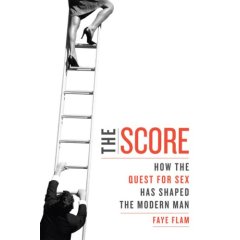
Faye Flam appeared on The Bat Segundo Show #223. Flam is most recently the author of The Score.
Condition of the Show: Attempting to contend with gender generalizations.
Author: Faye Flam
Subjects Discussed: Boot Seduction Camp as the prism with which to approach evolutionary science, the Mystery Method, crude philosophical rules vs. scientific rules, the SRY gene, masculinity’s backup gene, genetics and the delineation between gender, Jeffrey Eugenides’s Middlesex, bonobos and bisexuality, biological pair bonding, Alan Alda and testosterone poisoning, the decline of macho actors, oxytocin, Andrew Sullivan’s testosterone injections, certain oversights Ms. Flam made from John Tierney’s article on the correlation between shorter men and money, Alfred Kinsey and the human heterodoxy, Joan Roughgarden’s Evolution’s Rainbow, Dr. Peter Hurd’s studyon finger length and aggression, the differences between humans and sparrows, Rachmaninov’s hands, evolutionary science and other species, homosexuality and “sexually antagonistic selection,” risk-taking behavior and attractiveness, biological clocks, young men and very older women, and whether scientists or cultural pundits set the terms for human behavior.
EXCERPT FROM SHOW:
Correspondent: But not every man, Faye, is going to sit down and slap thousands of dollars wanting to get laid like this.
Flam: (laughs) No.
Correspondent: I mean, this isn’t the archetypal man. It’s almost as if this is an extraordinary, almost cartoonish construct on which you respond with science and examples with other species and the like. So I’m wondering why this was the one. Why you couldn’t just have some schlumpy guy in a bar who isn’t paying thousands of dollars?
Flam: I guess so. Well, these classes are pretty popular. There are a lot of guys who are into this. And The Game was a bestselling book. So it was a pretty big phenomenon. And it was a little extraordinary, which is what made it interesting. I wanted to start with something that was human and yet not totally mundane. And it caught my interest. It did sort of reflect this idea of the male sex working at just getting sex. Women will put a lot of effort into their hair and makeup, but not really to get sex. I mean, You can walk into a bar without makeup and still get some guy to go home with you.
Correspondent: Depends upon what types of bars you frequent.
Download BSS #223: Faye Flam (MP3)
Comments
One Response to “The Bat Segundo Show: Faye Flam”
Leave a Reply

Beyond Heaving Bosoms by Sarah Wendell and Candy Tan. The famed writers behind
Alice Fantastic by Maggie Estep. This wild and highly enjoyable narrative involves two sisters (presumably, the third one was still being rented out by Chekhov), a hippie ex-junkie mother who lives with seventeen dogs, a murder, gambling, and libidinous Hollywood actresses who live in Woodstock. But this is the wonderful Maggie Estep we're talking here. And what seems at first like a quirky yarn becomes something unexpectedly moving about connectivity. What I love about Estep's work is the way that she'll juxtapose an extremely astute observation (now that you mention it, why do cab drivers always have somebody to talk with on the phone past midnight?) with an often outrageous story development.
Generosity by Richard Powers. It doesn't come out until September 29th, but Richard Powers's latest will have anyone committed to books reconsidering their literary fervor. I foresee some animosity from the vanilla critics hostile to idea-driven novels, but book bloggers, YouTube chroniclers, and MFAs would do well to plunge into this chance-taking narrative, which introduces vital questions about what the reader's relationship is with media, scientific dissection, and "creative nonfiction." Are we rats fleeing to happy cities? Or can we find the humanism within the purported plague?
Pieces for the Left Hand by J. Robert Lennon. Lennon is one of the most underrated fiction writers working today. Much as On the Night Plain proved that Lennon had a lot more in the toolbox than heartfelt (and often very funny) suburban satire, this slim but fascinating volume juxtaposes 100 small-town anecdotes -- arranged by category -- in a manner that reads, at times, like Nicholson Baker's passions for minutiae and, at other times, Stewart O'Nan's concern for psychological detail. The result is fiction that makes us wonder about whether one person's subjective view of particulars can entirely be trusted. This book never found a publisher in 2005. But thankfully, Graywolf has released it in the United States, along with Lennon's latest novel, The Castle.
Wonderful World by Javier Calvo. This wonderfully raucous volume has been completely ignored by the Washington Post, the New York Times, and the Los Angeles Times. But it's probably one of the most delightful reading experiences I've had this year. Calvo cavalierly mashes up multiple genres and manages to mix up familial subtext with larger-than-life, almost cartoonish characters. (Indeed, one might argue that one mobster's penis is a character of its own in this sprawling novel.). This is not an easy thing to pull off, but Calvo makes it work. And it's helped immeasurably by Mara Faye Lethem's idiom-specific translation. (
The Means of Reproduction, Michelle Goldberg This thoughtful book tackles the complicated (and little discussed) subject of reproductive rights from numerous angles, which includes a number of unpleasant but necessary ones. The upshot is that there isn't a quick fix solution for declining birth rates and fundamentalist abuses. Just about every political faction has contributed to the friction. But you'll want to read this book anyway to refamiliarize yourself with the topic, but also to understand just what's occurred during the past several decades to get us where we are today. (
Ugh. Where’s my soap-on-a-rope? My fondue pot? My waterbed and my Hefner?