Senator Mike Gravel and Joe Lauria appeared on The Bat Segundo Show #224. Gravel and Lauria are the co-authors of A Political Odyssey. Gravel was a candidate for the 2008 U.S. presidential race. Lauria is an investigative journalist who writes for The Sunday Times.
Condition of the Show: Delving into the complexities of the military industrial complex.
Authors: Senator Mike Gravel and Joe Lauria.
Subjects Discussed: Whether Sen. Gravel and Joe Lauria share the same brain, The National Initiative for Democracy, Article VII of the Constitution, rules that prevent people from participating in the electoral process, the military industrial complex, the Civil War and the defense budget, Eisenhower’s transportation system, Harry Truman and Communists, Iran’s missile defense, living in a culture of fear and a culture of information, X-ray machines at airports, Gravel’s involvement in the celebrity culture of politics, “Rock,” involvement with Obama Girl, whether or not Senator Obama or any of the Democratic presidential candidates have been in touch with Gravel since the debates, whether or not Gravel is done with electoral politics, leaving out details of Gravel’s life between 1981-2006 in A Political Odyssey, political visibility, balancing substance and celebrity, the semiotics and audience reaction to “Rock,” the “unnecessary” nature of war, Woodrow Wilson, war as an endless continuum, whether or not Americans deserve the government that currently represents them, Colin Powell and false threats, Daniel Ellsberg, Dick Durbin, Frank Wuterich and Murtha’s defamation suit, the Speech or Debate Clause, morality and collateral damage, Scoop Jackson, Gravel standing up against the ABM, working with hawkish Senators, and political peer pressure.
EXCERPT FROM SHOW:
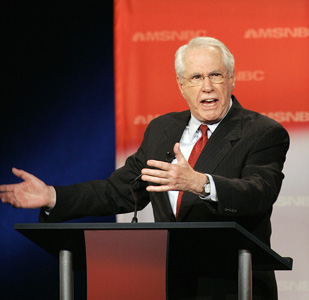 Correspondent: A question to both of you. The modifier that frequently ripples, so to speak, throughout this book in relation to war is “unnecessary.” You question Woodrow Wilson’s motives for getting us into World War I, writing that America was not threatened. Yet I must bring up the bombing of the Lusitania. And I must also point out that there was the Kingsland Explosion. The Zimmerman telegram. I mean, what is a necessary war? Was America really not at threat in World War I? Is this what you’re saying?
Gravel: Of course it was not.
Lauria: Well, I’ll just say briefly that the idea of the Zimmerman telegram was absolute nonsense. Why did Wilson send ships into the areas where they could be sunk?
Gravel: Right. And there was an argument that it had munitions. I mean, Woodrow Wilson didn’t have to go into the First World War at all. In fact, had he not gone in, there’s a chance that we never would have had the Second World War. Had we let them, that was their war, bleed themselves out. Well, you realize that after the First World War, the democracies of the world were in command of the world. And who screwed up the 20th century but the democracies? Clemenceau and the British and ourselves were the ones that set up the tobacco of the 20th century. Does it get any worse than that?
Correspondent: Okay, that clarifies…
Lauria: There wouldn’t have been Versailles. There wouldn’t have been a settlement to the war.
Gravel: There wouldn’t. Because…
Lauria: You would not have had Hitler.
Gravel: No, you wouldn’t have had Hitler. Because the Germans could not have refielded their armies that had left. The French could not have refielded their armies. So there would not have been Versailles. This was like the movie, The Last Man Standing. Well, the American troops! The British were not standing. The French were not standing. The Germans were not standing. So there we were. The Americans were standing. And we were the heroes. And old Woodrow Wilson was basking in this light. Woodrow Wilson was not the great President we made him out to be. Believe me, he was not.
Correspondent: I thank you for the clarification, but back to the other question. Is war necessary in any sense? Can you cite specific conflicts? Specific battles?
Gravel: I know of no war in history that did not beget more war.
Correspondent: But that kind of dodges the question very skillfully.
Gravel: No, that doesn’t dodge the question. I know of no war that has not begotten more war.
Correspondent: Is it necessary though?
Gravel: I don’t know if it’s necessary. I don’t know if it’s necessary. You attack me. I gotta kill you. Then your brother says, “Well, you killed me.” It’s the famous American cowboy story. You know, vengeance wreaks more vengeance. What kind of question is it? Maybe the question you ought to ask is to take the question from Jesus. Turn the other cheek and maybe you won’t get the other cheek lopped off.
Download BSS #224: Sen. Mike Gravel & Joe Lauria (MP3)
© 2008, Edward Champion. All rights reserved.
Listen: Play in new window | Download
What a self-righteous twit Senator Gravel is. Of course wars are tragic. Life is tragic, for the matter of that. But wars are sometimes necessary. The Civil War was necessary, among others. Liberating Europe from Hitler? Absolutely necessary.
Violence can occur in other contexts besides war. How about the Cultural Revolution in China? People lost their lives without a war. How about the Irish potato famine? No shooting there, but people died by the thousand.
Life is difficult for most people most of the time, and has been throughout history.
We in the United States have been so lucky that we are naive. We have freedom of speech, and the luxury of making stupid remarks, a luxury Senator Gravel takes advantage of every time he opens his mouth.