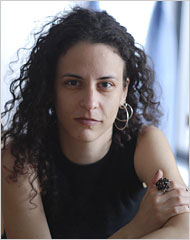
Fiona Maazel appeared on The Bat Segundo Show #212. Maazel is the author of Last, Last Chance.
[LISTENING NOTE! Please note that this show contains numerous grinding noises. We have endeavored to remove as many of these as possible, and reduce the noise where possible. Alas, SOME aural residue remains.]
Condition of the Show: Considering the niceties of superplagues.
Author: Fiona Maazel
Subjects Discussed: Being under observation, the relationship between kosher chickens and superplagues, rich WASPy girls, individual vs. societal ironies, keeping the protagonist’s name somewhat secret, Mary Shelley’s The Last Man, on not reading Camus for protective purposes, Panic in the Streets, the anxiety of influence, opting for a more realistic plague narrative, using humor to cantilever a dark narrative, devising multiple historical voices, pawing around in the dark, reincarnations, Groundhog Day as the essence of reincarnation, thongs and corporeal elliptical themes, the dangers of reading too fast, perceived titular homages to Nabokov, reviewers who are “certain” about books, auctorial intentions, moving around and setting a portion of the book in Texas, wanting to be T.S. Eliot, pursuing the grit, the pervasiveness of television, revolting against cultural media, Nordic tales, developing a conscious understanding of a deity, Stanley as a barometer, and agitprop.
EXCERPT FROM SHOW:
 Correspondent: If one looks at more lower brow choices, like Stephen King’s The Stand or The Andromeda Strain, or any number of superplague television series, like The Survivors and things like that, one tends to find a narrative that begins with the decimation of humanity. Yours is not that particular book. Again, going back to this question of inversions, I’m wondering if you made a particular choice. You had to have known about The Stand.
Maazel: Sure, it’s true. But I didn’t think it was an inversion. I thought it was credible actually. I did a lot of research about plague and also about the CDC and bioterrorism. And just how unlikely the scenario I proposed is. It’s extraordinarily likely. This isn’t an alternate reality kind of novel. It didn’t seem likely that someone would unleash a plague and actually wipe out all of humanity. That’s just not credible. I wanted to come up with a credible scenario. So I guess from the perspective of someone writing fiction or reading fiction, one might expect something like a terrific slate wiper to come along, as we’ve seen in so many of these movies and books. But I actually wanted something that seemed really realistic. That only 3,000 people would die and the fact that they put a stop to it. For instance, when we had this little anthrax outbreak or even bird flu, people are dying, but they’re still containing it. I was more interested in the anxiety, the terror, the foreboding of what could happen. Might this thing wipe out a hundred million Americans or a hundred million people? That was more interesting to me than watching this disease tramp across the country and actually kill off half the United States.
© 2008, Edward Champion. All rights reserved.
Listen: Play in new window | Download
[…] Fiona Maazel on Bat Segundo! […]