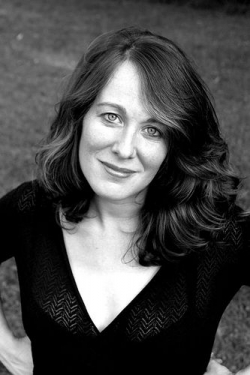
Laurel Snyder recently appeared on The Bat Segundo Show #313. Laurel Snyder is most recently the author of Any Which Wall.
Condition of Mr. Segundo: Concerned about walls and their failed sentience throughout the years.
Author: Laurel Snyder
Subjects Discussed: The extraordinary conditions in which Any Which Wall was written, the flexibility that comes from being a small fish, a writing identity tied to poetry and waitressing, the tendency for books to come quicker in the children’s market, financial experiments that involve finishing novels, YA authors and creating a backlist, Norton Juster, Edward Eager’s Half Magic series, being too tied to homage, the virtues of sitting your ass in a chair, sexism in YA vs. patriarchal walls, patriarchy and gods, italicized passages, whether or not discussions with editors can prove violent, the degree of defensiveness within writers, the etymology of “bleckish,” debating the vital issue of whether or not rats actually dance in New York subways, Robert Sullivan’s Rats, old ladies on unicycles, godlike narrators, Don Quixote, sending books out without an agent, being scared of the first person, how rewriting changes books, Roald Dahl, believing in voice, reader reaction, an author’s inevitable pattern of repetition, the dangers of ambition, the element of control, the quest for authenticity, on not being satisfied by books that have been written, the joys of having written vs. the joys of writing, impatience, the unexpected work-related spontaneity that comes from children, J. Robert Lennon, dictating and driving, finding moments of silence, and balancing life and the creative exigencies of anarchy.
EXCERPT FROM SHOW:
 Correspondent: Henry opines that all meals should be hand-holdable and that forks and spoons should be against the law. You, again as the narrator — and this is interesting. You as the narrator.
Snyder: I’m a little intrusive.
Correspondent: Yeah, you’re a little intrusive and you start to question what your characters are saying. And you object to this line of reasoning, writing, “How could you ever eat spaghetti without a fork? And how could you live without spaghetti?” I must object to your objection.
Snyder: You can live without spaghetti?
Correspondent: No. No, you can still eat spaghetti without a fork.
Snyder: Oh, that’s true.
Correspondent: You can always slurp up the noodles. Now that’s going to make a big deal of a mess and particularly….
Snyder: You don’t have a two-year-old, do you?
Correspondent: No, I don’t.
Snyder: I have a two-year-old, and have seen people eat spaghetti without a fork. And may I say, it’s not pleasant.
Correspondent: But Henry may very well just want to slurp his spaghetti. What’s so wrong about that? He’s going through a sort of slurping stage, as opposed to the more civilized fork and knife.
Snyder: I think that Henry’s mother would object. No, the intrusive narrator thing is an interesting thing. It’s coming out in the next book. The first two books both have this. [Up and Down the] Scratchy Mountains and Any Which Wall both have this intrusive narrator. And it’s a voice that I take from earlier books. And I really like those kinds of books myself. But I’ve begun to realize that there’s a degree to which, if you assert that much as a narrator, the characters never fully detach from me. And so with the next book, I’ve let that go. And in the book that I’m starting on right now — the book that I’m not going to have a deadline for, the book that I’m going to try and do differently — I’m actually going to first person. And it’s scary to me. But I’m letting go of not only of not only my intrusive narrator, but the third person altogether.
Correspondent: But I don’t know if I agree with the idea of a nagging narrator getting in the way of character. If anything, it actually causes certain…
Snyder: But it creates a kind of meta. It creates a kind of frame for the book. As long as the narrator is there. This is something I think about a lot actually. In a lot of children’s books, the kid is telling the story. Like it’s a first person story. But it’s not a diary. And this happens in adult books too. It’s the sort of opening of “This happened last October” kind of voice.
Correspondent: Yeah.
Snyder: It’s like, “Well, who the hell are you talking to?” Who is that person talking to? When the narrator is stepping forward and saying, “You the reader blah blah blah,” it creates a kind of stage, right?
Correspondent: Yeah.
Snyder: It creates a kind of stage for those characters to be performing on. And I think on some level — there’s a sort of theatrical. It’s a voiceover. And it’s like, you know how when you’re watching a movie and there’s a voiceover or like music starts in the background, and kids will joke, “Where’s that music coming from?”
Correspondent: Yeah.
Snyder: It’s that moment of “Where’s that voice coming from?” I actually have an idea for an adult novel that I’ll probably never write where the book begins with a third-person omniscient narrator. And then on page 150, that same voices says “you” or “me.” And you realize that it’s the voice of god. That third-person voice is essentially the voice of god. Letting that god then enter for the second half of the book to be a character. I can’t imagine writing that book, but I like the idea of that existing.
BSS #313: Laurel Snyder (Download MP3)
© 2009, Edward Champion. All rights reserved.
Listen: Play in new window | Download
laurel snyder is my hero. that’s all. and ed, too. laurel and ed. my heroes.