Nicholas Meyer appeared on The Bat Segundo Show #310.
Nicholas Meyer is perhaps best known for his work on Star Trek II: The Wrath of Khan. He is most recently the author of The View from the Bridge.
Condition of Mr. Segundo: Ah, listener my old friend, do you know the Klingon proverb that tells us revenge is a dish best served cold?
Author: Nicholas Meyer
Subjects Discussed: Lotus positions, talking back to prescience, writing books when the Writers Guild goes on strike, Samuel Johnson, the origins of The Seven Per-Cent Solution, words as a place of retreat, William S. Baring-Gould, generating “scholarly” commentary, Meyer’s dislike of Sherlock Holmes movies, Watson being portrayed as a buffoon, using the old Warner shield for Time After Time, the unusual opening shot of Time After Time and developing a directorial voice, Stanley Kubrick on the set of Spartacus, on-the-job training about cinematography, directing Ricardo Montalban, making specific choices, directors who don’t know what they want, the importance of understanding actors, finding distinct style with a preexisting Star Trek cast, William Shatner’s concerns on Star Trek II, the Coca-Cola product placement in Volunteers, responding to Ken Levine’s remarks on the scene that ruined Volunteers, Meyer’s problematic metrics with cinematic comedy, Black Orchid, whittling down the original draft of The View from the Bridge, being a script doctor on Fatal Attraction and determining Meyer’s precise involvement with the bathtub ending, calculating a film for an audience and the problems with doing so, how to write a good screenplay with Philip Roth’s source material, the differences between source material and other versions of the story, The Wizard of Oz, arguments about Dickens film adaptations, thoughts on Josh Olson’s “I Will Not Read Your Fucking Script,” The Avengers, and why Meyer’s frequent flyer miles are in the University of Iowa archive.
EXCERPT FROM SHOW:
Correspondent: You’re sitting in a rather strange lotus position.
Meyer: No.
Correspondent: Do you sit like this often?
Meyer: I’m not lotus actually.
Correspondent: Oh. Not lotus.
Meyer: You can’t see, but, underneath this table, my legs are stretched out in a very conventional position.
Correspondent: I’m sorry I wasn’t noticing your muscular legs.
Meyer: The anti-lotus.
Correspondent: How are you doing?
Meyer: I’m doing fine so far.
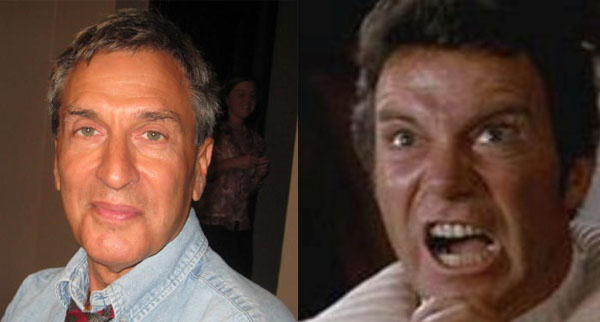
Correspondent: Okay. I had a question pertaining to recent events and also pertaining to your work and your tendency to have scripts mirror certain international events. I think, going back to Star Trek VI and Company Business, how real events tended to unfold in relation to those particular scripts. But simultaneously I might argue that you were prescient with one particular character in the Star Trek films. Most recently, as you’ve probably been reading the headlines or seeing various clips, a certain Congressman from South Carolina basically said something to the President. And I couldn’t help but think when that happened, Chekhov saying to Khan, “You lie!” Which I thought was quite prescient of you possibly. But simultaneously, in relation to Chekhov and Presidents, I should point out that Chekhov was able to correctly pronounce “nuclear,” whereas the previous President was not. So what do you attribute this linguistic prescience on your part?
Meyer: Well, talking back to prescience is like one of the weirder things that you can do. And I think the fact that Chekhov addressed Khan so disrespectfully in the well of the Botany Bay obviously qualifies him for a Federation reprimand.
Correspondent: Yeah.
Meyer: Does this address your question?
Correspondent: It sort of does. But it’s interesting that Chekhov could pronounce “nuclear” where George Bush could not. 43.
Meyer: The list of things that George Bush was unable to pronounce. In order to pronounce some of these things, I think you have to conceive of what they are first.
Correspondent: And Chekhov was able to conceive of what they were. I mean, it’s funny that Chekhov was the guy here. This could also have a lot to do with my own particular connections to your work and the larger canvas. But you did bring this up in your book and so I was tempted to infer many things in your scripts that possibly were intended or prescient or seer-like.
Meyer: Well, I think Chekhov’s remark clearly, as far as Congressman Wilson is concerned, is an accident. It was about thirty years before. And there are people who go around saying “You lie!” at the drop of a hat. Chekhov, I think, is more right than not when he accuses Khan.
Correspondent: Yeah. I also wanted to ask — just to go to a general question that isn’t so convoluted or so crazy. This particular book. Was this written during the writers strike at all?
Meyer: Yes.
Correspondent: It was.
Meyer: I write my books when the Writers Guild goes on strike. You’re not allowed to write screenplays. And I usually write it because I have to make money. And Dr. Johnson said a man is a blockhead who writes for any reason except money.
Correspondent: Yes. Well, that’s paraphrasing it a bit. But it’s close enough.
Meyer: Well, I got “blockhead” and…
Correspondent: You got “blockhead” and “money” definitely. Nobody but a fool wrote for money…
Meyer: For anything except for money, yes.
Correspondent: I think I’m mangling it now. Yeah, I’m familiar with that quote. You were a movie reviewer at the University of Iowa. You then wrote press kits for Paramount. And then you wrote The Love Story Story. And then you headed out west to become a screenwriter and what was, of course, this novel that came about. Quite a circuitous route in terms of approaching the inevitable. And so I’m curious why you postponed it for so long over the years. Was there a definitive answer? You say that you’re not an analytical person. But I’m sure you’ve had many years to think about this roundabout way of going to your present profession.
Meyer: Well, I always wanted to make movies from the time I was very young. I never thought much about the writing part of it. Which is interesting, because I’ve been writing since I was five years old. Writing was just something I always did. Words were the place to which I retreated. Sort of instinctively and intuitively all my life. I tried writing novels as a young man and I didn’t like my novels very much. And by the way, neither did anyone else. So I went to California eventually to seek my fortune and try and get into the movie business. And I was lucky. I started to make some progress. And then just as I was starting to have stuff produced, the Writers Guild did go on strike. This was back in 1972 or ’73, I think. And I was sharing digs with a young woman who said, “Well now, since you’re not allowed to write screenplays, you can write that book you are always talking about.” And that book was my fanciful notion of a Sherlock Holmes adventure, in which Holmes met and joined forces intellectually as well as narratively with Sigmund Freud. And there really wasn’t any good reason at that point not to try doing it. I don’t think I was expecting it to add up to much. But it was as much a way of passing the time when I wasn’t on the strike line as anything else.
And so, yes, it became a big success. It was the number one best-selling novel for a while in the United States. And then when it was optioned for the movies, I said, “Yes, I will sell you the option on condition that I write the script.” And the script with all its faults was lucky enough to be nominated for an Oscar. And so that sort of led me to the next level. And the next screenplay I wrote, I said, “Yes, I will sell you the script, but I must direct the movie.” And so I leapfrogged my way into my profession.
BSS #310: Nicholas Meyer (Download MP3)
© 2009, Edward Champion. All rights reserved.
Listen: Play in new window | Download
[…] led to this fruitful line of inquiry listening to cultural journalist and author Edward Champion interview screenwriter and director Nicholas Meyer, who was responsible for that film’s script. Wilson, […]
[…] On the Bat Segundo Show, Ed Champion interviewed Nicholas Meyer, man behind several Star Trek movies and, recently, author of The View from the […]