Patricia Cornwell appeared on The Bat Segundo Show #257.
Patricia Cornwell is most recently the author of Scarpetta. This interview serves as a companion piece to Sarah Weinman’s Los Angeles Times profile.
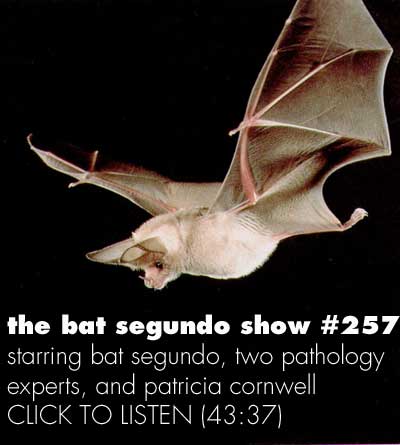
Condition of Mr. Segundo: Checked in for narcissistic personality disorder.
Author: Patricia Cornwell
Subjects Discussed: The genesis of Kay Scarpetta after three unpublished novels, Sara Ann Freed’s input into Cornwell’s early career, on being rejected by the Mysterious Press, Susanne Kirk, the unexpected success of Postmortem, how Charles Champlin’s Los Angeles Times review changed the publisher’s perception, writing a Scarpetta book before the last one was published, switching from first-person to third-person midway through the series, tinkering around in the movie business, being unable to write anymore in the first-person perspective, on later books lacking the warm element of character interaction, trying to get better through experimentation, listening to fans and readers, bringing back Benton Wesley from the dead, the differences between Cornwell and Scarpetta, writing sex scenes, privacy and reluctant fame, reporters who have the temerity to follow Cornwell into the bathroom, cops and submachine guns, Ab Fab, Judd Apatow’s films, Cornwell’s continued involvement with forensic science, taking out full-page ads to correct being misquoted by a journalist, pursuing the Jack the Ripper case, making various investments, surviving in the dour economy, and Cornwell’s political involvement.
EXCERPT FROM SHOW:
 Correspondent: What’s interesting too is that your career essentially started at the behest of very legendary people in the mystery world.
Cornwell: Right. That’s right.
Correspondent: And then Susanne Kirk found it at Scribner and picked it up from there.
Cornwell: And she was quite a champion for it. Because the publishing house, from my understanding back then, was very dubious about it. This was so different. Nobody wrote books like this back then really. First of all, you had a serial killer who was a stranger to the victims and a stranger to everybody. And the tradition of “mysteries” is that it was someone in your midst. And there were so many traditions that were shattered. Because real crime shatters those traditions. And I was writing about what I saw, and really taking a journalistic point of view. Although I was weaving it into fiction. And some of the rejection letters were “Nobody wants to read about morgues or laboratories.” And certainly not a woman who works in an environment like this and sees what she does. It seems silly now. But back then, that just wasn’t done.
Susanne though had the futuristic vision to think, “This is new and different. And this is pretty cool. And I want to publish this book.” But she had to have yet another opinion. She had to have another person read it. And they deliberated. And they just barely decided. In fact, the telephone call I got — the famous telephone call that changes your life — it was iffy. It was “We think we’re going to publish Postmortem, but we want to get one more person to read it.”
Correspondent: So it had to go to the editorial board in other words.
Cornwell: It was actually an outside consultant they had. Someone they considered an expert. A man, whose name I don’t remember. And they needed one more person to look at it to see if they really were going to do this. And that was my great turning point. My telephone call was a maybe. And then they did decide to take it on. But it was a very small printing. 6,000 copies. $6,000 is what I got paid. No advertising. No marketing. No nothing. And by the time people discovered it, it was out of print in hardcover.
BSS #257: Patricia Cornwell (Download MP3)
© 2008 – 2009, Edward Champion. All rights reserved.
Listen: Play in new window | Download