Allison Amend most recently appeared on The Bat Segundo Show #256.
Allison Amend is the author of Things That Pass for Love.
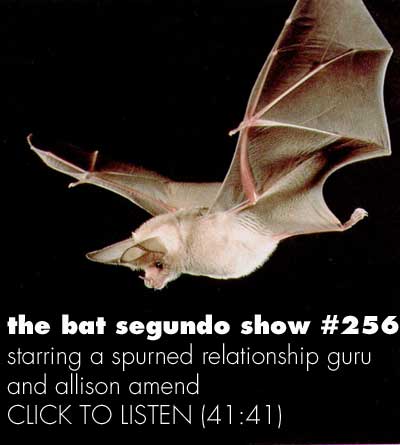
Condition of Mr. Segundo: Pondering the troubling things that pass for love.
Author: Allison Amend
Subjects Discussed: Dealings with the Atlantic Monthly, what constitutes a proper golf story, miniature golf, how Jewishness and faith relates to sustaining a narrative, speaking multiple languages, Pig Latin, the connotations of “molested,” small animals in short stories, whether an author should be concerned about manipulating the reader, grabbing the interviewer by the beard, discovering stories through subconscious intent, stories that “need more gerbil,” writing stories that run counter to an innate perspective, verisimilitude, magical realism, whether multifarious themes and motifs disguise the primary premise of a story, the narrative complexities of romantic intimacy, avoiding the “chick lit” label, Curtis Sittenfeld, the Glimmer Train essay, Amend’s two unpublished novels, dealing with potential editors who issue demands to include a love story, how much one should compromise for art, authenticity vs. marketability, frequent appearances of Zima within Amend’s stories, authors who include brand names in fiction, experimenting with lists and found documents, planning the endings of stories, selecting stories for the collection, and thematic unity.
EXCERPT FROM SHOW:
 Correspondent: Golf figures prominently into a number of these stories. In “How Much Greater the Miracle,” you write, “The soul and golf are interrelated. I try not to wax too philosophical, but the soul is like a golf ball.” Now is this particular statement one of the reasons you frequently return to golf in your writing? Do you feel that golf gets a bad rap? Is this your way of essentially taking it, or absconding it, from the upper-class country club associations? Are you trying to counter the John Updike/Richard Ford/Kevin Costner kind of approach to golf? I think this is a very important question!
Amend: Sure, sure. I think that your answer is much better than the one I’m going to give you.
Correspondent: No, I’m sure your answer is going to be fantastic.
Amend: Which is that back when I was in grad school, Michael Curtis, who edits the fiction for the Atlantic Monthly, requested some golf stories. He was editing the fiction section of Golf Digest.
Correspondent: Oh wow.
Amend: And he needed some golf stories. So I was like, “I can write a golf story.” And he said, “Oh, it’s very good. I don’t want it. But it’s a good story.” And I said, “Thank you. I’ll write another one.” So I wrote another golf story.
Correspondent: Aha!
Amend: He said, “I don’t want this either. But I like your writing.” So I wrote one more just to see. But actually I do really like golf as a literary theme. Because, first of all, it’s something for your characters to do without really having to have them do a lot of business. So everyone knows how you play. I mean, everyone sort of knows the theory of golf. You hit a ball towards a hole. And so your characters can talk a lot and can think about things without — it’s not like it’s basketball, where you have to describe the reaction all the time. So I really like golf that way. But also it’s this really absurd game. I played a lot when I was younger and don’t play so much now. But if you told me that you can’t see there’s a hole about the size of your palm and you can’t see it from here. But if you hit the ball three times, you will hit it in the hole. I would never have believed it.
Correspondent: Now you say that you had had golf experience before when you had been asked to do these stories. Or did you have to go into golf again and do a refresher course so to speak? Or a refresher run?
Amend: Well, I was at Iowa. We had a lot of free time.
Correspondent: Okay. They have golf in Iowa.
Amend: They do have golf in Iowa. And it’s actually pretty accessible. There’s a great municipal golf course. A nine hole golf course. And so I actually played a decent round of golf. But mostly I just asked my parents. They are very into golf. And so when I needed some golf details to make the story seem more authentic, I just asked them. I said, “What do you do if the ball’s on the side of a hill?” And my dad’s like, “Well, you hit down on it obviously.” I’m like, “Oh, of course.” And I’m taking notes as I’m talking to them. So that was my golf experience.
Correspondent: But this is an interesting notion of what a golf story is.
Amend: Right.
Correspondent: Because if one plays golf, it’s automatically a golf story? Or golf happens to be a motif? I mean, how golf-intensive does a golf story have to be?
Amend: You know, I don’t know. I don’t think that the golf story is going to be the next hot genre. Although there is the golf novel that does pretty well — apparently every year. But for me, it’s just a story where I have to ask my parents a lot of questions about golf to write it. So to me, that’s a golf story.
Correspondent: I’m just wondering if there’s any golf criteria for a golf story. I’ve never been asked to write a golf story. And I’ve never actually considered, until we just talked about this subject, about what a golf story entails. And so I’m wondering. Maybe it’s like a Christmas story.
Amend: It just has to be some Christmas.
Correspondent: Yeah, I don’t know.
Amend: Yeah, I think so. I’m not sure that I’m the best person to ask, since none of my stories were accepted for Golf Digest.
Correspondent: But they’re in here! There’s like three golf stories in here.
Amend: But they’re in there. In which case, golf is sort of a theme.
Correspondent: Yeah! So you are a golf story person.
Amend: Apparently, I’m a golf story person.
Correspondent: Among many other things. Well, okay.
Amend: Well, I could be. I’ve been called worse.
BSS #256: Allison Amend (Download MP3)
© 2008, Edward Champion. All rights reserved.
Listen: Play in new window | Download
Hi ,This is a plea from Bonny Scotland! I met Ron Stelten when he came over to Europe to test himself on the European Tour. I caeddid for him in a few events, and have since kept in touch. Ron wears his heart on his sleeve, and I gained a real insight into the burning desire he has to prove his talent at golf, when I caeddid for him.A true student of the game, it most certainly was not through a lack of effort, or ambition, that he did not quite reach his targets on the European Tour. In fact he led the Madiera Open that year going into the last round only to be a victim of severe winds that forced him down the field , but still a high finish. So the talent was there for all to see!Ron even then needed the financial backing to take the pressure off and allow him to play his best golf.So I ask all American golf fans to back Ron Stelten and send him over to the UK to continue his quest to reach his golfing goals! I will team up with him again and get Team Stelten back on the links once again!Thanks Patrick.