Rebecca Solnit appeared on The Bat Segundo Show #312. Solnit is most recently the author of A Paradise Built in Hell.

Condition of Mr. Segundo: Finding hostility within legitimate clarification.
Author: Rebecca Solnit
Subjects Discussed: William James’s second treatise on pragmatism, the alternative notion which means the same as a preexisting notion, General Funston’s martial response to the 1906 earthquake vs. Pauline Jacobson’s push for camaraderie, beliefs conditioned by response, the psychological reset position, assumptions about human nature, innate helpfulness, responses to the Blitz bombings, the minority option of panic, Enrico Quarantelli’s disaster research in the early 1950s, Caron Chess and Lee Clarke’s elite panic, Kropotkin, the question of community’s compatibility with institutional authority, the LAPD officer who was courteous to protesters, good cops vs. anarchy, how Argentina’s government affects the manner in which people come together, the 2001 Argentina economic meltdown, the failure of Starbucks workers to give ambulance workers free water on 9/11, Martin Luther King’s notion of beloved community, John Guilfoy, the joy of disaster, resorting to Hobbesian metaphors, Henry James writing to his brother in San Francisco in distress, the looting question in Katrina, Timothy Garton Ash’s response to 9/11, assumptions that journalists make in relation to disaster, quibbling with Naomi Klein’s The Shock Doctrine, acknowledging contemporary suffering, the Republic Windows strike, mutual aid, the slippery nature of the definition of “civil society,” taking control of the vernacular, work with TomDispatch.com, alternative media, a new language of emotion and not being connected, capitalism’s regulation of society, Dorothy Day’s notion of not being able to admit how people have failed us, becoming a writer, value-added theory and programemd human response, and the Donnell Harrington/Dan Baum controversy.
INTRODUCTION:
On April 13, 2008, Rebecca Solnit published an essay on TomDispatch.com called “Men Who Explain Things To Me,” in which she rightly complained about “the presumption that makes it hard, at times, for any woman in the field from speaking up and from being heard when they dare; that crushes young women into silence by indicating, the way harassment on the street does, that this is not their world.” In a September 2009 interview with The Believer, Solnit expanded on these thoughts, stating to Benjamin Cohen that she despised “the more face-to-face stuff when I get squelched, dismissed, insulted, and presumed ignorant by silly men in passing.”
I was aware of all this before I talked with Rebeca Solnit and I set out to respect this temperament. Solnit remains an interesting and an original thinker. And The Bat Segundo Show has always been about embracing people who are misinterpreted or misunderstood. permitting them to clarify their positions in a challenging and admittedly idiosyncratic manner. But my basic approach of civil disagreement, applied even to viewpoints I agree with for any doubting Thomas piped into the podcast, occasionally gets me into trouble.
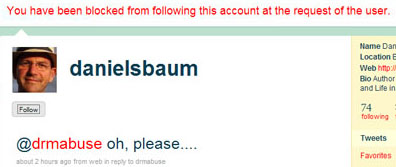 I was also aware of Solnit’s dispute with Dan Baum, in which Baum, reviewing Solnit’s book in the Washington Post, quibbled with the “evidence” that Solnit produced in relation to New Orleans shootings in the Algiers neighborhood just after Katrina. Indeed, in asking Dan Baum to clarify his thoughts, he proved obdurate in his viewpoint and proceeded to block me on Twitter.
Additional investigation, revealing the full extent of the Algiers evidence, is available at the Nation site and a link to A.C. Thompson’s article has been provided on the Bat Segundo website. But during our conversation, near the end, I hoped to get Solnit to clarify the nature of this evidence on the record and she proved just as uncooperative as Dan Baum.
I asked Solnit a perfectly reasonable question concerning why she could accept Donnell Herrington’s account on its own, without legitimizing his claim further with supportive evidence.
Here are a few reasons why evidence beyond oral testimony is so important.
In 1987, Tawana Brawley accused six white men of raping her. It was later revealed that Brawley created the appearance of a sexual assault. Brawley managed to dupe all manner of well-meaning people with her unfounded assertions.
In 1989, a man named Charles Stuart claimed that an African-American gunman with a raspy voice robbed him and killed his pregnant wife, Carol. He had injuries (or evidence, by Solnit’s definition). Subsequent testimony revealed that he had orchestrated the entire incident. There was no African-American gunman. Stuart had preyed on racist sentiments.
In 1994, Susan Smith claimed that an African-American had carjacked her with her sons in the car. As we all know, she was the one who had staged the entire incident after she had killed her own children.
I will leave the listener to judge whether my questioning predicated upon these considerations was right or wrong.
For what it’s worth, I do not believe that Solnit is entirely ignorant. Her books have demonstrated that she is an accomplished thinker. And despite some minor caveats, I can wholeheartedly recommend the book which forms the center of this conversation.
But it is wrong for Solnit to confuse clarification with dismissal of her viewpiont. It is also wrong for any person who purports or aspires to be an intellectual, whether Dan Baum or Rebecca Solnit, to insist that any view is above inquiry or examination.

EXCERPT FROM SHOW:
Correspondent: One of the parties involved in this particular dispute…
Solnit: (looks at her watch)
Correspondent: This will be my last question. Don’t worry. One of the parties in this particular dispute actually blocked me on Twitter. And that is your online skirmish with Dan Baum. He blocked me when I was trying to actually ask him about this. I am curious. I want to just clarify this thing because there was considerable controversy over your use of the word “evidence.” You said, “I had the evidence.”
Solnit: Well…
Correspondent: Basically, when you wrote, “There are plenty of rumors, but the evidence was there.” Then you said, “I had the evidence.” Now I think the confusion of this whole needless pedantic skirmish had to do with the fact that you were about to describe what…
Solnit: Hang on just a second.
[Solnit interrupts and answers a phone call. Not recorded to protect privacy.]
Correspondent: Alright. Just to be…
Solnit: You know, in the short thing, I say that people go to jail on sketchier evidence that has been produced in a lot of ways.
Correspondent: But what specifically was the evidence? Was it the AC Thompson findings at the time? The FBI investigation? I mean, at least according to what was in the book.
Solnit: Well, the FBI investigation hasn’t led to any conclusions.
Correspondent: Yeah.
Solnit: But evidence to send people to jail depends on specific individuals being tied to specific crimes, but we have a lot of witnesses to…attempted murders, to bodies with bullets in them, in the area, and a lot of witnesses to men boasting of killings, etcetera. You know, there’s a lot of pieces. And there’s too many pieces to not believe that something happened and to not be pretty clear that what happened was that these vigilantes, you know. And these heavily armed vigilantes threatened, shot at, injured, and most likely killed black men in the immediate aftermath of Hurricane Katrina.
Correspondent: So the testimony of Donnell Her….
Solnit: You know what? I’m not going to get into this. I’m not here to talk about a letter. I’m here to talk about the book.
Correspondent: Well, I’m trying to just clarify specifically what the “evidence” was. Was it Donnell Herrington’s testimony to you and AC Thompson when you were sitting at the table? Was it…
Solnit: It was a huge…it was a great many people who are not connected to each other coming forward with the same story. It was the medics and the common ground clinic telling me that they had many people confess to them in the immediate aftermath of Hurricane Katrina, that they had witnessed or participated in murders of this type. It was the videotape evidence of the Danish videographer’s videotape. It was Donnell Herrington’s testimony. It was, you know, other pieces of evidence about the vigilantes, including positive news stories about how they defended their neighborhood. It was Malik Rahim telling me and various other people, including Amy Goodman, at great length about what he had experienced in terms of threats and harassment and an expectation of a race war in his neighborhood, and bodies lying in the streets, including the body that he showed Amy Goodman and the Danish videographer on camera. It was the subsequent evidence that served us from the Pennsylvania detectives who went down who said that they found multiple bodies lying in the streets of Algiers with gunshot wounds and that they themselves heard many confessions and their videotape of yet another vigilante since deported, admitting, boasting of many killings. You know, there’s a huge amount of evidence. And the word “evidence” doesn’t mean that it’s conclusive.
Correspondent: Okay.
Solnit: But there’s an overwhelming amount of evidence that all points to exactly the same thing. And Donnell Herrington — you know, I trust him a lot more than I trust you, for example. And he’s — you know, his story checks out in every way. The doctors who treated him talk about other people coming with bullet, with gunshot wounds. And, you know, there’s a huge pattern that all points to the same thing.
Correspondent: But in relation to the people that Herrington saved on the boat, did you talk to those people who he saved? To have some independent confirmation of his story or anything along those lines? Or…
Solnit: (pause)
Correspondent: Did AC or anybody else? Just to verify his story against other accounts and the like?
Solnit: You know, many say — you know, that wasn’t part of the story that we needed to check out. And, you know, I didn’t verify a lot of other people’s stories that they rescued people, that they did this, that they did that either. Because, you know, this isn’t a legal trial. And Donnell’s story checked out in every way that it needed to check out.
Correspondent: So basically, for you, “evidence” means what they told you on the…
Solnit: You know…
Correspondent: I’m just trying to determine what you meant by “evidence.” Just to figure out. I mean, I happen to agree that videotapes, photographs, and statements are evidence. I’m just trying to determine if there were other additional third party ways of verifying the primary evidence. That way, you have a really all-encompassing — like a ballistics report of the shots that were fired as well. That’s what I’m….
Solnit: You mean, on Donnell’s.
Correspondent: Yeah, exactly.
Solnit: Well, the shotgun wounds, the medical.
Correspondent: Medical reports.
Solnit: The medical reports check out. The doctor checks out. Everything else Donnell said checked out. We spent a great deal of time with him. And then part of the complication is that the coroner perjured himself in the trial, you know, in the fight to get the medical records in court. A lot of those records are missing. The New Orleans Police Department is incredibly corrupt and incompetent. They chose not to investigate the case when Donnell basically came up and said, “Somebody tried to murder me and I want you to look into it.” They have yet to open a case. So the legal — until the FBI stepped up, the legal system had completely ignored this. So the kind of legal testimony that’s often demanded doesn’t exist because the legal system, you know, is not, has not, in New Orleans and Louisiana has not been interested.
Correspondent: But how can you be sure that everything that Herrington said to you is absolutely 100% true? I mean, memory, as we all know, is the worst liar of them all. Even if he had most of the details right, he may have general details….
Solnit: Well, what are you calling into question? That somebody shot him twice with a shotgun at point blank range?
Correspondent: Well, that’s pretty clear based off of what we see.
Solnit: Well, there were two other men with him who corroborated what he had to say. AC Thompson talked to both of them. There’s the doctor who saw him when he came in. And then you have to — you know, and this is how…. Absolute verifiable truth, you know, is a metaphysical question. Courtrooms get into it in some ways. But, you know, this is not a criminal trial. Everything checked out. Everything made sense. We spent a great deal of time with him. I don’t know why you’re calling him into question to begin with, but…
Correspondent: I’m a natural skeptic, that’s all.
Solnit: Why would somebody come up with — how else would somebody in those circumstances get shot? Uh, you know, it’s very clear he got shot twice with it. You know, this is totally fucked up and I can’t believe you’re doing this shit. I think it’s really obnoxious. It’s really off point and really kind of lame. And if you want, there’s a huge preponderance of evidence. It’s been checked out. It’s been checked out by CNN. It’s been checked out by The Nation Magazine. ProPublica, etcetera. You know, I’m not here. You didn’t ask me to bring a huge amount of documentation. I didn’t bring a huge amount of documen….
[Tape runs out]
BSS #312: Rebecca Solnit (Download MP3)
© 2009, Edward Champion. All rights reserved.
Listen: Play in new window | Download
Thanks for posting this. Even though it ended rather unfortunately, it could have been the beginning to another good conversation had the other party been willing to treat it as such! What parts you did get answered were great.
You know I really like her writing – I think she is a truly great writer. I just wish she wouldn’t be so surprised by this. You can’t write about something so shocking and then be surprised when people challenge it. She needs to stop being so defensive and just say what she knows (as she did here) and why she believes it and stop getting so angry.
She doesn’t do herself or the book any good by getting defensive – it always makes her look small and that’s a shame.