Noah Buschel’s The Missing Person (opening in New York today) is, as the title intimates, yet another entry from the Hey, I’ve Got a Clever Twist! school of filmmaking. Now several clever twists, nestled within a narrative at unpredictable points, are perfectly wonderful. Some American independent filmmakers, such as Darren Aronofsky and Shane Carruth (the latter regrettably absent from filmmaking since his low-budget breakthrough Primer), have fulfilled this grandiose requisite of complex storytelling, which shares some qualities with the “prodigious fiction” identified by literary critic Tom LeClair in 1996. But an embedded narrative, whether brainy or entertaining, is only as good as the character qualities and developments it pitches at unexpected arcs.
I’m quibbling with the very quality that prevents The Missing Person from fleshing out its seedy and goofy potential, which is more concerned with the singular twist: that one revealing moment on which all action hinges upon. We can probably blame the unitarian “clever” narrative impulse, a clunky can rattling around the halls of cinema for the last two decades or so, on such overrated offerings as The Usual Suspects and The Crying Game — both competently put together, but emotionally hollow and reliant upon strong acting once you know the Big Reveal.
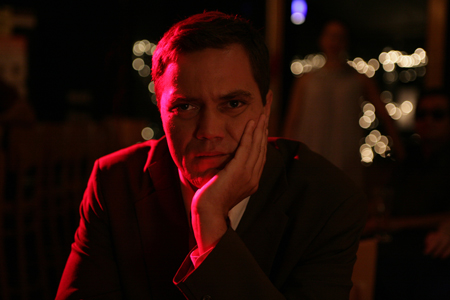
And like all Hey, I’ve Got a Clever Twist! films, The Missing Person is at its most interesting before we know the why. A former NYPD officer with the promisingly idiosyncratic name of John Rosow (played by Michael Shannon) lies in bed in a sparse rundown flat, complete with subway cars rattling noisily behind him and constructed of seemingly nothing more than blue concrete. We learn that he is an alcoholic, that his services now involve primitive forms of private investigation, and that he is not particularly adept at his job. Rosow’s work is ridiculously easy and ridiculous lucrative. $500 a day plus expenses. The missing man he must track on a train sits with his compartment door open. A middle-aged woman later throws herself at Rosow. A Los Angeles cop on a Segway hectors Rosow for smoking a cigarette. There is something of the Old World dying within Rosow. And the burned out quality is strangely augmented by Shannon’s mumbling and shuffling manner. Shannon even adds a tinge of Bogart to his inflections. (He isn’t the only actor mimicking a forgotten cultural figure. Frank Wood, playing the eponymous missing person, oscillates his deep voice so that it sounds eerily like Dick Cavett.)
We are therefore left to wonder why such an incompetent would not only get work — particularly during the present economic climate — but get handsomely paid for it. As one character says to Rosow, “You stick out like a broken nose.” This is an unusual character approach rarely seen in movies today, and Buschel manages to accentuate these incongruities with some understated humor. Rosow confuses the famous search engine with gogolplex. Rosow is more adept chopping up lemons and limes and pouring drinks rather than getting hard information. And while there are needless flashbacks to Rosow’s past interfering with his character qualities in the present, Rosow’s crude no-bullshit quality — seen when he defiantly fires up a cigarette in a cab and when he extracts a camera phone from a smarmy cell phone salesman — bears the funny conceit that even a relatively clueless man committed to single-minded pursuit can get results. This is, after all, an age more concerned with political correctness and passive aggressiveness.
But because The Missing Person is a Hey, I’ve Got a Clever Twist! film, the twist betrays these giddy possibilities. The talented Amy Ryan, who executive produced this film, is wasted as a throwaway Girl Friday. And her fate at film’s end is precisely what we expect. It doesn’t help that the Clever Twist, as is most frequently the case with such movies, isn’t very plausible. I won’t reveal what happens, but I must ask how the Missing Person can get away with his crime without any other government agency or insurance company locating him. He operates in plain sight. There’s a lot of money invested in his fate. Surely, someone would have found him before Rosow.
This major story flaw spoils what should have been a quirky little movie. I can commend Buschel for his blunt and slightly eccentric dialogue. “You’re putting me in a very idiosyncratic spot here,” says one character. A cabdriver states, “I’m not allowed to talk about directions. I’d get into big trouble.” There’s also a pair of FBI agents who offer Rosow an extra pair of sunglasses that they picked up from 7-11.
It’s evident that Buschel has a good knack for quirky moments that don’t feel particularly phony. And I regret that I haven’t seen his other two films. But after seeing The Missing Person, I suspect that Buschel has a movie in him that’s just as good as Wayne Kramer’s best films (The Cooler and Running Scared). He is clearly operating in the same mode. And since giddy filmmakers lifting from life (rather than Diablo Cody’s insipid cultural reference) seem to be in short supply these days, I certainly hope that, with future offerings, Bushel does away with his reliance on Clever Twists and trusts his crazy subconscious to offer us something more spontaneous and special.
© 2009, Edward Champion. All rights reserved.
This movie was not at all a “Hey, I’ve Got a Clever Twist! film” I don’t think this movie is trying to be clever. It struck me as sincere, jazzy, and not dependent on plot or twists. What is funny is to see a reviewer categorize a fairly original and uncategorizable movie and then proceed to review the movie under the false lable. Sure beats reviewing the actual movie itself, huh?! Hard to review something new and fresh, isn’t it?!
The “Hey, I’ve Got a Clever Twist” formula need not be explicit in its execution — and in this case, it’s not. Rather, it is the clever twist’s consequences that become explicit and porous upon thinking about them. Once we know the twist (Rosow’s past and the missing person’s past), and we start to use basic logic, then the story doesn’t hold up. So what might have been a strikingly original film (as I described above) turned into a derivative gumshoe narrative, complete with that cheesy sober close in Chicago.
It’s not original? You’ve seen music used like that? You’ve seen the pacing and lighting before? Oy.
Maybe your problem is you think the movie is all about plot and twists. It’s really not. The truth is, it’s not for you. That’s the truth. It’s for other people who aren’t so literal and don’t have such tight grips.
I personally think Shannon and Buschel are ones to watch.