“You are representing a media and you’re a reporter. The American nation is made up of 300 million people. There are different points of view over there.” — Iranian President Mahmoud Ahmadinejad
“You know, you need to talk to economists. I think I got a B in Econ 101. I got an A, however, in keeping taxes low and being fiscally responsible with the people’s money.” — President Bush
From a September 20, 2007 post-interview discussion with Danica McKellar:
McKellar: That should have been my first warning. When you first said, I’ll give you a softball question, like, there’s going to be a hardball? But what?
Me: You’re saying that you don’t answer hardball questions?
There is something very disturbing going on in American journalism right now. Perhaps this has always been the case to some extent, but it appears that one may only ask certain questions. An interview subject, in turn, is not responsible for talking about certain topics, even those in which she has a decided hand in. Never mind that these topics may contain important details about our ever-changing world. It doesn’t matter if the topic is politics, sports, entertainment, or social issues. This self-imposed censorship, understood by savvy marketing forces and no different from pre-glasnost Pravda house style, has pervaded the American consciousness with a fervor that is truly disheartening for anyone cares about one of America’s greatest precepts — the freedom of the press.
 The unspoken rules of celebrity junket interviews, which are designed to cover all flaws and prevent any and all character deficiencies from being made public, dictate that the celebrity is perfect and can do no wrong. Ask questions that are soft. Ask questions that wouldn’t harm a gnat. Constantly flatter the celebrity. This is the way things work. And if you don’t play by these rules, if you actually attempt anything approaching journalism, you are a scoundrel of the first order.
I do not subscribe to these rules. I believe in a press in which important questions can and should be asked of anyone. Because people and the books that they create should be taken seriously. Particularly when they are misunderstood.
It was a Thursday afternoon. I was walking along Canal Street and observed a truck towing an enormous bus, causing the traffic to spiral into a slipknot incompatible with two-way flow. A couple looked on at this and were laughing incessantly. And even I had to crack a grimace. Was it a harbinger of some sort?
I arrived in a cafe to interview Danica McKellar about her book, Math Doesn’t Suck: How to Survive Middle School Math Without Losing Your Mind or Breaking a Nail. It was my second interview of the day. My first interview had gone very well, extending unexpectedly into 75 minutes. McKellar’s book was a guide for girls, containing helpful hints on how to compute the Greatest Common Factor, transform percentages into decimal values, and the like. I am very much interested in gender roles and, in particular, the great gender gap in math and science. I also feel that any book which offers girls positive role models for entering into mathematics is worth investigating. Nevertheless, as the book’s subtitle indicates, there was something within the book’s pages which suggested that girls, even those who are pursuing math, should fall within a feminine stereotype.
“I’m here to tell you from personal experience that you can be a glamour girl and a smart young woman — who can certainly do math,” wrote McKellar.
Why the glamour girl/smart young woman dichotomy? Isn’t this perpetuating a stereotype?
There was McKellar’s bold claim on page 279 in which she made a comparison between getting a bikini wax and preparing for a math test:
But after a few more sessions and a lot more pain, I found that I could calm myself down. The mind’s power over the body is incredible. All I had to do was think about roses or rainbows or fluffy clouds, and it didn’t hurt as much! Sounds wacky, I know, but I’m telling you — it actually works!”
The mind’s power over the body is indeed incredible, and I couldn’t help but wonder about some poor girl with a body image issue reading this passage. Junior high school is hard enough for girls. Why perpetuate the pain further?
I mention all this, because this is the thinking I apply for every interview. My girlfriend has joked that I would have made a particularly pernicious litigator. But I choose to use my powers for good, if you can call “good” asking serious and off-kilter questions of various authors, intellectuals, and celebrities. I may be a tough interviewer, even with authors I dearly admire, but I have tried to offset this by being as kind and polite as possible. There is a very specific science to what I do, but I do not profess that it is perfect.
Nevertheless, it is my impression that when one writes a book, one should be able to stand by its principles. One should be sufficiently confident to respond to any points in a civil manner.
It was with these tenets in mind that I asked Ms. McKellar a series of serious questions:
McKellar: Playing with make-up, fashion, jewelry. These are pretty universal.
Me: No. But you’ve just admitted that they’re not universal. Because it’s not the…
McKellar: Oh no, I’m sorry. I shouldn’t have said universal. I should have meant, um….I should have said that they’re consistent throughout time. Women throughout the ages have loved these kind of things and they’re fun. And it’s part of. So I think that the girls have a much deeper interest in self-presentation than guys do. In general. And I’m making a total generality here. Um, girls are more interested in: Who am I and how I come off to the rest of the world? These are things. This is the way that girls seem to answer the question, “Who am I?,” at that age. And that’s when they answer that question. In middle school. Who am I? And how do I compare? That’s what all those teen magazines and quizzes are about, right? That’s why I have quizzes in my book.
Me: Yeah, yeah.
McKellar: Take this quiz and find out. All those quizzes in magazines, they all answer the question, “Who are you? Take this quiz and find out.” And it’s irresistible. I used to love that stuff. And most girls do.
Me: But maybe that’s actually perpetuating this idea of either trying to ask themselves who they are. See, instead of seeing the monkeys or the prime numbers, they see instead these kinds of horoscopes and these quizzes and the like, and then they say, “Oh, I fall within a particular taxonomy.” Is it not better to just take the really helpful suggestions that you give to girls and let those sort of stand alone? And let those actually be that thing that says, “Who am I? Well, you know what? I am a girl and I can do math. And therefore, there is nothing that can stop me.” It’s like the ultimate empowerment.
McKellar: That’s what I think I’m doing. I’m a girl and I can do math. And I can love lip gloss too and do math, and there’s no contradiction whatsoever.
Me: I’m curious, would you call yourself a feminist?
McKellar: Different people have different interpretations of that word. In terms of the interpretation that says, I believe in equality of men and women, of course, absolutely.
Me: What definitions would you quibble with?
McKellar: Well, there’s so-called Nazi feminists out there that give them that name. That try to say that, you know, women are better than men. And there’s just some of that out there. It’s the good old pendulum they’re trying to swing the other direction.
Me: Well…
McKellar: I really think that men and women are completely fabulous creatures in their own right and very different from each other.
Me: Who are these Nazi feminists? I mean, Rush Limbaugh, of course, coined the term “feminazi.” I’m curious as to who would fall into that particular camp.
McKellar: That’s not what we’re going to talk about.
Me: Well, I think it would be very important to talk about, given that you were saying this book actually empowers girls. Therefore, in a certain sense, it is calling for this equality of…
McKellar: I mean, you’re asking me to warn girls against listening to certain people?
And so on. I was not trying to pass judgment. I was only trying to understand. I mentioned that “Nazi” was a loaded word. Whether I was being too insistent on this topic is subject to your perception, but I have a feeling McKellar wasn’t asked about feminism before. McKellar, at any rate, clearly didn’t care for my line of questioning. Indeed, as she would later tell me, she had not experienced any interview like this. Whether this was a case of me somehow skating through red tape or a failure of the publicists to examine the interviews I do, I don’t know.
As I was preparing to shift the topic to something having nothing to do with Nazis or feminists, McKellar called for a break.
I did promise McKellar that I wouldn’t make a short segment that was accidentally recorded during this “break,” which did indeed live up to the word’s Middle English etymology, available in podcast form. Being a man of my word, I’ll honor that promise. But I’m not going to let this stop me from reporting on this story.
While McKellar took her break, I tried to explain to her that I was a journalist and that I was asking tough questions of her because I took her book seriously. I pointed out to McKellar that I had not asked her any questions about The Wonder Years and had no intention to, as I was a literary journalist.
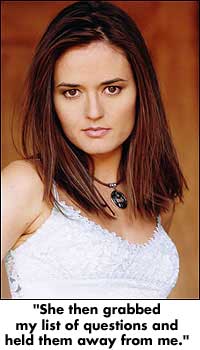
She then grabbed my list of questions and held them away from me. After studying these questions, she then began setting conditions. I couldn’t talk about the Stuff Magazine shoot, in which she had posed in a bikini. I told her that I didn’t understand. She then turned to the publicist and asked her what her perspective was.
She then noticed that my recording unit was recording, the increasing digits likewise surprising me, and then hit the STOP button.
She and the publicist then demanded that I play back the most recent audio. I refused. It was bad enough that my questions had been taken from me and that I suddenly had to clear what I could ask — something I have never done with anyone, even when I was conducting interviews in the late ’90’s with film people of considerably greater stature than McKellar.
The publicist said, “Well, our audience isn’t compatible with your audience.”
I told the publicist that I disagreed. She then asked me how I had found out about the book. Perhaps this was naive of me, but I was stunned that I would be treated like some disposable component in the marketing machine and I simply said that a book about gender roles and math interested me.
McKellar again expressed her discomfort. She didn’t like my attitude.
The publicist said, “Well, I was a bit uncomfortable too.”
Maybe so. But shouldn’t the publicists have done their homework? I’m not hiding what I do here. Any person can listen to any of the podcasts and listen to how I conduct interviews.
I didn’t see any point to continue the interview. McKellar and the publicist left. And I packed up my gear.
It would also appear that McKellar has a history of being rather touchy about the idea that her book might be reinforcing gender roles. McKellar and her publicist kept insisting that I was attacking her character. I was not. I was asking her questions about her book and trying to understand how her own views about gender roles were reflected in a book instructing girls to excel in math. A book is, after all, a vessel of information transmitted from author to reader. And if the vessel involves an author telling girls what to do, then it seems entirely reasonable to ask questions about what steps are taken in transmitting this message.
I don’t believe my questions were unreasonable. But I am a rather persistent person who often ventures into unusual territory.
But I return to the original question. What is the role of the reporter?
Maybe a reporter is, as Amborse Bierce once described him, “a writer who guesses his way to the truth and dispels it with a tempest of words.”
I don’t deny that I’m often guessing at the truth with these conversations. I don’t pretend to speak on behalf of anybody but myself. So I inure myself from President Ahmadinejad’s charge. I’ve never claimed to know everything, and I am often quite wrong in my thinking. But I’d like to think that in pressing so vigorously upon a particular topic that there remains some possibility of getting at the truth from a subject. The idea of even President Bush, whose economic policies are responsible for current events, evading any question that doesn’t have anything to do with economics, represents a completely unreasonable limitation. And if reporters are still permitted in our culture, why then should anyone set limits upon what they ask of their subjects?
Do we now Taser anyone who asks a dissenting question? Do we throw journalists in jail when they won’t give up work product? These examples, representing Andrew Meyer and Josh Wolf, respectively, may be more extraordinary exemplars of a growing antipathy against those who ask who questions. But these questions must be asked.
We haven’t learned anything from the regrettable night of June 22, 1812, when Alexander Contee Hanson, the owner and publisher of the Baltimore newspaper, the Federal Republican, was attacked by a faceless mob and beaten, along with many of Hanson’s followers, by anti-Federalists. The mob also destroyed the Federal Republican‘s offices.
There was a time not long ago in which the terms “media training” and “media clearance” were not part of media vernacular. One wonders how a reporter writing for a 19th century newspaper would negotiate today’s intricate waters. If you think my questions are tough, consider this exchange with a Concord New Statesman reporter (available courtesy of the recent opening of the New York Times archive) from June 1, 1852 between a reporter and a mother on trial of murder:
Said I, “Do you think you had for your child the ordinary feelings and natural love of a mother?” She looked at me full in the face, with eyes gushing with tears at the question. “Sir, I would gladly have laid down my life for it! I could have given it away while in the full consciousness of my condition, but I resolved to work myself into the grave before my child should have separated from me. Do you think, Sir, I would part with that which life would have been an intolerable burden?”
Here is a regional reporter asking a tough question, more insensitive than any query I posed to Ms. McKellar, and getting an answer that is quite emotional but considerably revealing.
The restrictions of the celebrity interview and the immediate assumption that some questions should not be asked represent threats to the ability of reporters to chronicle the issues of our time. I’m wondering if some future scholar, looking at our time a century and a half from now, will get the kind of insight that we can get about this 19th century mother. If journalists pull their punches and willfully subscribe to conditional reporting, how can they be expected to offer something for posterity? How can they be expected to record history?
© 2007, Edward Champion. All rights reserved.
I once heard about a journalist who was among the army of interviewers talking in 5-minute slots to Jack Nicholson about his latest movie. When this guy entered the hotel room, he responded to Nicholson’s question, ‘How did you like the movie?’ by saying that to be honest, he didn’t like it much.
A lively conversation ensued in which Nicholson tried to point out the merits of the film, and when the five minutes were up, the actor ignored his PR guy’s interruptions and kept talking.
I guess the moral of this story is: you win some, you lose some, but it’s always worth trying.
Maybe one day the good old pendulum will swing in the other direction.
“Perhaps this has always been the case to some extent, but it appears that one may only ask certain questions. An interview subject, in turn, is not responsible for talking about certain topics, even those in which she has a decided hand in.”
Unfortunately, this has always been the case. Celebrity itself is an industry, each star is a commodity, and image is what sells. But, come on. Surely, you walked in there knowing that there was nothing serious about the book, so why bother acting like you were there for serious journalism? No one really cares what celebs have to say.
(Now I have to Google “Danica McKeller” because I have no idea who she is.)
>>No one really cares what celebs have to say.
(html characters ate my previous post, trying again)
::No one really cares what celebs have to say::
Kids do. I have a daughter who likes math, Legos, nail polish, and Polly Pocket. And in spite of growing up underneath my reign of cynicism, she admires female television characters. So even though I personally don’t care how deep Danica McKellar’s wading pool is, as her parent I have to be interested in that sort of thing for brief periods of time — particularly when there’s academic and/or role model throwdown.
“I mean, you’re asking me to warn girls against listening to certain people?”
Just curious… What did you say after she said this?
You used the word “taxonomy” on Winnie Cooper.
“Here is a regional reporter asking a tough question, more insensitive than any query I posed to Ms. McKellar…”
Though isn’t that a shaky analogue? You’d have to unearth some hardball 19th century interview questions tossed at, say, Sarah Bernhardt, or the very famous *Joseph Pujol*, to establish a reasonable comparison…
I’m guessing you aren’t the first person to question McKellar about the inconsistency in her message. Maybe the feminist question hit her too hard. It’s fine to be smart and girly, but it’s offensive and condescending to assume that’s the way all girls are. She seems to think that she broke the mold, but when she stereotypes all teenaged girls, she shows that not only is she not unique, she’s just as bad as everyone who thinks girls only care about the way they look. Now that I think about it, the title of her book very specifically defines her audience. Any girl who doesn’t equate survival with the status of her manicure could easily pass up this book.
1,000,000 words on a child television actor cutting you off after you imply her teen girl book is dumb. Did you want her to handle it like hannity & colmes? Get a life, Ed. It isn’t a real book, it’s a teen product.
Danica, I grew up with you Thank you for the journey. Shame you don’t act anymore you could have been a greatBIG movie star
I think Danicas book is great. There is nothing wrong with girls acting like girls and Mckellar is absolutely correct that most girls like make up and such things. Call it stereotyping if you want but I think anything that encourages normal girls to paticipate in education and that they don’t have to act stupid to be attractive and popular is great. Both of you behaved rudely to each other and took yourselves way too seriously, too bad.
“I was not trying to pass judgment. I was only trying to understand.”
No, you were not. I’ve listened to the whole podcast, and it’s obvious you were arguing for the sake of arguing, and really passing judgement. Your tone of voice is sarchastic, and as soon as McKellar says something, you reply with a ‘But why is that?’-type of question. Nothing she says is good enough as an answer to you, and no matter how many times or ways she tries to clarify her position, you go after that clarification.
There is something to be said for letting your subjects breathe. Honestly, going after someone like this is not asking “tough questions,” it’s just exhausting the person you’re interviewing. I completely understand why McKellar had to take a break.
So what that her book is aimed at “girly-girls;” is it your view that they don’t exist, or that it’s wrong for someone to focus a book on just this market? Why would this be any more wrong than the hundreds of technical books written for “boyish-boys”?
Overall, McKellar replied to your questions in a positive and composed manner, but you yourself came off like a self-important teenager with a microphone.
Lottaknow: It is clear that you are unfamiliar with the concept of journalism.
Not at all. But there are different types of interviews that suit different subjects. Danica McKellar’s book is aimed at tween/ teen girls, and is supposed to be about making math easy and fun for this group. That’s a positive goal, and though it’s important, doesn’t call for hard-hitting, take-no-prisoners questions.
In your interview, you treated McKellar as if her book had some kind of darker agenda: your way of asking questions was hostile. Whenever she answered your questions, you kept pushing, eventually steering you both into irrellevant waters (feminazis?). That doesn’t translate as “taking the book seriously.”
So I’ll ask you again: are you actually against McKellar’s book? Do you object to the fact that it’s aimed at only one group? Why the hostile, all-out attack?
Lottaknow: Nope. It’s clear to me that you don’t understand journalism. I was not interested in performing cunnilingus on Ms. McKellar. Nor is any decent journalist. Again, I suggest you revisit journalism history of the past fifty years. You may want to check out Jimmy Breslin for starters. It is not my fault that Ms. McKellar lacks the ability to think. But it is my fault for actually believing this unpleasant person to be worthy of my program.
It’s bad this didn’t work out well. However I would like to see more interviews with authors of popular science/math literature; simply because I think you could explore the subject better than anyone, considering you interview to find out more about the book and critically analise it, flaws included, rather than just promote it.
Rajasthan is visited very frequently by the global tourists.
Once you have the shortlist, check the reviews of these agencies online.
Obviously, there are many factors contributing
to your answer.
cunninglin-?what?-now Im starting to think your critics were spot on…I seriously think you are threatened by beautiful women who are intelligent. She had a specific audience with that book and there are not a ton of women with her credentials(cocreator of the Chayes–McKellar–Winn theorem with a bachelor of mathematics) reaching out to that demographic.I’ve never heard your podcasts but a man’s work is his calling card and based on this article you reaped what you sowed (not quite what you were looking for).Nobody needs a degree in journalism to actually see what you experienced with Ms. McKellar: getting schooled.
I actually have a degree in journalism and even I don’t agree with OP. The interviewee happens to be an expert in mathematics and it is lame to expect politically correct response from her on gender stereotypes. I’m wondering why didn’t you ask her anything related to algebra. Clearly, you didn’t study that part as seriously as the bikini wax one.