An Elegy for Listening

Washington Post: “Even at this accelerated pace, though, the fiddler’s movements remain fluid and graceful; he seems so apart from his audience — unseen, unheard, otherworldly — that you find yourself thinking that he’s not really there. A ghost. Only then do you see it: He is the one who is real. They are the ghosts.”

RELATED: Grimes Poznikov: “In 1987, after being ticketed by the police for playing his trumpet 13 decibels above the legal sound limit, Mr. Poznikov quit his act, moved out of his rented apartment and began sleeping in the streets. He stayed with friends from time to time — particularly his off-and-on girlfriend, Susan ‘Harmony’ Tanner — but the freedom of the outdoors always pulled him back to the sidewalk, he told a reporter last December.”

Sleep-Deprived Roundup

Indolent Roundup

BSS #108: Ken Alder

segundo108.jpg

Condition of Mr. Segundo: Puzzled by polygraphs.

Author: Ken Alder

Subjects Discussed: The connection between polygraphs and Northwestern University, the United States’ fascination with lie detectors and cultural connections, why allied nations use junk science, polygraph tests and employment, the lie detector as coercive device, the CIA, Aldrich Ames, John Larson and William Keeler, Leonarde Keeler, the lie detector vs. due process, waterboarding, August Vollmer, paranoid personal lives of the polygraph progenitors, the subjugation of women, criminal technology and the white male, the polygraph showdown between Ken Alder and Fred Hunter, reliable confessions, American loyalty, detective fiction and tabloid journalism’s role in promulgating the lie detector, polygraphs and movie studios, advertising, Erle Stanley Gardner, asking Doug Moe’s question to Alder, the placebo effect and crime statistics, Alberto Gonzales and contemporary coercion, and the dream of psychological certainty.

EXCERPT FROM SHOW:

Alder: You know, it’s such a bizarre claim. There are different kinds of historians of science, and some historians of science go after the people who have the really big ideas and figure out these great novel ideas like Darwin and Einstein transform the world. And I do the opposite almost. I’m interested in history of the banal — those things that are so ubiquitous, as almost to be invisible. We don’t even notice them anymore. And lie detectors in this country are just part of the landscape and yet we’re the only country in the world that uses them.

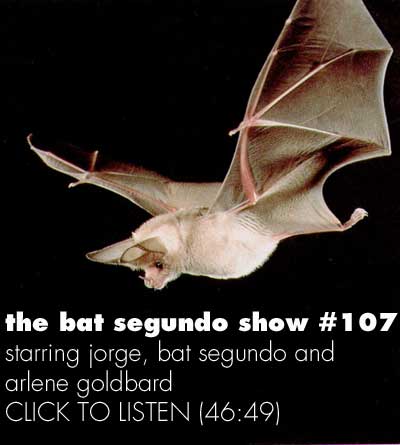
BSS #107: Arlene Goldbard

segundo107.jpg

Condition of Mr. Segundo: Feeling that the community misunderstands him.

Author: Arlene Goldbard

Subjects Discussed: Artistic individuality vs. creative community, the benefits of 20th century funding for the arts, the WPA, community murals, public plays, happenings, the political agenda of “creative community,” collective absolutism, the Forum Theatre and “spectactors,” collaborations between professional and amateur artists, the Great Wall of Los Angeles, the dangers of constant artistic modifications, impoverished people and art, art and fame, reality TV, Stalinism, the Ukiah Players Theatre, and government artistic subsidization.

EXCERPT FROM SHOW:

Goldbard: Marx had this favorite saying: Stadtlyft mach frei. City air makes you free. Which the sense being, in a place of anonymity, you are free to completely express your individual essence and characteristics in a way that you may not be. You may be constrained in the small town you came from. Because people know your name and your face. And you can fool them once, but your probably can’t fool them twice. So there’s a truth that a certain degree of anonymity creates a certain degree of social freedom. And people want that to some extent. You don’t want to be surrounded by gossip. You don’t want people looking over your shoulder all the time. But the kind of community that I aspire to is one in which there’s tremendous permission to be different.