Review: Fighting (2009)

“Bob Semen is a freak but New York needs freaks. At his best he was hope for the hopeless and at his worst, no more than a lesson. An adventure to be lived and learned.” — Dino Montiel, A Guide to Recognizing Your Saints

New York does indeed need its freaks. But few artists wish to broach the terrible truth that the richer and cleaner New York under Bloomberg doesn’t particularly desire them. Those seedy characters lovingly portrayed in Richard Price’s books and Abel Ferrara’s films now occupy the realm of endearing fantasy rather than representative reality. Ferrara himself notably attempted to reclaim his lost New York in 2007’s Go Go Tales (largely shot in Rome’s Cinecitta Studios and sadly unseen here in the States beyond film festivals) and the same can be said of Price’s last novel Lush Life, which, as Salon’s Richard B. Woodward and others have observed, doesn’t quite possess the authenticity of today. That’s a stunner, considering how dead-on Price’s previous achievements were. But the bums lost and were pushed rather rudely into the patchy remnants of the underground, causing our best artistic practitioners to drift into the past. Still, maybe the current economic downturn will fire up a few slackers to take any rug they want from the house.

Because of all this, it’s no surprise that the New York depicted in Dito Montiel’s second feature, Fighting, bears little resemblance to current New York. In Montiel’s universe, a hustler can get away with selling an all-too-obvious Harry Potter ripoff just blocks away from the publishing industry hubs in Midtown, African-Americans shout loudly about Billy Joel tickets, landlords post overdue notices on doors to embarrass tenants (rather than sliding them under doors), and gamblers fail to do the most rudimentary background checks on bagmen delivering half a million dollars. Montiel’s Manhattan is as true as the blown-up photo of an aerial view sitting behind one man’s desk, accessible through a door containing an equally cartoonish illustration of money. All this is something of a surprise given Montiel’s heightened attention to detail in his last film, A Guide to Recognizing Your Saints. (Yes, modern subway trains did often roll by in 1986, among many other notable gaffes. But this low-budget film felt right for the most part; especially with one powerful moment between Shia LeBeouf and Chazz Palminteri, just after LeBeouf observes a death, in which the father-son power dynamic seesaws twenty times in a New York minute.)

The inflexible authenticity booster — that Walter Benn Michaels sort of blowhard — would see all this as a bad thing. (If you missed Michaels’s small splash in the pool tended to by the gated community, Michaels stated, in all seriousness, that American Psycho — a novel, incidentally, turning eighteen this year — recalled Edith Wharton’s novels of manners and that Ellis had written a truer novel than Philip Roth, Toni Morrison, and Michael Chabon. This is the kind of wild and tenuously supported claim that apparently has you spearheading a New York Public Library discussion. You can observe the glum video results here, where the rigid Michaels comes across as some Richard Dawson-like figure of the literary world, a man very much in love with his own voice waiting for nearly everyone around him to supplicate to his ostensible intellect. I was surprised he didn’t get up from his chair, kiss Susan Straight on the lips, and entreat the audience to “play the Feud.” After spending ten minutes reading his essay aloud like some hoary and entitled hybrid of Ben Gazzara and Lee Siegel, Michaels doesn’t seem to consider that American Psycho might, in fact, be a satire or a pastiche. That the brand names and the consumerism juxtaposed against savage violence has less to do with dutifully reporting on manners and more to do with sending up entitlement. Michaels seems unable to come to complete terms with Susan Straight’s concern for location over character, which she admits to him and which defies his generalization of what authors seem concerned with, or, for that matter, David Simon’s affinity for seemingly unreal books like Schindler’s List. To give you a sense of Michaels’s subtlety, the man not only rolls his eyes, but remarks on rolling his eyes. And if he happened to be in the hood, I suspect that this hotheaded attitude would get the man beat with a baseball bat — a la Montiel. Michaels is also shockingly out-of-touch with such writers as Stewart O’Nan, Richard Russo, and William T. Vollmann, all of whom have devoted much of their fiction to working-class and/or alternative perspectives. And yet Michaels’s flummery has been lionized. Because it’s the New York thing to do. Too bad a few freaks weren’t invited to sit at the table. But, hey, this is New York.)

The more intriguing question is whether there’s any value in the inauthentic. Should we dispose of a film like Fighting that is unapologetically artificial? Well, only a humorless cloghopper like Michaels would. For what it’s worth, I found myself pleasantly surprised to have enjoyed Montiel’s movie as much as I did, precisely because it seems to concern itself with deliberate fabrication as a response to a very real predicament of a city gone horribly gentrified. The movie feels like some bizarre homage to the action movies produced by Cannon Films in the 1980s. It’s almost as if the film is suggesting that even the kind of ridiculous bravado you got with Chuck Norris in Invasion U.S.A. would better serve New York than the neutered passive masculinity too easily settled upon today. The cinematography, much like those choppy action flicks shot in the pre-500 Tungsten days, avoids volatile high-contrast situations. It seems photographed directly for VHS. (The movie does end up employing a few helicopter shots for the climactic showdown.) But that’s part of the fun. Because Montiel’s metropolis is rendered as if some 1985 incarnation of New York merged with one prominently featuring billboards of the Legally Blonde musical. And the aesthetic resemblance here is so striking that I found myself extremely startled by the first appearance of a cell phone.

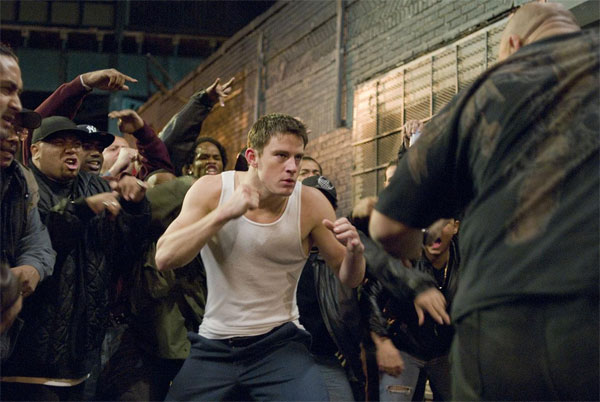
The fights in this movie, rather remarkably, don’t involve blood. These bouts are of the crunchy, bone-breaking, and drinking fountain-collision variety. The safe, crowd-pleasing type you’d expect from a Cannon movie. You could easily replace Michael Rivera with Billy Drago. My Cannon parallel theory may hold up when we consider that, just after every fight Channing Tatum is involved in, one of the gang members points his finger at the supine defeated opponent and laughs. And I haven’t even mentioned the cheesy subplot with Brian White’s Evan Haley. The rich New Yorker/poor small town implant vendetta between Evan and Channing Tatum’s Shawn MacArthur goes all the way back to high school.

Channing Tatum, incidentally, makes an iffy pugilist, both in look and in execution, but he does serve as a weird amalgam of Patrick Swayze’s Dalton, a young Patrick Dempsey, and Mark Wahlberg talking to animals. His character doesn’t smoke and he doesn’t quit have the guts to say, “I’m telling you straight It’s my way or the highway.” He desperately pursues Zulay Henao and insists on clarifying that a forced 20-minute breakfast in which he claims not to be hungry is a date. (I found myself inexplicably recalling the rather ridiculous way Richard Gere shovels eggs into his mouth in An Officer and a Gentleman during this awkward meet-cute moment. Perhaps the fights in this movie are meant to be as pleasantly incongruous as the smackdown between Gere and Louis Gossett, Jr. that comes out of nowhere near film’s end. My moviegoing companion seemed convinced that Montiel was channeling They Live‘s Nada. Now, in hindsight, I am skeptical of both claims. But this does demonstrate the free association risks that come with a particular aesthetic.) Montiel has better success with Shawn MacArthur when Zulay Henao’s daughter’s abuelita tells him to get the hell out of their apartment and refuses to understand his belabored gratitude in Spanish. Here is a MacArthur who doesn’t quite have the guts to say, “I shall return.” But he’s content to fight anyone he needs to for tens of thousands of dollars.

But the reason this movie worked for me as a guilty pleasure involves how something wholly inauthentic may very well have emerged from Montiel’s reality. In Montiel’s case, it starts with Bob Semen, cited in the quote that began this essay and one of the many gritty hues brightening the streets in Montiel’s memoir. Bob’s described in the book as running an “unbelievable illegitimate, straight-out false, television movie and modeling business on 52nd Street and Broadway, right upstairs from the Kit Kat Club.” (No surprise that this locale is where much of Fighting‘s action takes place.) Bob harbors grandiose dreams to turn Montiel’s band, Gutterboy, into a media sensation. One of his plans is a ten-million-dollar movie called No More Mistakes about the guy who invented the pencil eraser. (Which sounds as dubious as a ten-million-dollar

Bob never made it into Montiel’s film adaptation, but Frank the Dog Walker did. As played by Anthony DeSando, Frank is a languorous-tongued hustler who drawls out his vowels with a vaguely gay Queens timbre and expresses his dubious plans with spastic arm thrusting. And with Fighting, there appears to have been something of a schizoid split. Both Frank the Dog Walker and DeSando made it into Montiel’s second movie, but the double helix was split. Bob transmogrified into Frank, and this was a composite further altered by DeSando. But now Montiel has found an actor to carry these idiosyncrasies further, one who can improbably carry this somewhat preposterous but strangely entertaining movie.

Bob and Frank are now Harvey Boarden. And I don’t know if this movie could have worked without Terence Howard in the role, who improves on DeSando’s performance and improbably anchors the film. Here is a man who succeeds at his hustling in spite of his seemingly space delivery. He fills up dead air with little maxims picked up from his father and a steady drawl that involves lingering on one word across multiple sentences:

A: “I got a place around the corner. You can stay there until you find another place.” (“place”)
B: “We’re in a a $100,000 Mercedes. That’s where we’re going.” (“we’re”)
C: The “You tell…” that precedes Harvey’s efforts to delegate. (“you tell”)

We soon realize that it is these emphatic repetitions that has kept Harvey going. (And indeed, Fighting continues with the Altman-like overlapping dialogue rhythms that Montiel carried out in his first film.) Harvey may have stacks of Broadway tickets on his table. He may claim to be in the “tickets and sneakers” business. But he stays alive in this New York for the rich because he finds a way to inhabit each scene and demonstrate his worth through quiet repetition. And if the movie abides by the rule that a hustler is “someone who cannot win that wins,” then surely there is room for a world that cannot be authentic but that remains authentic in its convictions.

Make no mistake: this is a cheesy fighting movie. But Montiel knows very well that New York in real or fictive form needs its freaks. For those dwelling on the freaks being squeezed out, here is a movie that, for a time, offers hope for the hopeless.

Unfollowed

Dear @MyFriend:

You unfollowed me on Twitter today, and I simply haven’t been the same. There are salty beads of sweat slithering and agitating the angry furrows of my aging forehead and my left testicle has just popped out of my boxers. I am considering switching back to briefs, but I don’t think this will help. And I don’t think any of this will encourage you to follow me again on Twitter. But I must tell you the truth. Because you are, in no small sense, responsible for all this. I bought some fresh glue from a Duane Reade so that I’d have a new habit to take up. Something to help me through the sadness. But nothing can distract me from the dismal truth. Forget the economic upheaval. Thanks to Twitter, I now have some inkling of how David Kellerman felt. I wonder how many followers he had when things got bad for him. My guess is that you would not have unfollowed David Kellerman if you knew that he was on edge. I don’t know if I’m on edge, but the glue sure is helping. And I’d probably do the same thing that David Kellerman did, but I’m too cowardly and too lazy to hang myself right now.

All this is your fault. I followed you, knowing then that you had around 700 followers, some of whom were following me. When I followed you, I thought you might eventually follow me, and that the two of us might follow each other for life. It would be like a marriage. We’d be committing to each other, but we wouldn’t have to live with each other or cook or clean or shout at each other or eventually pay alimony. I retweeted your posts, figuring you would eventually see that I was fond of you and hoping all the while that you would follow me right back. And sure enough, you decided to follow me when you had around 925 followers.

Well, I was quite impressed. And to show my appreciation for your act of kindness in a prominent social network, I believe I bought you a beer once, or maybe it just happened to be another person who had your name. (You know Twitter. After a while, you see the fail whale everywhere.) We may have felt each other up in a broom closet at some point. Who knows for sure? But we definitely had some fun, if it was indeed you. The real details aren’t important. What’s important is the pithy bits of significance we express online. The problem, of course, is just how well we know each other or whether this whole Twitter thing even begins to encapsulate anything close to the social experience.

But now I know that it doesn’t. Because you unfollowed me. And if social networks actually mattered, then this cruel act would never have occurred. Now I don’t know if I can approach Twitter the same way. Because you have unfollowed me, I cannot DM you to clear up this misunderstanding. I am here by my computer, begging you by email to follow me again. To consider my emotional well-being over your organizational convenience. I mean, I simply don’t understand why you follow someone like @stephenfry, but not me. It’s not that I’m as smart as @stephenfry. But @stephenfry doesn’t tweet nearly as much as I do. And I’m more inclined to @reply you. Has @stephenfry ever @replied you? You see, I have. And while I may not have @stephenfry’s clever wit and conversational acumen, wasn’t there some small solace in knowing that someone was out there @replying to you?

Perhaps you’re one of those fools who believe that Twitter isn’t the center of the universe. Or maybe you’ve fallen asleep right now and you’ve lost your grip on the bottle of Pilsner Urquel and it’s all dribbled down your loud Hawaiian shirt. (I also feel uncomfortable using your first name or assuming that these biographical details are true, but what else do I have to go by other than your tweets? These details came from tweets that you posted, respectively, “8 hours ago,” “1 month ago,” and “3 months ago.” I have carefully studied all of your 1,247 updates.) Maybe I’ll never know you through Twitter. Maybe I’ll never know myself. But surely you must understand that there’s another person at the other end who will eventually figure out that you’ve unfollowed him, and who will spend many hours weeping.

I thought we were friends or, at least, acquaintances. Did you ever really like me? Or was your follow just a put-on? I won’t sleep easy until there’s an explanation. Or maybe you can just send me a check for $6.00 (beer plus tip) to recompense me for the expenses I blew. You were, after all, simply pretending. Or you can just follow me again and we can act as if nothing ever happened. Alternatively, if you know of a good therapist who you can recommend to me — someone who is on Twitter and someone who I can follow — I think you owe me at least a reference under the circumstances. My ethical core is this: I would never unfollow my worst enemy, in large part because I wouldn’t follow him in the first place. You’ve caused me endless emotional distress, confusion, and psychological pain. I wish I could unfollow you right back, but I can’t seem to quit you.

Very truly yours,

Edward Champion

Mashup of Drafts (With Annotations)

I cannot be bothered to write anything of importance at the present time. Therefore, I offer the following post composed entirely of random sentences from other posts that I started in 2009, and I never finished, and that I have no real intention of finishing (with pertinent annotations):

I am in Midtown Manhattan, where the streets have no name. [1] Thanks to the dependable rage and knee-jerk regularities of the big crunching boot known as the Internet, Billy Bob Thornton has, in the past four days, been widely derided for his boorish appearance on a CBC radio program. [2] We make drinking within the realm of financial possibility while we tax the fuck out of cigarettes. So let’s take this oxidized sportster out for a spin, shall we? There is a part of me that might feel like one of those hokey magicians playing a PTA meeting for $75, the type who attempts to pass off that all-too-simple trick of squeezing water behind your elbow as cutting-edge.[3] Some figure who genuinely wallows in the suffering of others. Some savage soul who wants to kick in the teeth of anyone really. But I’m sure they’ll both choke on their free foie gras at some junket later in the year.[4] Never mind that I offered counsel and empathy when his personal life was falling apart. There is nothing entertaining, thoughtful, funny, literary, or striking about any of the material that is regularly posted here.[5] Last night, as I rested my freshly pedicured feet on my manservant’s lithe and writhing back, I found myself exceptionally alarmed. Our team of researchers, using the finest investigative techniques that microfiche has to offer, have located an essay written in 1983 by a hotheaded young man, who reportedly beat an Apple IIe with a baseball bat just after banging out the deranged essay reprinted for our readership below.[6] The box, the simple box, the box that rhymes with fox, the box you get back from the bagel shop that has your lox, may be the art form of the 21st century.[7]

[1] Careful readers of op-ed columns in a certain newspaper will likely see what I was satirizing. One common quality of these abandoned drafts is the fixation I have on the New York Times. This says more about me than the New York Times.

[2] I have been building up to an enormous essay about masculinity that I need to get out of my system. The theme has recurred in numerous drafts over the past eighteen months and there have been pitches to numerous outlets. Alas, nobody is really interested in the topic. Except that they are interested, as the near two million people who watched that YouTube video demonstrates.

[3] This metaphor was rooted in personal experience. And I’m going to have to figure out another applicable essay to get it in. When I was a boy, I would often attend Parents Without Partners outings with my then single mother, who was looking to get lucky and who, as it turned out, was extremely miserable. While adults gathered together for mediocre potluck dishes, I was left to wander the floors of some meeting room with frayed beige walls — the kind you found quite often in the mid-1980s that was often turned into a makeshift dance hall but that had not been architecturally designed for that purpose. But everybody knew that all the single parents were pinching pennies, with varying results and outright poor children with holes in their shirts and unwashed shorts pretending to be middle-class. There, I’d talk with other nervous kids, who were all likewise abandoned by their parents and were in need of a sad social fix. The adults often hired a cheap magician: someone who needed some pocket money, but who had certainly not made professional magic a full-time job. The kids didn’t care to be condescended to. And for some reason, they often looked to me. Because I tended to have a very loud voice and say things that apparently you weren’t allowed to say. (Or so many adults frequently told me. There was one particularly pious gentleman who took my mother aside outside of a church and said, “There’s something of the devil in that boy.” These days, it’s more or less the same thing. Except that the adults take other adults aside to talk shit about me and use four-letter words to describe how terrible I am. And it’s all a bit awkward because I’m now an adult.)

Anyway, I would often raise my hand when the magician asked for a volunteer. And if he was ever a bit condescending to my fellow kids, I would then expose all of his trickery to the audience, pointing specifically to the sponge behind my elbow and exposing the mechanisms of his act during the course of the show. I was truly a little asshole. But one such magician took me aside after his act, and he was very kind to me. And he asked me if everything was okay at home. I told him no. And he said I should perform magic shows because the other kids were very amused by my antics. And I remember that magician’s kindness any time I see some troubled kid trying to figure shit out, and I try and do something about it.

[4] This seemed a particularly vicious thing to say. One often writes in the moment and is astonished to see what one has written later.

[5] This sentence was written during the morose early days of quitting smoking.

[6] A chasm of memories I haven’t thought about in years have provoked ancillary imagery. It is no accident that violence remains a constant motif.

[7] I don’t believe any writer should be hindered by singsong prose. Some “literary” authors would be better off writing children’s books and rediscovering why they enjoy writing in the first place. It is very sad to have seen them deteriorate.

Viral Marketing

ellroyfacebook

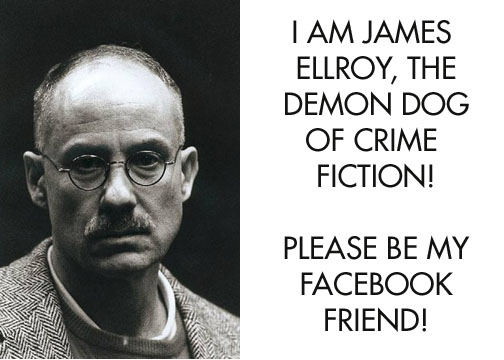
As Sarah Weinman reports, in a signed note on the back of the forthcoming James Ellroy novel, Blood’s a Rover, the Demon Dog of Crime Fiction is urging all of his readers to find him on Facebook. This may very well be the most brazen Web 2.0 pitch in the history of book industry marketing. And the last thing I want to do is kick a Demon Dog when he’s down. So go to Facebook, find James Ellroy, and lift this great writer’s spirits for the benefit of arts and letters! Perhaps by befriending Mr. Ellroy in this manner, he might be tempted to write even stranger novels for the joys and pleasures of readers around the world! (That is, when he’s not being poked by people he barely knows, given virtual gifts, or being chatted up by bored 15-year-olds.) Now if only we can convince Mr. Ellroy to get on Twitter and Tumblr, then we may very well make Mr. Ellroy the Demon Dog of All Media.