The Bat Segundo Show: Jaimy Gordon

Jaimy Gordon appeared on The Bat Segundo Show #391. She is most recently the author of Lord of Misrule.

Condition of Mr. Segundo: Praying to equine gods for a better motel room.

Author: Jaimy Gordon

Subjects Discussed: Dancing with award winners, the Gargoyle interview from 1983, how “the best young writers” change in an instant, Michael Brondoli, Tom Ahern, on not being terribly prolific, being cherished by 25 people, Shamp of the City-Solo, battling procrastination, subterfuge by husbands and publishers to get Lord of Misrule finished, inspiration points from John Hawkes, learning Italian, the use of Yiddish words in Lord of Misrule, referring to the same character from multiple vantage points, creating inconsistencies, Two-Tie’s philosophy of the world, private people who scheme, passing time and stories before radio and television, Cynthia Ozick, Marilynne Robinson, the pre-Internet storytelling culture, Steven Milhauser’s Edwin Mulhouse, Kellie Wells, the use of television in fiction, DH Lawrence and sex, staying “young” as a novelist, hanging out with criminals, being preserved by immaturity, the problem of not working enough, joy and ecstasy as a requirement, Nicole Krauss’s refusal to dance, Janet Maslin’s sense of “the exotic,” the National Book Award judges, Gordon’s explanation of her “churlish” speech, “A Night’s Work” as the origin point for Lord of Misrule, characters who escaped the novel, Two-Tie vs. Batman’s Two Face, the problems of drinking a lot, having an uncle as a loan shark, the multiple meanings of dirty books, the many ways that a grown man can get into trouble, using one’s own life as material, being a dark romantic, on not believing in real life, discussing opera with Bill Clegg, challenging Jane Smiley’s notion of the “narrowness of the world,” colors and description, the dangers of falling down the linguistic rabbit hole, unexpected methods of attracting regular readers, astute reviews from horse racing people, happy accidents in the author/reader relationship, vulgar desires to see one’s novel at an airport, the need to love literature, Donald Westlake’s Parker novels, how popular literature chronicles the underworld, Leonard Gardner’s Fat City, Balzac, the myth of pulp, loving horse racing despite its corruption, Czeslaw Milosz’s notion of America as a moderately corrupt country, the complicated emotional connections between humans and animals, and the paucity of fiction dealing with animals.

EXCERPT FROM SHOW:

Gordon: I didn’t think I was writing this for the small presses. I thought that this was a book with some commercial potential. And I eagerly gave it to my then agent, who showed it to a few places and came back and said, “You know, Jaimy, I think you have to face it. You’re still a small press author.” I was very depressed and very mad. My agent and I — she’s a very nice woman, maybe not good for that kind of book — we parted company at that point. And I worked on the manuscript again for a few years. Sporadically. Took out of it some of the Medicine Ed material. About this 72-year-old illiterate groom who knows how to work roots, knows how to do folk magic, and is looking for a home. Trying to make this big score for that purpose. I reworked some of that Medicine Ed material into a separate story, which came out in Witness and I loved the way that that chapter came together. I decided I had to redo the novel that way. But I didn’t finish it before I was overtaken by the deaths of my two parents and other things that happened in the last decade. But anyway.

Correspondent: Did it require an ultimatum from McPherson? “Hey, Jaimy, you better finish this book!” Is this the only way to finish a book for you?

Gordon: At some point, I must have rashly promised him that he could have it by the summer of 2010. I’d even kind of forgotten about that. Because I’d many times vaguely told him, “Well, if no one else will do it, you can have it.” But I had meant to get it out there and sell it. And I do think that I could have probably found someone if I had really asserted myself. Gotten a new agent and so on. But I’m a procrastinator and easily distracted. And I forgot about it. And suddenly McPherson said, “Well, it’s going to be this summer, you know. It has to be this summer because I think this book could be a contender for the National Book Awards.” After I stopped laughing, I said, “Well, alright.” I figured this book has been sitting there. An unmovable, implacable obstruction on my writing table for the last ten years. At the least, I gotta get rid of it. I’ve got to get it out of my way. I said, “Alright. I’ll start revising it.” This was maybe back in May. But I didn’t start revising it. And I found out later that he and my husband, who’s also a writer — a German writer, Peter Blickle — were having conferences. “What are we going to do to get this woman back to work? She has to finish this manuscript!” And somehow McPherson got the brilliant idea of sending me galleys with this corrupt early manuscript. It was even the earliest manuscript.

Correspondent: (laughs) Oh really?

Gordon: They must have sent him the file back before I even took the Medicine Ed material out. And so he sent me galleys. I mean, it’s easier now to generate galleys than it used to be. But he sent me galleys and he said, “Well, this is the book.” This is the book coming out in July. We’re sending this to press on such and such a date. And I was absolutely horrified. The biggest problem in getting back to work on it had been that, for five years, I couldn’t bring myself to read it. I could not make — I mean, it’s really hard to revise a book without reading it. And, for some reason, I just had an aversion to it. I know why it was. I’ll explain in a minute. But at this point, I was galvanized, horrified into reading it. And when I did, I thought, “This is not bad at all actually.” I had even forgotten a few subtle points of the plot. I found that I cried twice when I read it. I thought, “Well, you know, I must really have something here.”

Correspondent: Crying for the good reasons, I hope.

Gordon: Yeah, that’s right! I wasn’t crying because I thought it was so bad. I cried because I was moved at the plights of some of the creatures therein. But anyway.

Correspondent: Ten years of procrastination. I mean, that’s a lot of procrastination. Especially since the book here…

Gordon: Oh, that’s nothing for me.

Correspondent: Really? Nothing? Why do you require publishers and husbands to play such tricks upon you? I mean, some writers make up the excuse, “Oh well, I’m always thinking about the novel!” or “I’m submerging myself in the novel when I’m not doing anything related to the novel.”

Gordon: How about “I was occasionally thinking about the novel?”

Correspondent: Yes!

Gordon: Occasionally I thought about it.

Correspondent: Essentially, you’ve got a “My dog ate my homework” here. So what’s the real excuse?

Gordon: What do I do?

Correspondent: Yeah.

Gordon: Well, both my parents had lingering last illnesses. And they required care. But I was not — I’m one of five siblings. There were plenty of others. But nevertheless, there were very big events in my life. And then there was another family member who was sick. That took time. But what did I do to make myself better? Did I go into my study and write? No. I took Italian lessons. I got passionately involved in opera. In fact, I have to write some kind of a book about opera because I’ve spent so much of my time following opera in the last ten years. It’s the way horse racing was for me at a certain stage. So it’s going to be absolutely necessary for me to make use of it at some point.

Correspondent: Who was the novelist who said that the novel is everything that an author has been thinking about for the last five years?

Gordon: Who was that?

Correspondent: I’m blanking out on the name.

Gordon: The way I heard it, it was ten years.

Correspondent: Ten years. There’s variations of this quote. It seems to me that, for you, it’s actually the five years from forty years ago. Is that safe to say? Do you require a long introspection time before finally getting the project nipped in the bud?

Gordon: The truth is: this novel was substantially written between 1997 and about 2002. I know exactly the date because I was in the Fine Arts Work Center in Provincetown as a returning fellow on the beginning of a sabbatical in fall 1997. And it just so happened that John Hawkes, who had been my teacher at Brown, was there on a senior fellowship for the month. And I always associated my passionate interest in horse racing and my urge to write about it with him. Because he had written about racetracks in Sweet William and The Lime Twig. That’s probably the most famous of his novels that concern horse racing in any way. He was kind of a fantasist about horse racing, although eventually he bought a crippled old, once great stakes horse. Whereas I had actually worked on the racetrack. And when I saw him in 1997, I said, “I’m finally going to write that racetrack novel. I’m here to start it.” And he said, “Well, make sure you make the horses into real characters in that book.” Which I did, I thought. But it didn’t take an extraordinarily long time to write an advanced draft. I don’t write early drafts. I don’t tear through 400 sheets of paper never looking back. I construct every page and work on every sentence a long time. And I’m really fairly well along by the time I get to the end of the book the first time. But I also do a lot of new writing when I go through those pages again.

The Bat Segundo Show #391: Jaimy Gordon (Download MP3)
This text will be replaced

Under the Net (Modern Library #95)

(This is the sixth entry in the The Modern Library Reading Challenge, an ambitious project to read the entire Modern Library from #100 to #1. Previous entry: Sophie’s Choice)

The movement away from theory and generality is the movement toward truth. All theorizing is a fight. We must be ruled by the situation itself, and this is unutterably particular. Indeed it is something to which we can never get close enough, however hard we may try as it were to crawl under the net.

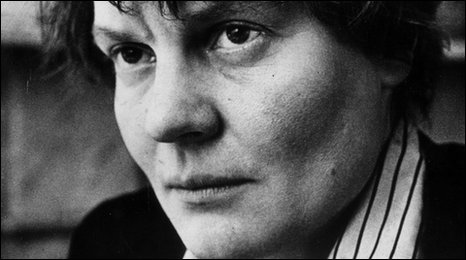
The above sentiment comes from Annandine, a character in a manuscript entitled The Silencer, modeled upon some philosophical chatter between a frustrated translator named Jake Donoghue and an industrialist/sophist named Hugo Belfounder, which is contained within Iris Murdoch’s debut novel, Under the Net. And if all that makes the book sound like a matryoshka doll with endless porcelain layers that need to be opened if the reader has any hope of unraveling the truth (to some degree, it is), then I should also note that Under the Net is also a sprightly picaresque novel. There are dogs, fireworks, giant Roman film sets occupied by socialists, martinets working at hospitals, experimental theatrical performances, and mad searches for people in pubs.
The Complete Review‘s Michael Orthofer called these affairs “a bit too manic” and accused Murdoch’s protagonist of living a life that was “a bit too unsettled.” The latter charge is certainly true. Jake Donoghue does indeed hop from domicile to domicile, often at the behest of a generous woman, seeking rent-free space to sleep and frequently checking his possessions in with a newspaper vendor named Mrs. Tinckham (a working-class Lady Metroland?). But I think the good Mr. Orthofer’s being a bit unfair. The book’s bountiful gallivanting reminded me of similar evenings I’ve had. I may not have plunged fully clothed and drunken into the Thames (although I have thrown my unclothed and inebriated form into the San Francisco Bay), but I have climbed through windows, crashed parties, and found myself locked in rooms. I suppose verisimilitude depends upon the circumstances you invite into your life. For my own part, I have been liberal-minded.

As many know, Murdoch was an Oxford-trained philosopher and a leftist (at one point, a member of the Communist Party, as was de rigueur among the Oxford set), leaving one pondering the real-life origin of the above-cited philosophy. The snippet may have emerged from something Murdoch overheard from two students. Or perhaps it didn’t have any existential origin point at all. At the end of Under the Net, after many journeys in London and Paris, Jake is presented with an observational puzzle. “I don’t know why it is,” he responds. “It’s just one of the wonders of the world.”

This tidy finale suggests that the philosophy presented in this novel is very much about the journey rather than the destination. The “original” Jake/Hugo conversation, which concerns the lofty topic of whether or not language is capable of expressing our true feelings, demonstrates the inherent emotion within the proposition. “There’s something fishy about describing people’s feelings,” says Hugo, who swims in these choppy waters to expound his theory that all statements are falsified from the start. Say that you’re “apprehensive” after the fact, Hugo says, and it doesn’t cut the mustard. That these words are exchanged in an experimental clinic, where both men are sick, says it all.

If language can’t capture every mite of emotional complexity, then the completed volumes contained within Murdoch’s volume matter very much to her effervescent characters. Jake’s translation of a novel becomes an unanticipated instrument of coercion. The Silencer, Jake’s effort at writing a novel (“treated to a few lukewarm reviews”), is also responsible for much of the lack of communication between characters. Because Jake has modeled his novel on his conversation with Hugo, he is reticent to reestablish ties — until, of course, he discovers Hugo’s involvement with a pair of sisters he knows. And even then, he has “really very little idea about what I wanted to say to Hugo.” It is only when Hugo is ensnared in a hospital that Jake can at long last use language to patch things up. But Hugo claims that, despite his singular philosophy from the past, he cannot remember what he talked with Jake about. Later still, Jake locates Hugo’s copy of The Silencer (Murdoch’s novel contains a remarkable amout of breaking and entering), and discovers that Hugo has “underlined passages, put crosses and question-marks in the margin; and at one place there was a penciled note, Ask J.” Is Hugo being coy? Or does he genuinely not remember? And if it’s the latter, where does the point of translation begin?

Why not seek such answers in the protagonist himself? Jake’s main employment comes from translating a hack French novelist named Jean Pierre Breteuli, author of such books as This Wooden Nightingale. But later in the book, Jake discovers that Jean Pierre’s latest volume (which Jake hasn’t yet translated) has won the Prix Goncourt. This merit is enough to confuse poor Jake, who has spent much of his time viewing Jean Pierre’s work (and thus his own labor) with derision:

I had classed Jean Pierre once and for all. That he should secretly have been changing his spots, secretly ennobling his thought, purifying his emotions: all this was really too bad. In my imagination I was already lending the book every possible virtue, and the more I did so the more I felt a mingled rage and distress which drove every other idea from my mind.

Murdoch plays Jake Donoghue in the first person. And it seems prudent to bring this up, given that the two Quentin sisters he encounters are both involved in performance. The younger, Sadie, is a film star, a seeming ingenue who Jake dismisses as childish (despite hanging out with men who enjoy being childish), but who proves more cunning. She asks Jake to take care of her flat, but she locks him in. Still looking for a place to live, Jake meets the older sister, Anna Quentin, who is a former singer six years older than Jake, a past fling, and now something of an experimental theater queen (literally crowned by Jake). Anna’s also as old as Murdoch was when she wrote Under the Net. Jake attempts to reintroduce himself into Anna’s life through a quite eccentric method:

At that time too I had, in a not entirely disinterested fashion, been teaching Anna some Judo, and one of our customs had been that when I came in I would seize her and throw her down into this corner to be kissed. The memory of this rose in me now like an inspiration and I advanced upon her. I took her wrist, and for an instant her eyes wide with alarm, very close to mine, and then in a moment I had thrown her, very carefully, on to a pile of velvet costumes in the corner of the room.

If Anna can be likened to Murdoch, might it be possible to construe this as a character pouncing upon its creator? That’s probably a stretch. Still, Jake has his custom, just as sufficiently transferred through years of singular permutations as The Silence, and it is feeling which causes this physicality. If it so astonishing through physical action, then is it not possible that such fancies are just as astonishing through the linguistic? Jake’s competing with fragments of all types. When Anna eventually leaves, Jake is locked up in the theater and must spend the night in a room amongst a good deal of bric-a-brac. When Jake catches sight of Anna later in Paris, he cannot catch up with her. He is reduced to plucking her shoes from the grass.

Jake is certainly a young man with fussy peculiarities (“I hate entering a crowded room and feeling a whole gallery of faces focused upon me,” “I find that sea voyages promote reflection”), yet one who impulsively declares that he’s a socialist when confronted by a political figure named Lefty Todd. What do politics mean in this book? More of a dog-and-pony show (with a film set subbing in for the pony) than anything else. There is an effort at a political conversation between Lefty and Jake. Jake makes an appointment to continue it, but he never does. If philosophy is something that is transmuted over iterations, then politics resembles more of an endless cycle.

Under the Net is dedicated to Raymond Queneau, and this French comic novelist proved to be such an influence that Murdoch would later cop to copying him as much as she could. One sees Queneau’s Pierrot Mon Ami as one of two novels that Jake leaves behind when he must flee his rent-free home at the beginning. The other book Jake abandons is Samuel Beckett’s Murphy. Despite Murdoch’s dedication, it is with Beckett that the imitative influences are more readily identified. Jake has distant kin named Finn, often confused as a servant, and this is very close to the relationship between Neary and “his âme damnée and man-of-all-work, Cooper” in Murphy. Neary’s pursuit of Miss Counihan might be likened to Hugo Belfounder’s pursuit of Sadie in Under the Net. Where Murphy suffers from heart attacks (although that’s nothing compared to Neary’s ability to stop his heart), Jake suffers from shattered nerves. However, in a possible deference to Neary’s sputtering palpitations, Murdoch does have Jake’s heart “beating out the refrain too late” when locating a taxi. More obviously, in both books, a hospital figures prominently.

In a 1968 interview with WK Rose, Murdoch was to call Murphy “a kind of ancestor to Under the Net.” And in John Bayley’s book, Elegy for Iris, Murdoch’s husband revealed that Murdoch learned about Murphy directly from Queneau himself when the two writers hung out in various Brussels cafes. Jake Donoghue’s account, expurgated, accelerated, improved and reduced, gives off undeniable similarities, yet both books are sui generis.

In assessing Under the Net later in life, Murdoch was to write, “I can see very clearly how bad it is. It is very romantic and sentimental, even what is intellectual in it is intellectual in a romantic way. If anything saves it from complete wreck it is a sort of vitality and joy that lifts it a little.”

But it is this very sentimentality that not only makes the novel so much fun, but that permits Murdoch to use conceptual philosophy as ironic comedy. Aside from the funny methods in which the Quentin sisters lock Jake up, Jake’s cosmic fate serves as a comical counterpoint. He can only be kicked out of a domicile or locked into one. (These incarcerations are interesting involutions of Beckett’s Murphy, considering that Wylie is locked out of his room and our introduction to Murphy sees the layabout tied up by choice in a rocking chair. There is no rocking chair in Under the Net, but there is a rocking horse with “big vacant eyes.” This is undoubtedly a nod to the opthalmically obsessed Beckett, as well as DH Lawrence’s “The Rocking-Horse Winner.” (Indeed, there are many winners at the racetracks in this novel.) Murdoch, to her sly credit, provides no homage to chess.

There is also the matter of Mister Mars, a stunt dog owned by the Bounty Belfounder Studio who is encountered by Hugo while locked in a cage. Mister Mars doesn’t quite serve as a Schrodinger-like answer to the Cartesian logic within Murphy, although at one point he does play dead so that Jake can escape an imbroglio. Over the course of the book, the dog is both young and old, worth nothing and worth quite a bit, quiet and boisterous. Yet the many parties feel the need to appraise him. “Sorry to be a business girl,” reads the final message concerning Mister Mars, “but one has to watch the cash, with the cost of living and partly living what it is.” “Partly living” is the key phrase here. Perhaps the young Murdoch, the progressive-minded humanist who eventually liberated herself from the Communist Party yoke (becoming a very hard Thatcherite in later years), was trying to determine if the novel offered a reconciliation point between accurately representing life and some concession to narrative that involved “partly living.” Under the Net succeeds because it is both a series of adventures (akin to The Ginger Man) and reflective of a young person’s intellectual journey. And what better metaphors are locked rooms or diminishing paramours for the divagating and theoretical manner in which we seize every possible scrap and hang on to every possible word?

[UPDATE: I had no idea that another Iris Murdoch biography had been published, but Martin Rubin’s review in the Wall Street Journal (published the day after my essay) sheds some additional light on the connections between Murdoch’s early life and her early novels. Was Jake Donoghue inspired by Frank Thompson? And if Murdoch recruited Thompson to the Communist Party, is it possibly that Lefty’s laughably smooth coercion of Jake in Under the Net is based on this exchange?]

Next: Jean Rhys’s Wide Sargasso Sea!

BAMcinématek: De Palma Suspense

If all De Palma films come from Hitchcock, then all words written about De Palma must originate from Pauline Kael. Kael once identified De Palma’s style as “a perverse mixture of comedy and horror and tension” that came with “a lulling sensuousness. He builds our apprehensions languorously, softening us for the kill.”

That’s a highfalutin and reserved way of ignoring one possible takeaway: if Brian De Palma were not a filmmaker, he may have ended up as some kind of felon. Indeed, so subtly disturbing is his imagery, murderously more so on the big screen, that one is tempted to give the man a movie camera before he hurts someone. I’ve had conversations with film buffs over the years and I’ve been relieved to learn that I am not alone in having these momentary thoughts. But “softening us for the kill” or speculative homicidal impulses don’t really permit us to understand De Palma.

Now thanks to a retrospective series that you can still catch at BAMcinématek, there’s an opportunity to see just how potent the man’s films are. There are three films left in the De Palma Suspense series. There’s Raising Cain, a somewhat unfairly condemned late period movie that Peter Travers once described as a “De Palma movie made by a forger who can barely conceal his contempt for the artist he’s copying.” But was De Palma mimicking Hitchcock or the Hitchcock pilferer he was always being pegged as? More promising than Raising Cain is the vibrant and elegant Femme Fatale, in which De Palma more successfully embodies homage into homage, including a brazen “seven years later” flashforward, a film festival within the film, and numerous cinematic archetypes.

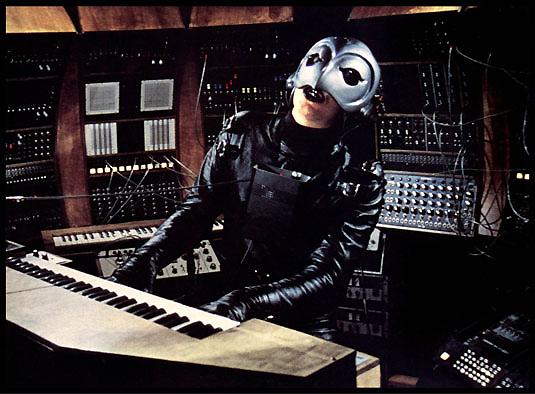
But the last film still playing is Dressed to Kill, one of De Palma’s masterpieces. Its mixture of sex and violence proved to be too much for some audiences in 1980. It was protested by at least one group that declared in its circular: “DRESSED TO KILL ASSERTS THAT WOMEN CRAVE PHYSICAL ABUSE; THAT HUMILIATION. PAIN, AND BRUTALITY ARE ESSENTIAL TO OUR SEXUALITY.”

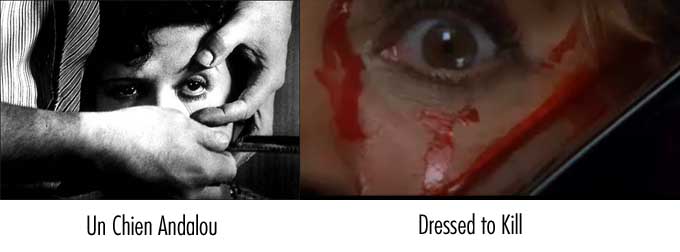
This is a misread, I think. One only needs to discern the manner in which the camera cranes in on a closing elevator door, catching the reflection of a woman being murdered, to see that voyeurism has much to do with this brutality. As the grisly scene plays out, we see (above) a connection to Un Chien Andalou. Yet while Dali and Bunuel were eager to slice the eyeball, De Palma does not. He leaves the razor there and slices the cheek. Is all violence equal in cinema? Or is De Palma’s razor the new tongue? If the latter, it’s a very twisted joke.

There is something valiantly creepy about De Palma’s films before Bonfire of the Vanities. It’s probably a mistake to ascribe some ethical code, whether religious or not, to movies that have the effrontery to depict atavistic human emotions. (I especially admire this attempt to comprehend De Palma through his lack of religious affiliation: “There is no indication that De Palma was an active churchgoer or member of an organized congregation or denomination as an adult.”) But the boldness cuts both ways, so to speak. One can feel unsettled by the needless punishment that Angie Dickinson receives for having an affair in Dressed to Kill (even as one remains dazzled by that movie’s museum scene), while also applauding the bravery in broaching intense father-daughter relationships in Obsession.

To some degree, this willingness to depict the unpleasant aligns De Palma with such iconoclasts as Lina Wertmüller (declared misogynist by many for Swept Away) and Dario Argento (whose hands have always portrayed the hands of any male murderer he depicts on screen). But by cementing human behavior in cinematic history, he’s suggesting something more dangerous and intriguing. In cinema, all emotion is valid. Cinematic language permits us to confront our darkest emotions in the smoothest of terms. If that is one method of appreciating his films, then it seems incumbent for any serious filmgoer to see his work on a movie screen. From what I understand, this is becoming an increasingly dicier situation. I am informed that Sisters requires forty to fifty thousand dollars worth of restoration work and that most of the prints, save two (owned respectively by producer Ed Pressman and MOMA), are largely faded.

The Bad Prose Reading Project #2 (“It Was Real Light”)

Back in February, I initiated the Bad Prose Reading Project — an effort to find new joy and meaning in prose that was truly atrocious. The joy and meaning would be delivered through audio dramatizations.

The idea behind the Project was to respond to a specific phenomenon that all readers know very well. Every now and then, you encounter prose so wonderfully preposterous that it feels quite a crime not to share it with other appreciative readers. Some confine this morbid pleasure to the Bad Sex in Fiction Award handed out yearly by the Literary Review. Others test their mincing mettle by contributing their own exemplars to the annual Bulwer-Lytton Contest.

But the best bad prose isn’t always planned. It’s written and discovered by accident.

I had thought that The Bad Prose Reading Project would be a one-off. But then, on April 14, 2011, I discovered an extraordinarily awful specimen. It was so atrocious that it filled me with great delight! And as I read the words, I took further joy! When you listen to the recording, you will hear me go overboard near the end as I preach about “letting live and loving.”

As always, I won’t name the author, the story, or the novel that I’m reading. I feel this is fair to those who may judge the prose to be excellent. Needless to say, if I’m dramatizing it, it’s probably been published somewhere in the last few months. But that’s also part of the fun. Perhaps in dramatizing “bad” prose, the oral delivery may transform it into “good” prose because my dramatization is “bad.” Or perhaps I’m overthinking the experiment.

As always, I invite listeners to judge the results. The second installment of The Bad Prose Reading Project features the phrase “it was real light” and can be listened to below.

The Bad Prose Reading Project #2 (“It Was Real Light”) (Download MP3)

This text will be replaced

The Bat Segundo Show: Ian Rankin

Ian Rankin appeared on The Bat Segundo Show #390. He is most recently the author of The Complaints.

Condition of Mr. Segundo: Playing good cop and bad cop with his interlocutory approach.

Author: Ian Rankin

Subjects Discussed: The benefits of talking with a Scotsman on St. Patrick’s Day, sartorial description in prose, pleated miniskirts, balancing descriptive detail against dialogue, people who are intended to be larger than life, on not describing the central character, physical descriptions that compete with the expectations of television, Malcolm Fox vs. John Rebus, trying to make a protagonist who isn’t a maverick compelling, the adjacent sounds of garbage being emptied, what tastes in music reveal about character, family and backstory, the connections between Rebus’s father in The Black Book and Rankin’s father, moving past autobiographical connections, Rankin’s early pursuit of an English degree, avoiding the existential possibility of Ian Rankin the Accountant in early years, parents who don’t understand, Woody Allen, the limitation of locations in Edinburgh to write about, Doors Open, financial institutions and cities, Edinburgh as a microcosm for Scotland, the economic collapse as a creative muse, occupations that permit access to every layer of society, Michael Connelly’s start as a journalist, journalists-turned-novelists, sources who retire, making things up vs. research, not getting too close to the police, The Wire, the disadvantages of amateur detectives, Mario Puzo making the mob up in The Godfather, when imagination turns you into an unexpected police suspect, Hide and Seek‘s close similarities to real crime, serendipity, the universal nature of office politics, how much police procedure a writer really needs to know, being oblique enough to be believable, writing a first draft in six weeks, William Gibson, writing and revising on the road, Alexander McCall Smith’s prolificity, the danger of forgetting plot details, eating multiple candy bars per day as an alternative to nicotine addiction, nonsmokers who write convincingly about smoking in fiction, Rankin’s addictive personality, computer games, Iain Banks’s addiction to video games and Scottish roads, Rankin’s addiction to Twitter, being unable to tweet using a European phone due to the draconian wifi costs established by hotels, keeping a diary vs. maintaining a Twitter feed, writers as public property, the drawbacks of instant feedback, Facebook, The Social Network, Twitter as an exercise in editing, eBay addiction, compartmentalizing time, the possibilities of bringing Rebus and Siobhan Clarke back, not having a storehouse of ideas for future books, comics and working on Dark Entries, the creative differences when working with another person’s character, John Constantine, Neil Gaiman, hanging out with Alan Moore, naming characters after literary writers and rock stars in The Complaints, when too many character names begin with the same letter, long and ambitious novels, biases against shorter novels, Muriel Spark, The Prime of Miss Jean Brodie, the poet’s talent of distillation, the rising market share of ebooks, commercial forces and maintaining a mystery series, attracting new readers for a series, parallels between the publishing and the music industries, speculating on a future industry of freelance editors, independent bookstore alternatives to Borders, the modest revitalization of vinyl, the frequency of cheek gestures within The Complaints, repeating words and phrases, intrusive commas, manuscript fatigue, becoming part of the old guard mystery writers, and keeping books fun after multiple books.

EXCERPT FROM SHOW:

Correspondent: Michael Connelly, who was also a journalist at one point, has discussed how he was worried that, as a journalist, a lot of his sources and a lot of his contacts would possibly go away. And this would prevent him from getting a lot of really interesting stories that he could put in his novels. I’m wondering if you’ve faced anything similar to that with your network of sources. Or whether you have accidentally burned a source. Have there been any problems?

Rankin: The problem with my sources is that a lot of them have retired.

Correspondent: (laughs)

Rankin: If they were my age — I mean, I’m going to be 51 this year — most of them have retired form the police. So guys that I met in my mid-to-late twenties when I was starting the [Rebus] series are now gone. And you either have to find a new set of people. Or you just make it up. I mean, it is fiction after all. What I do is that I’ve got enough people around me who can help me with the detail if I need them. But I don’t want to get too close to the police. Because I don’t want the books to become public relations exercises for police. And, of course, the only people who will talk to you are the good cops. The ones who are straight, you know. They’ll talk to you. Well, if that’s the only people you’re meeting, you might feel constrained. You might feel you can’t suddenly write about cops who’ve broken the rules or who’ve bent the rules a little bit. So I only go near the police when I need them. I mean, with The Complaints, I did need to talk to someone who worked in internal affairs. I set that up through another contact, who’s a senior police officer. But it was a couple of hours of conversation. And that was all I needed. That gave me a sense of what this organization would be like, what the office politics would be like, what kind of powers they have, what kind of stuff they did. Two hours. And the rest of it is invented.

Correspondent: Have facts and background been more of a limitation than a help throughout your work?

Rankin: Well, I do think there’s restrictions on what you can and cannot do. Because readers are much more sussed than they used to be. I mean, they’re watching cop shows on TV — whether it’s reality shows or dramas.

Correspondent: Or The Wire for that matter.

Rankin: Yeah. But they feel they know what goes on forensically. They feel they know what goes on at a crime scene. So you can’t suddenly start taking liberty. I mean, I’m very lucky. Because my guys are professional cops. Therefore, they would be at the scene. It’s much harder if you’re talking a kind of Miss Marple character. This notion that an amateur detective — a Lord Peter Wimsey or a Miss Marple — could just turn up at the crime scene and trample all over it. And that the cops wouldn’t give him a good kick up the backside and send him on their way. These days, it’s much harder for readers to take on board and accept. So I don’t write about private eyes. And I don’t write about amateurs who just happen to get caught up in drama. I write about people who get invited into the drama. Because that’s their job.

Correspondent: On the other hand, there’s, of course, the famous story that Mario Puzo made all of The Godfather up. So much so that mob people were reading this and they were saying, “How did he know so much about this?” Is this similar to your situation when you invent something? That almost inventing layers or systematic connections is almost better than relying on getting something right.

Rankin: Well, I mean, on the very first book that I wrote, I got the idea for the plot. And then I went to a police station to talk with a couple of cops. You know, just to get some background and some detail. And they asked me what the plot of the book was. And I told them. And it turned out that it was very close to a case they were working on. So they viewed me as a possible suspect for a short time. Until they decided that I was just insane. But the next book after that — Hide and Seek — two or three years after the book was published, a similar case came to light. And that gave me great kudos in Edinburgh. Because cops and the public alike said, “How did you know about this stuff?” I mean, it was kind of there. It was happening a few years ago. But it wasn’t. It hadn’t come to light then. And I had just invented it. And it came true later on. So people thought I knew what I was talking about. But I really wasn’t. I was making it up. And that continued to happen. There was a lot of serendipity. That I would just write about something that then seemed to be true. And it worked the other way as well. I would take a really true thing like the G8 — when the G8 came to Scotland. And that was just a great source of information. All you had to do to research that book [The Naming of the Dead] was to live in Scotland for a week. And that was a very easy book to write from my point of view. Because about half of the stuff in there actually happened. Up to and including President George W. Bush falling off his bicycle while trying to wave to a police officer. In my book, it’s Rebus. I mean, what if it wasn’t? It was someone else.

The Bat Segundo Show #390: Ian Rankin (Download MP3)

This text will be replaced