Posts by Edward Champion

Edward Champion is the Managing Editor of Reluctant Habits.

Review: The Brandon Book Crisis

Brandon Scott Gorrell and Tao Lin’s The Brandon Book Crisis contains a considerable amount of white space, thereby reflecting the aesthetic of an Outlook email printout. One suspects that the people in publishing deal with such printouts on a regular basis, even as they tell each other not to print out emails. There is, after all, an environment to save. Do people print out emails anymore?

One is tempted to quote Lacan here. Or perhaps another French Situationist. Some writer who might prevent depression. The real is too depressing. Even if it’s only a recession. White space leaves most writers depressed. The after image of this white expanse on various pages: also depressing. Brandon Scott Gorrell and Tao Lin should not be faulted for failing to predict the reviewer’s mood. Reviewer has not yet had coffee and, only yesterday, entered into a controversial exchange on Twitter over Starbuck’s and non-Starbuck’s coffee that amused about four people. It is quite possible that The Brandon Book Crisis will amuse more than four people. I now have the PDF open at Page 17. I don’t know whether I should laugh or cry. But these two guys put out a book and I haven’t. It’s that white space again. They somehow knew. They are watching me. They are watching me attempt to negotiate a morning without coffee and, like the rest of the literary community, they are laughing at me. They will beat me down until I am reduced to one of Tao’s unpaid interns.

The book claims to have arranged its emails from Monday through Friday. This, as it turns out, is a lie. For shortly after reading Page 4, outlining the weekdays and the page numbers, we then must endure the shock of Page 5, which doesn’t have any text on it (unless one counts the page number in the lower left-hand corner). We then turn to Page 6 and we are greeted by the words, “THURSDAY APRIL 23.” Tao informs us in a chat transcript: “brandon book cover crisis in ‘full on’ mode.” Yes, this is a crisis. A crisis in design. A crisis in narrative. A crisis that will probably be ignored by Granta and Bookforum — but a crisis nonetheless. I am having a crisis just thinking about the crisis.

On Page 12, there is reference to the white space problem. These authors may know what they are doing

On Page 18, there is an email containing the phrase, “chat me, i can’t chat you, internet closed.” Is this an allusion to Brokeback Mountain? Often when I hit Alt-F4 on Thunderbird, I wonder if my relation to my inbox is sexual. I am tempted to tell Thunderbird, “I just can’t reply to all of you, baby.” And since this is close to a famous line in Brokeback Mountain, I get uncomfortable. Perhaps Tao Lin experiences the same level of discomfort. Kudos to him for popping that conceptual cherry.

I have not had any personal dealings with Thomson-Shore, Inc. But there is a minatory quality to the email exchanges.

The book has a helpful index explaining references to various media figures and companies. This will be a valuable handbook when the world has forgotten about us.

Perhaps this book is a way for a number of disenfranchised literary figures to find credibility. To defeat the monster of white space.

“Think I’m just going to copy/paste in word doc,” says me at 2:10 PM on Friday, April 24. A fast way to defeat white space. Now that I’m looking at all the time stamps, I’m realizing that these kids are up earlier than I am. It is quite possible that they are putting together a book without coffee. Maybe they are not afraid of the monster of white space. But if they are, then why do they put so much of it in this book?

Other quotes:

“If you email him cc me in the email.”

“We can convert the photo to grayscale and make it the Pantone Black.”

I’m wondering if this book is quietly urging me to apply for a job at Kinko’s. The authors could not know that I was having a nervous breakdown. But if you want to be reminded of a particular Outlook aesthetic and the monster of white space, you can read this book. It is too short for anyone to have a nervous breakdown. But the authors might. And that seems more than a bit needless.

Plans For My Literary Ego

I’ve been getting a number of emails about BEA. And by “number,” let’s just say that it’s not a big number. In fact, the number is so small that I have been spending hours trying to rebuild my dwindling ego and pretend that the number is actually greater than it really is. Keith Gessen probably gets more emails on the subject of BEA than I do. And he’s in Russia right now. And goddammit, that makes me so mad. Why should Keith Gessen get more emails than I do? I mean, I’m spending a good deal of my time burning pictures of Keith Gessen that I download on the Internet. Particularly the ones of him in which the top button or two of his shirt has been unbuttoned. He has replaced Steve Almond as my primary subject of hate. So fuck you, Keith Gessen. And fuck you, New York Post. (It seems to me that I should likewise throw a random newspaper into my sad mix of enmity and self-loathing. And, well, why not The New York Post? I will cut it out of my life from now on. It’s the only way to be sure.)

Before I tell you what my decision is about BEA, let’s talk about the world. After all, the world revolves around me — and by “world,” I’m talking about an extremely small part of the literary world, and by “literary world,” well, let’s just say that half of half of half of half of one percent of anybody who has had the good fortune to shake my hand in the past six hours really cares about any of this. But it is a world nonetheless. And it is an ego that must be groomed, trimmed, and otherwise packed into a precious valise.

But in thinking about the emails that are coming in and in thinking about how this relates to the solipsistic world I live in, it’s permitted me to think about the possibility of whether or not I might be attending BEA.

Let us establish my credentials: I have taken in every BEA that has ever happened like blow snorted off the top of a Hollywood hooker’s sternum. When it comes to BEA, there can be no better expert than me on how to attend, report, and take meetings. I am the BEA Master. There will be an area of the exhibition floor named after me. That is how much I matter.

But I am not so sure I can be coaxed to make a decision until BEA actually happens. Let’s just say that I welcome speculation on whether I will or will not be at BEA from anyone who cares to send speculations.

P.S. Please buy my paperback.

P.P.S. For something far less egotistical and commercial-oriented, consider the Guys Lit Wire Book Fair for Boys.

[UPDATE: In case you haven’t figured it out by now, the narcissism being satirized in this post belongs to Mark Sarvas, not me. But to set the matter straight, I have added a 2009 introduction to the 2005 post I wrote about Steve Almond. Other than this preface, I have not altered that post or the comments in any way. Unlike Mark, I actually maintain history and I own up. I have also emailed an apology to Steve Almond.

To read all the boring sordid details, you can go to that post. I’ve learned, without even going out of my way to do so, that Mark has been meaner and snobbier to far more people in the publishing world than I could ever possibly desire to be spiteful to. (And I fully admit that I’m not always the easiest guy.) But, boy, was I wrong about Mark big time.]

The Bat Segundo Show: Nelson George

Nelson George appeared on The Bat Segundo Show #285.

Nelson George is most recently the author of City Kid.
segundo285

Condition of Mr. Segundo: Drowning in the inevitable tide of gentrification.

Author: Nelson George

Subjects Discussed: George’s thoughts on Fort Greene, gentrification, black artists and real estate, the inevitable nature of change, finding a balance between the personal and the artistic, artistic arrogance, on not being the person at the party who wanted to do something, living a fatherless life, mentoring Chris Rock and other artists, jealousy, helping other people, the concept of ass power, inspiration vs. perspiration, making art in little rooms, the relationship between creativity and place, Babyface and L.A. Reid, Hemingway, being around artistic peers, crime and guerrilla art, loft jazz, the rigid distinctions between black music genres, world music and cross-genre fusion, undermentioned hip-hop metaphors, WBLS and Frankie Crocker, whether or not Hot 97 lives up to cross-genre fusion, Auto-Tune and narrowcasting, trying to get work from Robert Christgau, Grandmaster Flash, going to Prince’s apartment to listen to Parade, junkets and ethical journalism, the crazy amounts of money that Island Records threw at Bob Marley, journalism and the sports industry, the corruption of the music industry, why sports figures weren’t interesting subjects to George, Oscar Micheaux and Warren Hudlington, getting tired of critical analysis, how book-writing changed George’s career, artistic evolution, and revenge.

EXCERPT FROM SHOW:
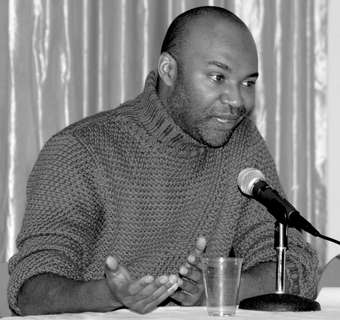
nelsongeorgeCorrespondent: You write, “In my adult life, I’ve seen that while white institutions could be unthinking, even brutal, toward black aspirations, individual whites, either through genuine friendship or political philosophy, could be crucial allies. So while I never lost sight of racism, it became a huge part of my personal development to take whites as they came, not expecting racism or prejudice from them. And even if it was there, not to overreact, but remember it and exact revenge when I could.” But isn’t revenge along the lines of a kind of negative emotion? Or a negative idea like racism? I mean…

George: Revenge is…

Correspondent: Success itself is the best revenge, I would argue.

George: Depends on what they did to you. It depends on what they did to you.

Correspondent: Well, what did they do to you exactly?

George: People can get you fired from jobs. People can try and sully your name. People can try and hurt people you love. And so sometimes if you can get them, you will.

Correspondent: Yeah, but…

George: It’s just very basic.

Correspondent: But how much have…

George: It depends on what it is.

Correspondent: How much have you dwelt on this notion of vengeance? Is vengeance good?

George: Not very much.

Correspondent: Not really.

George: Not very much. I mean, vengeance is not a very useful emotion most of the time. But selective getting back at people is always very refreshing.

Correspondent: When was the last time you got back at someone?

George: About a year ago.

Correspondent: And what provoked that particular impulse? You just were feeling…

George: No, no, no. It’s not so much a thing. It’s just…revenge is actually very useful. It’s acts of commission. It’s acts of omission, not commission.

Correspondent: Yeah.

George: That is, there are things that happen. Opportunities that arise. That you know someone who it might be really good for. Or it could help them. And you don’t help them. You don’t tell them about it.

Correspondent: Yeah. So it’s really exclusion. That’s your form of revenge.

George: I would say that it’s the easiest one to apply. Because it involves no action.

Correspondent: Yeah. It involves very little in the true destroying of someone’s career.

George: Right, right.

Correspondent: It’s just a step back. It’s a therefore healthy vengeance.

George: Yeah, because it’s too — oh, I don’t have time to be conniving. That’s crazy.

Correspondent: (laughs)

George: I’ve got to actually — you know, because I’m not that. And it puts it. You know, to be that. I know people who really do think that way. And it takes a lot of their time. Like, well when are you going to do something for yourself?

Correspondent: Yeah.

George: But if you feel like you’ve been wronged by someone, and you’re in a position to help them and you don’t, then you’ve got that out of your system and you can move on.

BSS #285: Nelson George (Download MP3)

This text will be replaced

The Bat Segundo Show: Blake Bailey

Blake Bailey appeared on The Bat Segundo Show #284.

Blake Bailey is most recently the author of Cheever and the editor of the two-volume John Cheever set recently issued by Library of America.

segundo284

Subjects Discussed: Eponymous titles, Cheever as a brand name, whether literary biographies are needed, contending with Updike’s review, the hard things that Cheever said about Updike, the literary biography as a history of the 20th century, interview subjects who use pseudonyms, telephone prank calls, writing a biography while considering the Cheever family, establishing total independence, corralling incidents in Cheever’s journal with real-life incidents, whether or not Cheever’s accounts could even be trusted, explicit connections between the stories and Cheever’s life, similarities between Richard Yates and John Cheever, shyness and courtliness, living in squalor, Cheever’s phony aristocratic voice, getting naked, Robert Gottlieb’s late-career intervention, whether or not Cheever was washed up after Falconer, financial unease, Dwight MacDonald’s “By Cozzens Possessed,” the power of literary critics in the 1960s, narcissism, status and quids pro quo, Cheever pushing the envelope in his fiction, Cheever’s strange obsession with television commercials, Cheever and postmodernism, Donald Barthelmie, and Cheever and postmodernism.

EXCERPT FROM SHOW:

blakebaileyCorrespondent: John Updike. He wrote a piece called “On Literary Biography” — I’m pretty sure you’re familiar with it — in which he asked whether we needed literary biographies at all. He concluded that “[t]he vocabularies of psychoanalysis and of literary analysis become increasingly entwined; though we must not forget that these invalids receive our attention because of the truth and poetry and entertainment to be found in their creations.” Now, of course, in the last piece he wrote for the New Yorker, after his death, he reviewed your book. And he wrote that “all this biographer’s zeal makes a heavy, dispiriting read,” where he wanted your narrative “pursued in methodical chapters that tick past year after year, to hurry through the menacing miasma of a life which, for all the sparkle of its creative moments, brought so little happiness to its possessor and to those around him.” So I put forth to you, Mr. Bigshot Literary Biographer, why do we need literary biographies? Are you perhaps more of a literary historian? Because there is a considerable amount of detail in this. Would you call your book more of a history? Is it really gossip-peddling? What’s the deal here? Defend yourself from Mr. Updike’s charges!

Bailey: That’s a pretty involved question, Ed. Can I take it one at a time? You mention Updike first of all. And I’m sure that Updike would be tempted to do without literary biography. Particularly a literary biography of himself. And I think that that was somewhere in his agenda when he reviewed my book. Which he was kind enough to call and which will be used as a pull quote in one of the advertisements “a triumph of thorough research and unblinkered appraisal.” Now I would venture to suggest a couple of things. First of all, that Updike was a dying man when he reviewed my book. And it was very depressing to read — and not the first time that Updike has been exposed to this — to read about some of the many hard, hard things that Cheever had to say about him in private. Because as Updike has noted on many occasions, Cheever was always witty and debonair and charming in person. And really tirelessly promoted Updike’s career. He seconded his nomination in the National Institute of Arts and Letters. He was the primary nominator of Updike to the Academy of Arts and Letters. And so on. And blurbed hiim, and congratulated him. On and on and on. In private, in his journals, Cheever was, to put it charitably, very ambivalent on the subject of Updike. And so that can’t be very pleasant to read. And also the chapters dealing with Cheever’s own death from cancer must have been grindingly lugubrious for Updike to read.

I would also — and this is a very self-serving theory, but not without merit, I think. I have now written a very thorough biography of Richard Yates. I have now written a very thorough biography of John Cheever. The three great chroniclers of the American postwar middle-class are generally perceived to be Richard Yates, John Cheever, and John Updike. I have been named on more than a few occasions as a prospective biographer of John Updike. He is vary chary of biographers. And I think that he did not like the prospect of my bringing my thorough research and unblinkered appraisal to bear on an account of his own life. So this was a very shrewd way of steering me off at the pass. Because I could hardly seem disinterested after a biting review of my book. One of the very few biting reviews I have received, I might add.

Correspondent: I’ll jump back to that point momentarily. But going back to the idea.

Bailey: Do we need…?

Correspondent: Why do we need literary biographies?

Bailey: Well, I mean, I think that that’s a silly rumination on Updike’s part. Unless he’s — I would have to see the entire context. Is he calling it a question of validity of biographies in general? Because I think biographies are one of the most fascinating genres. Certainly I am more attracted to exploring the universe of a single individual and can imply so much thereby. I think that, and indeed, it’s been noted that my biographer of Cheever has also something of a history of the 20th century of literary life in America. So, well, of course we need literary biographies. Who’s more interesting than Cheever? I mean, he had the most exhaustively documented inner life of any major American writer. A 4,300 page single-spaced typed journal, which one can constantly counterpoint with his rather absurd and certainly disparate public personae. So I think literary biography is fascinating. And I think well-done literary biography is doubly fascinating.

Correspondent: But would you say that this history of the 20th century would be your way of essentially deflating or countering the Updike charge that really it should be just about the writer’s work?

Bailey: Oh absolutely not. What nonsense. Uh, no. I think that again — Joyce Carol Oates, of course, is famous or infamous for coining the term “pathography.”

Correspondent: Yeah.

Bailey: In her review of the Jean Stafford biography. That is any biography which places an unseemly emphasis on the subject’s tortured inner life. I think if you tell the whole truth about your subject that everything will work out. You just show the man in the round. And ultimately, you will deplore certain aspects of him or her. And you will sympathize with certain aspects. I was confronted with some pretty nasty stuff about Cheever. But in the end, I the biographer felt compassion for him.

BSS #284: Blake Bailey (Download MP3)

This text will be replaced