BEA 2009: The Truth About Book Piracy
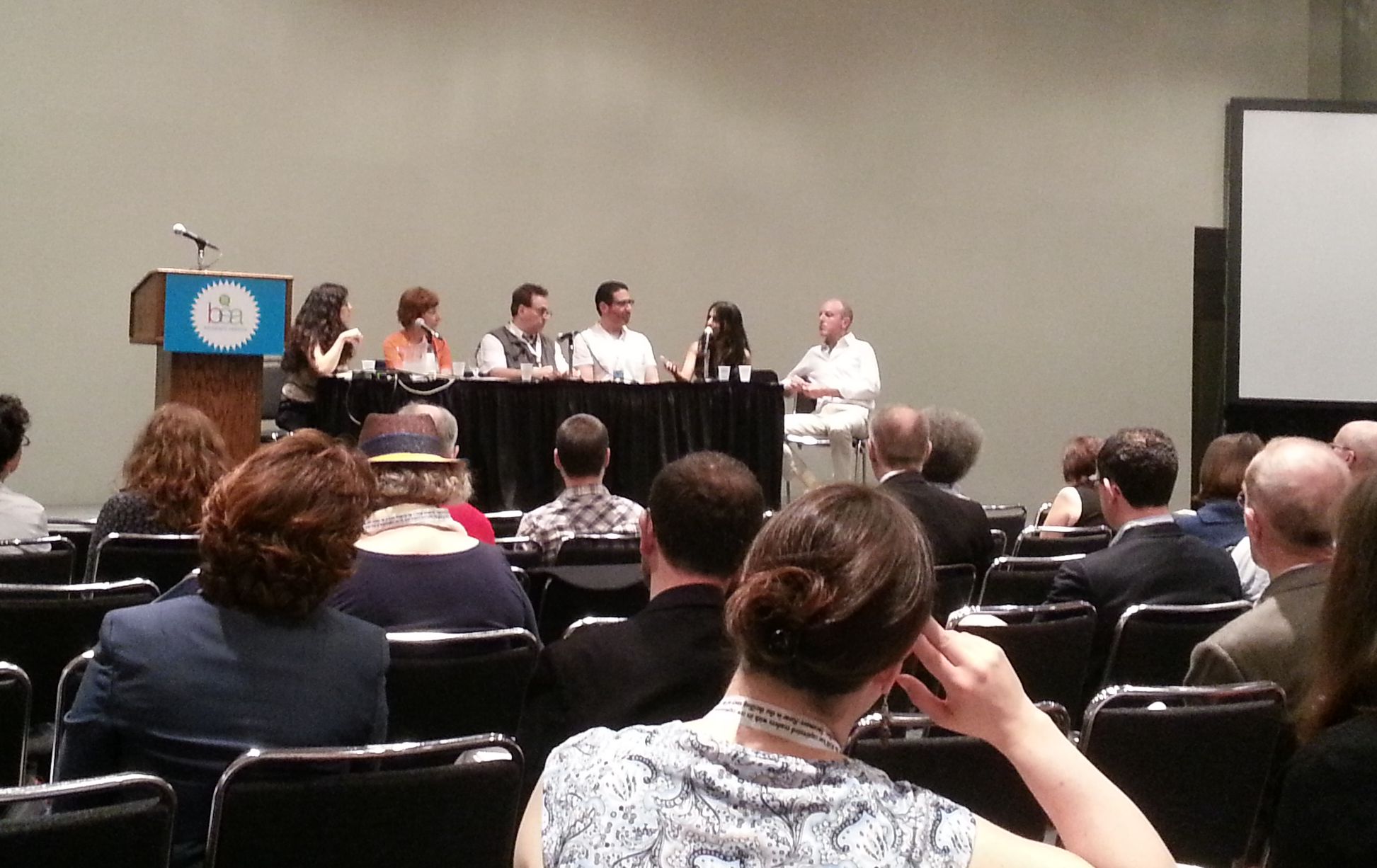
At BookExpo America, Wet Asphalt’s Eric Rosenfield entered into a lengthy conversation with Brian O’Leary of Magellan Media. And it became necessary to capture their quasi-caffeinated colloquy for reasons that will soon become apparent.
I had seen O’Leary earlier in the year at the “Challenging Notions of Free” panel at Tools of Change, along with O’Reilly’s Mac Slocum and Random House’s director of business development Chelsea Vaughan. O’Reilly and Random House had agreed to participate in a study hoping to pinpoint the effects of P2P distribution — namely, the impact of digital books, both in pirated and legitimate form, on print book sales. And they were standing in a conference room in February to present Magellan’s results to the public.
The results were a bit surprising. According to O’Leary’s subsequent report, “Impact of P2P and Free Distribution on Book Sales,” book piracy wasn’t nearly as ubiquitous as some had suggested. While O’Leary’s report had only O’Reilly and Random House as participants, it appeared that some of the publishers’ fears about piracy were unsubstantiated. Only eight frontlist titles published by O’Reilly in 2008 could be located as torrent files. When these books did become available as torrents, the torrents were uploaded to the Internet far later than expected: some 20 weeks after publication date on average. Furthermore, for the titles available as torrents, on average, sales were 6.5% higher for these books during the four weeks after they were uploaded.
Despite the braying of New York Times guest bloggers, book piracy was hardly the Manichean scenario that some of the DRM advocates had implied. And the chances of Stephen King and Toni Morrison riding on motorcycles appeared to be unlikely. In his report, O’Leary suggested “a less binary model to evaluate the use of free” — one doing away with the parallel experiences from music and movies and accounting for tangible interface realities.
But before the “information must be free” acolytes begin offering a Nelson-like “Ha Ha,” it’s important to note that this isn’t a scenario in which a partisan can dance a jig jig one way or another. O’Leary is pointing out quite rightly that both publishers and open source advocates are making statements about piracy without specific correlative data to draw from. O’Leary’s results are a great step forward, but with Amazon offering a new version of the Kindle seemingly every two months and publishers remaining understandably mum about sales data, it isn’t exactly possible to locate the theory of everything.
In the interview, O’Leary pointed out that not only were there differences in book piracy between fiction and O’Reilly books, but even within specific types of fiction. And getting publishers to participate in ongoing efforts to study this unexamined issue might allow reliable correlations to be formed. O’Leary also alluded to additional studies conducted by John Hilton that involved studying the effect of free digital books on print sales. Hilton was surprised to learn that Tor Books gave 24 of its books away, but saw 20 of the titles with decreasing sales. Random House’s ebook experiments, by contrast, had seen increased print sales for all four titles that it had used for the experiment. But was it the type of books? The specific titles? The way the free ebooks were introduced?
“Certainly when you see that big a swing, you want to look at the type of book or the type of genre or the type of test,” said O’Leary. “I mean, keep in mind that not all digital tests are the same. If you’re using digital content on the first book in a science fiction series to promote the tenth book, it’s different from using digital content to promote the current book. So you want to capture all those things and then start to mix and match over time.”
But with only O’Reilly and Random House willing to use the machines in O’Leary’s laundry room, one wonders if anyone can iron out all the wrinkles.
BEA 2009: The Cool-Er Reader
As widely reported over the past week, BookExpo America featured several $249 e-readers. And while I certainly observed many people salivating over e-readers as a whole, a good deal of drool congealed around the edges of Interead’s Cool-Er Reader. Teleread’s Paul Biba reported that the Cool-Er is “very light and feels good on the hand.” (The Interread people did not allow me to corroborate Mr. Biba’s findings. While I don’t desire to undermine Mr. Biba’s understandable excitement, I would not be doing my duty if I didn’t point out that the same words might be said of a freshly washed and folded beach towel.) Wet Asphalt’s Eric Rosenfield reported that the Cool-Er people were very defensive when their device was compared with other e-readers. And I suppose that companies are indeed prone to getting a little defensive when are greeted with legitimate questions instead of marketing opportunities.
On Sunday, May 31, 2009, I was more or less off-duty and somewhat hungover. I had devoted the morning to baking cookies and alotted the afternoon to my theatrical appearance at the Firebrand blogger signing. Under such conditions, the only apparel you can really wear is a Cocaine Fiends t-shirt. Nevertheless, I felt it necessary to check the Cool-Er Reader out for myself. I talked with marketing director Phil Wood and did my best to separate the booth’s beach imagery from all the hype.
BEA 2009: Michael Lewis
As the above photo reveals, I did indeed talk with Michael Lewis at BookExpo. Unfortunately, it appears that we didn’t get audio for this three minute conversation. This was due to a regrettable technical glitch with the equipment. But in my defense, this interview occurred on a day in which I didn’t really intend to do interviews. But the Norton people suggested it. And I had the equipment on me. And I had precisely 90 seconds to get everything out of my backpack. It seemed a good idea at the time.
Mr. Lewis, known predominantly for his financial writing, has a new book called Home Game: An Accidental Guide to Fatherhood. The book has cobbled together numerous journals that Mr. Lewis kept as he became a father. I asked Mr. Lewis if, over the course of this journal writing, he had viewed fatherhood in the same manner in which he viewed denominated bills, or whether he possibly arranged the book in chapters that lined up to specific monetary units. Mr. Lewis became a little confused by this, but he denied that he had set out to reconsider fatherhood in ones, fives, and tens. When I asked Mr. Lewis if his book had mentioned any dead presidents, he said that the book did not. I did not understand why Mr. Lewis dropped eye contact with me as the interview progressed. I thought we were having a pleasant conversation. Perhaps his throat was parched and he needed a bottle of water.
But let me assure you that Mr. Lewis does take fatherhood very seriously. And anyone who needs a serious book about fatherhood may want to consider purchasing Michael Lewis’s Home Game: An Accidental Guide to Fatherhood for the family home. I thank Mr. Lewis and Norton for the three-minute conversation, and I apologize that this post serves as an accidental guide to a conversation in which I did not get audio.
I should also observe that Michael Lewis’s shirt was somewhat liberally unbuttoned. Apparently, fatherhood is something in which your neck may require additional contact with the air. I sincerely hope that there is a chapter in Home Game that explains Mr. Lewis’s sartorial decision.
BEA 2009: Yiddish Yoga
Until Friday, it had not occurred to me to subdivide yoga into cultural and lingusitical categories. Enter Lisa Grunberger, author of Yiddish Yoga, who documented “an act of translation” that involved yoga and her grandmother Ruthie.
BEA 2009: A Few Positive Words
It has been suggested by more than a few parties that my BookExpo coverage betrays a sourpuss disposition. It has also been insinuated that I was predisposed to find negativity within this three-ring exposition. Not at all.
Here are some positive observations: The fine folks at Firebrand managed to set up a booth at BEA that proved to be a popular destination point for any number of quirky literary types. The many perspectives that will emerge from the fairly open press credentials policy will certainly assist Reed Exhibitions (and others) in determining BEA’s future. There are a number of passionate people who still believe in books — perhaps epitomized best by the emerging consultant/communal evangelist Richard Nash, who has hit upon the very sensible idea that writers are also readers — and who are making slow but steady progress in getting others to understand present developments. 7×20x21 suggested that there was no shortage of young energy willing to take on the troubling problems of the future. If the interest and presence from the big publishers were reduced, there remained many small presses and university presses who saw a consistent level of foot traffic comparable to previous years. (I didn’t quite find the crazy guy hawking his self-published book in a rented booth, much less the guy with the toilet seat around his head who had showed up at previous BEAs. But there did seem to be a larger makeup of aspiring authors cropping up at panels.) If Penguin wasn’t exactly promoting Thomas Pynchon’s Inherent Vice at BEA (as Kirk Biglione wisely observed) and China Mieville remains one of those names that people get excited about on the floor but that Del Rey seemed strangely diffident in pushing, there remain numerous advocates under the radar. The book bloggers panel, which seemed to me a strange repeat of the 2004 litblog panels, attracted a fairly packed house. The wheel may be reinventing itself, but the one-two shuffles haven’t stopped and the enthusiasm hasn’t permanently quelled. And for all of my complaints about the Book Reviews 2010 panel, there was nevertheless a healthy swarm of spectators. People may not understand the present forms, but they certainly want to. It’s just a question of how much they are willing to adjust their thinking. And it’s also a question of whether the publishing industry wishes to latch onto the unhelpful panacea of Chris Anderson-style generalizations.
My suspicions about BEA have more to do with whether this massive conference is presently in the right form with which to bring together these many viewpoints. Perhaps the manner in which we unite publishers, booksellers, authors, and assorted parties needs to match the drastic manner in which the industry is changing. The digital enthusiasts need to understand the perspective of a 60-year-old publisher who will never use a Kindle. And the frightened publisher needs to comprehend why readers aren’t jumping up and down about DRM. It has become vitally important for us to listen to the opposite perspective. We can’t just keep to the comfortable corners of the room.
BEA 2009: Book Reviews 2010 Panel Report
Panel: Book Reviews 2010: What Will They Look Like?
Participants: John Reed, The Brooklyn Rail (Moderator); Ben Greenman, The New Yorker; Otis Chandler, Goodreads; Bethanne Patrick, The Book Studio; David Nudo, Shelfari; Peter Krause, Tactic Co.
I certainly went to this morning’s NBCC-sponsored panel with an open mind. Alas, with stiff moderator John Reed reading word-for-word off of his list of questions and the question of whether book reviews were even worth saving largely ignored, this was, as you might expect, business as usual, with Ben Greenman and Otis Chandler offering the only real substantive commentary. The rest was buzz words and bullshit dichotomies. Expert content vs. user-generated content, book reviews versus book recommendations, Coke vs. Pepsi. While Bethanne Patrick was very careful to ask everyone not to contain their silent fury, I kept my hand raised during the Q&A and was not called upon. I presume that they found out about the cherry bomb I planted in the boys room toilet.
You knew that something was off with this panel pretty early. But the question percolating in my mind had more to do with whether these people even loved books anymore, or even cared about lively writing. And I suppose it was answered when Reed asked the question, “Is there anything that you’re looking forward to leaving behind?” There was uncomfortable silence from the quintet, before Bethanne Patrick replied that she was very interested in leaving behind the idea that there were plenty of places for authority.
(It is worth noting that as I type these words in the BEA Press Room, I am listening to a robotic-sounding author talking in a very stilted tone about the “emotional charge” in his book. I have no idea who he is, but that’s part of the problem. Yes, this is the mechanical level of excitement here. Dare to express even the slightest feeling and you will be dragged away by Jacob Javits security.)
I think the fact that these five people don’t have any value or excitement for what they are offering — or are diffident about expressing such value or excitement — should say it all. Don’t sit there in silent fury or anything. Except that there’s really no place for you here.
“What is authority?” asked Peter Krause, who offered several dollops of generalized Gladwell/Anderson-style terminology for the crowd, including some of the silly dichotomies I have described above. How does Twitter give you authority? Does it come when somebody follows you? Or is it the way in which you link?
I wanted to get the panel discussing the all-important question of whether one should tweet in one’s underwear or not. Or perhaps they might consider the side effects of drunk tweeting. Or how you might lose a few followers if you tell an off-color joke that offends a few people. That seemed a far more intellectual discussion pertaining to “Book Reviews 2010″ than anything presented at this joke of a discussion.
At least Ben Greenman was wise enough to suggest to the crowd, “You should probably listen to yourself.” He cited John Leonard as a critic whom he disagreed with 70% of the time, but who wryly pointed out the benefits of adversarial writing. Yes, I thought to myself, if only we could have some of that right now to counter all this groupthink bullshit.
“We do need a guide to navigate through the wilderness,” said Otis Chandler. “Who are the experts?” All well and good, but it all seemed comparable to some rich guy hiring a guide to hack his way through a jungle. It also seemed to me that Chandler’s position — despite the apparent egalitarian nature of Goodreads — was very much rooted in discounting the audience’s intelligence. Part of the success of Goodreads, as I ranted and raved to a few gracious listeners after the panel, is because there is no longer a place for enthusiasm or excitement in the newspapers. While I did agree with Chandler that people are more inclined to listen to their friends, what Chandler (and the other panelists with the possible exception of Greenman) missed was the possibility that critics never present themselves as trusted friends to the readers. They dictate rather than get people excited. And the hoary heads stuck up the sad ass of this industry seem to misunderstand and underestimate the ability for people to find an alternative when they’re talked down to as if they’re wearing dunce caps.
Forget about Book Reviews 2010. What about Book Reviews 2009? Or Book Reviews 2004? These are the real questions these people should be asking. But they won’t. Because I don’t think they really have any answers.
BEA 2009: Bethanne Patrick
I talked with Bethanne Patrick, host of The Book Studio, in an effort to determine the proper way to say “Whee!” in relation to books. There is some discussion here about the NPR contretemps (specifically, their phony use of “Whee!”) and there is a good deal of suggestive talk.
BEA 2009: Clifford the Big Red Dog
During the course of my BEA journalism, I encountered the large and appealing figure of Clifford the Big Red Dog. Since I was feeling that this year’s BookExpo America simply wasn’t cutting it, I attempted to put forth some questions to him and get his thoughts on the subject. The above video reveals his answers.
BEA 2009: James Ellroy
Back in April, it was revealed that the galley for James Ellroy’s Blood’s a Rover contained a note asking all of Ellroy’s readers to become his Facebook friends. Well, since Ellroy happened to be at BookExpo America, I decided to ask him about what the nature of this “Facebook friend” relationship entailed. Ellroy promptly placed his arm around my shoulder and gave me his explanation. I think it’s safe to say that Ellroy’s idea of “Facebook friend” is much different from Jonathan Franzen’s.
BookExpo: The Myth of “Big Ideas”
There’s a desperate atmosphere evident even in the panels. And I’m not just talking about the execution, but the conception. One such panel that I walked out on, featuring the likes of Chris Anderson and Lev Grossman, was devoted to whether or not publishers still hold the keys to the castle. It was a sad and lifeless discussion that felt as pathetic as the hired dancers attempting to drum up some attention in the vestibule for some book that most people will forget about by tomorrow morning. (Indeed, it might be argued that people will probably remember their free cocktails over prospective titles. It is worth noting that agents are already wary of being solicited, and it’s just the early afternoon.)
But back to the panel. Chances are that if you’ve attended an O’Reilly conference, you’ve seen this type of generalism before. A bunch of men sit before some microphones and begin to spout off a bunch of technological libertarian nonsense. The participants often believe that, because there is some rumbling in publishing’s plate tectonics, now is the time to espouse some new sentiment or to seize some desperate stretch of land. It’s the dawning of a revolution! But these new politicos — who seem more inspired by Thomas Friedman than Thomas Jefferson — don’t understand that serfs can’t adapt from an agrarian economy overnight. Meanwhile, the old dogs never seem to understand that they can’t hold onto their vassal system forever. But there’s no time like the present to make impetuous statements that can only advocate one side or the other, but can never find a middle ground for both.
I spent ten minutes watching this “Big Ideas at BEA” conference, in which the only big idea that anyone wished to consider was whether or not Chris Anderson would have to hold a microphone after the trusted lavalier attached to his shirt couldn’t communicate his predictable patterns of prediction. There was something fittingly symbolic in the microphone’s failure. The very system that had catapaulted Anderson to fame was beginning to fall apart.
And the very discussion that Anderson and his cronies here wished to promulgate was no less interchangeable with any number of talks given at any number of conferences in any number of locations.
When in doubt, go for the predictable. It’s the only “new” or “big” idea that people seem to have in this melancholy landscape.
People actually paid hundreds of dollars for this when they could have stayed home and curled up with a Malcolm Gladwell book.
BookExpo America: Initial Report
The two words that come to mind are “junior size.” With Macmillan off the floor altogether and even HarperCollins seeing reduced foot traffic, one wanders BookExpo’s floors in search of innovation, only to find one’s self subsumed in a heap of remainders. Perhaps BookExpo needs a reboot. The panel discussion is chintzy. The conversations are desperate. And everybody asks around for the remaining parties containing an open bar.
The most profound floor interview I have conducted so far was one with Clifford the Big Red Dog. He did not answer my questions about BookExpo’s future, despite my persistence. And regrettably he offered neither bark nor bite about the future of the publishing industry. I will be posting a YouTube clip later when it is possible to do so. But I keep thinking of BEA as a Big Red Dog. Perhaps shaggier and with less appeal than Clifford.
Some authors dress in desperate costumes. Others ask talk show producers how they can get on without a publicist. BookExpo feels very much like the live version of an issue of a monthly writing magazine. You’re just waiting to run into the human equivalent of some classified ad in the back hoping to scam you for some writing contest. I’m surprised there aren’t more people here with jars asking for tips.
I don’t even know why journalists are covering it. I don’t even know why I’m covering it really. I ran into Bella Stander this morning and, within our jocular exchange, she asked me why I was here. I told her that I was here to have fun. But it is difficult to get people excited when they are determined to remain so gloomy.
If BookExpo doesn’t do something fast, it will become some ossified corpse without even the consolation of a wake. But there is no Ronald D. Moore around to remind us why it is so important.
BEA Reports Coming
You will not see me anywhere near BookExpo America today, nor will there be any reports, writeups, transcripts, audio clips, damaging photographs, evidence for an elaborate blackmail scheme, or any other ancillary materials of anything that is occurring at Javits (or elsewhere) between now and tomorrow. I am presently juggling a considerable number of professional balls and I have slept very little and I have imbibed a hell of a lot of coffee. I have somehow managed to reply to email. It is my understanding that I will be permitted to collapse at some point between 7:00 PM and 2:00 AM EST, but this is contingent upon the current needs of my clients. I am one of those crazy bastards who will perform pirouettes on Red Bull if that’s what it takes to meet a deadline.
I announce all this not to draw attention to myself, although I suppose I should pimp my silly involvement in this otherwise fine this Simon Owens article on Sunday’s BEA blogger signing. Don’t know why the hell he bothered to talk to a guy who uses adverbs like that in everyday conversation, but he asked and I did. (Yes, I will be signing anything you want on Sunday, but I don’t know if I will draw the line — or my name — at breasts. But for those who need some extra incentive, I plan to block out some time to whip up some baked goods. I have been informed that there are authorities at Jacob Javits who may arrest me if I bring in baked goods to disseminate. But I will take my chances. It can’t be any worse than getting arrested for protesting at a Free Mumia rally.)
No, I announce all this to suggest that you go to all other literary and publishing sites for reports on Thursday’s BEA coverage. Because you won’t find anything here. No vacancy in my hotel, amigos. Sorry. But you’ll get some crazy multimedia from me in the next few days. And I am apparently attending something called a tweet-up and a nifty gathering in a bowling alley. For now, I toil!
(For those who are covering BEA for the first time, Bob Hoover has some invaluable tips for you.)
BEA Blogger Signing
Since today is apparently self-promotion day, I should point out that I have been signed up for a blogger signing at BEA. On Sunday, May 31, at 1:00 PM, at BookExpo America, I will be at Booth #4077 with bloggers Carey Anderson and Sarah Weinman to sign things. I am not sure what things will need to be signed, but I draw the line at credit card receipts to fund your child’s private education. If you don’t have anything for me to sign, I can sing to you. And if you want to avoid my terrible singing voice, I’ll be happy to just say hello. There may even be some baked goods, but I have been informed by the people organizing this that Jacob Javits Security is arresting anybody who dares to disseminate homemade cookies. You may want to stop on by anyway to see what this is all about.
Plans For My Literary Ego
I’ve been getting a number of emails about BEA. And by “number,” let’s just say that it’s not a big number. In fact, the number is so small that I have been spending hours trying to rebuild my dwindling ego and pretend that the number is actually greater than it really is. Keith Gessen probably gets more emails on the subject of BEA than I do. And he’s in Russia right now. And goddammit, that makes me so mad. Why should Keith Gessen get more emails than I do? I mean, I’m spending a good deal of my time burning pictures of Keith Gessen that I download on the Internet. Particularly the ones of him in which the top button or two of his shirt has been unbuttoned. He has replaced Steve Almond as my primary subject of hate. So fuck you, Keith Gessen. And fuck you, New York Post. (It seems to me that I should likewise throw a random newspaper into my sad mix of enmity and self-loathing. And, well, why not The New York Post? I will cut it out of my life from now on. It’s the only way to be sure.)
Before I tell you what my decision is about BEA, let’s talk about the world. After all, the world revolves around me — and by “world,” I’m talking about an extremely small part of the literary world, and by “literary world,” well, let’s just say that half of half of half of half of one percent of anybody who has had the good fortune to shake my hand in the past six hours really cares about any of this. But it is a world nonetheless. And it is an ego that must be groomed, trimmed, and otherwise packed into a precious valise.
But in thinking about the emails that are coming in and in thinking about how this relates to the solipsistic world I live in, it’s permitted me to think about the possibility of whether or not I might be attending BEA.
Let us establish my credentials: I have taken in every BEA that has ever happened like blow snorted off the top of a Hollywood hooker’s sternum. When it comes to BEA, there can be no better expert than me on how to attend, report, and take meetings. I am the BEA Master. There will be an area of the exhibition floor named after me. That is how much I matter.
But I am not so sure I can be coaxed to make a decision until BEA actually happens. Let’s just say that I welcome speculation on whether I will or will not be at BEA from anyone who cares to send speculations.
P.S. Please buy my paperback.
P.P.S. For something far less egotistical and commercial-oriented, consider the Guys Lit Wire Book Fair for Boys.
[UPDATE: In case you haven't figured it out by now, the narcissism being satirized in this post belongs to Mark Sarvas, not me. But to set the matter straight, I have added a 2009 introduction to the 2005 post I wrote about Steve Almond. Other than this preface, I have not altered that post or the comments in any way. Unlike Mark, I actually maintain history and I own up. I have also emailed an apology to Steve Almond.
To read all the boring sordid details, you can go to that post. I've learned, without even going out of my way to do so, that Mark has been meaner and snobbier to far more people in the publishing world than I could ever possibly desire to be spiteful to. (And I fully admit that I'm not always the easiest guy.) But, boy, was I wrong about Mark big time.]
BEA
For those who have emailed me, yes, I will be at this year’s BEA. I will be covering it here on the blog and in podcast form.
I’ve also heard some rumblings that Mr. Segundo may even be there. But I’m doing my best to stop that from happening.
Ignoring the Cast in Podcast
A podcast of Sarah Weinman’s BEA panel, Syndicating Litblog Book Reviews, is now available at the BookExpocast site. You can listen and see if it stacks up to my report. Alas, the lengthy and rather entertaining conversation between litbloggers and publicists that followed on the floor was excised from the podcast.
The Bat Segundo Show #46
Guests: Eric Reynolds, Mark Binelli, Matt Cheney, Jeremy Lassen, David Axe and George Scithers.
Condition of Mr. Segundo: Revealing himself to be a closet poet.
Subjects Discussed: Peanuts, Dennis the Menace, Popeye, Fascist Italy, eerie historical similarities, classic comedy teams, journalism vs. novel-writing, free lunches, on being frightened by Bat Segundo, zoot suits, how to crash parties, motivations behind 40 minute soliloquies, on being an embedded journalist, war fever, having a good time in Iraq, the origins of the second Weird Tales incarnation, H.P. Lovecraft, the current state of literary magazines, the influence of MFA workshops on speculative fiction, Strunk & White, on writing for money, and the benefits of writing groups.
The Bat Segundo Show #45
Guests: Paul Slovak, C. Max Magee, Carolyn Kellogg, Anne Moore & Dan Sinker, Lauren Landress, Terrie Akers, Camille March and Alan Davis.
Condition of Mr. Segundo: Showing an unexpected grasp of history.
Subjects Discussed: How Slovak manages Bill Vollmann’s prodigious output, details on Vollmann’s Imperial and the upcoming A.M. Homes memoir, a report on “what Mr. Segundo did last night,” Joe Meno’s The Boy Detective Fails, speculation on the Akashic Noir volumes, self-realization, yoga philosophy, on worshipping a god named “Ralph,” putting the “Other” in Other Press, Michael Tolkin’s The Return of the Player, travel guides, Marshall McLuhan, and having fun over the age of 25.
The Bat Segundo Show #43
Guests: Chad Post, Dennis Loy Johnson, Laura Kellner, Judith Recke, Eleanor Herman, David Ulin, Cary Goldstein, and Eli Horowitz.
Condition of Mr. Segundo: Resistant to party atmospheres, stumbling around for dubious wisdom.
Subjects Discussed: Reading the World, multiple badges and Chad Post’s doppelganger, a few unexpected reasons to be a bookseller, torture taxis, minor speculation upon the Starbuck’s DC monopoly, expensive books, Muhammad Ali’s GOAT, Andre Schiffrin’s secret connection with Silly Putty, information on the new Moleskine City Guides, followup on the planned Moleskine sale, the 200th anniversary of the first American dictionary, etymological controversy, sex and royalty, salacious historical ratios, Henry VIII and Anne Boleyn, the Los Angeles Times Book Review and the wrath of Mark Sarvas, the FSG Classics tag, books in translation, Frederic Prokosch, l’auto-fiction, stubble and grit, and the palliative effect of Hulk masks.
[NOTE: There will be at least two more BEA podcasts.]
The Bat Segundo Show #42
Guests: Carolyn Kellogg, Steve Saladino, Megan Sullivan, Amanda Darling, Kassia Kroszer, Kirk Biglione, Ron Hogan, Brian Murray, Michelle Wildgen, Mike Webster, Joseph Wortenva, Laurel Snyder and Delia Falconer.
Condition of Mr. Segundo: Believing he may have hit the worst point in his life.
Subjects Discussed: Dubious podcasting panels, marketing terminology, fisting, Tyler Cowen’s essay, bookstore websites, the “hit or miss” quality of BEA panels, whether or not “the long tail” is a great conspiracy theory, “the future is aluminum,” the relevancy of Wired, death, promoting a book without a publishing deal, the Tin House imprint’s break with Bloomsbury, playing chess vs. promoting books, a brief moment involving a Sousaphone, how to create exuberance without Richard Nash, the difficulties of shopping around a literary anthology, and shopping an Australian novel around in New York.
BEA: Shaky Connection
Apologies for being a bit slow on the draw. The wi-fi situation is extremely dicey and has been affecting all bloggers covering the event. But I hope to offer as much coverage as I can.
Pinky’s Paperhaus on the BEA Floor

BEA: Podcast Panel Report
Make no mistake. BookExpo America is an industry convention. If something here looks, feels or breathes cash potential, the men dressed in blue blazers and the well-coiffed and often middle-aged women dressed in conservative skirts rarely extending above the knee will be on it like loyal johns courting a favorite prostitute.
The hell of it is, nobody really knows what they’re doing. Least of all the panelists.
There was no better indication of this then this morning’s disastrous “How to Leverage a Podcast” panel, which Carolyn Kellogg and I (both of us being podcasters and both of us being more than a bit curious about how marketing language sashays with the medium) attended by the slimmest of time margins. A slick-sounding, bearded man by the unlikely name of Tee Morris led the proceedings. Morris, who hadn’t even bothered to don a business suit for this almighty trade show, was the author of Podcasting for Dummies. The room was filled with starry-eyed entrepreneurs looking up at this marketing majordomo and feeling a bit disappointed. He came across as a huckster without a clear plan. Many of the people walked out of the presentation, in large part because Morris’s approach was more “MAKE MONEY FAST!” than any practical summation of how a podcast can generate revenue or what it could do for publishing or how it could be ABOUT something.
In a mystifying move, Morris didn’t really zero in on publishing-based podcasts until forced into topical alignment by the slightly more coherent Rob Simon (the man behind this year’s BEA podcasts), who, rather fittingly, stood behind a podium on a slightly raised dais while Morris gesticulated on the ground floor.
What were, for example, the Battlestar Galactica podcasts? “It’s basically a director’s commentary on demand!” exclaimed Morris.
There were even some crazy gender assertions. “Women are [making podcasts] better than men. They are just keeping quiet about it.”
Morris seemed particularly proud of the way one publishing house (he couldn’t identify whether it was Simon & Schuster or Random House) came specifically to one particular podcast for sponsorship. And he failed to offer a clear plan to the hopeful attendees other than to get podcasts listed on major directories and try and get linked by other sites.
Perhaps intoxicated by the Web 2.0 fervor, Morris tossed all manner of buzz words and catchphrases into the fray.
“Podcasting enhances publishing.”
“Podcasting is the next big thing.”
He even quoted McLuhan’s motto, “The medium is the message.”
Carolyn and I watched slackjawed as Morris fumbled repeatedly, failing to point out the “literary” in “literary podcast.” Despite his unabashed zeal, Morris dodged one fundamental thing that makes podcasts work: the fact that they have an identity that runs counter to the bland conduits of corporate radio. He never suggested once to the podcasting hopefuls that they might learn a few lessons by, say, listening to a few podcasts before making a strike for the mythical cash vein.
And can one really trust a guy who refers to himself in the third person? “If you’ve never heard of Tee Morris until today,” Morris started, “you will eventually.”
Other Morris points of wisdom: “People like that behind-the-scenes stuff!” Who exactly? What constitutes “behind-the-scenes stuff?”
“Podcasts need to be branded!” How?
There was an attempt by Rob Simon at coining a new catchphrase: “Think outside the book.” Apart from the bastardization of a now tired corporate buzz phrase, shouldn’t a publishing-based podcast be thinking very much inside the bok?
Morris also cited Cory Doctorow as an example of a successful podcaster, but failed to note that he also runs Boing Boing, one of the most popular blogs on the planet and that this may have had a bit of a hand in getting people to listen to the podcast.
Morris did have a few good points, such as the idea of using a podcast to reach to the hard-to-reach white male audience in publishing. But even this still limns Morris’s troubling approach, perhaps symptomatic of most of the Web 2.0 panels here: throw heaps of statistics at the crowd and expect them to draw mystifying associations.
Welcome to the publishing industry.
BEA, Here We Come
Sarah Weinman: “We won’t be livebloggingāwith all the catalogs and galleys winding up in all those bookbags, who has the strength to carry a laptop?”
Well, we do apparently. But then we’re slightly insane. In fact, our tech rig was packed and tested last night and found to be more or less sufficient for walking the floor. Although this year, we’re not bringing bulky microphone stands. That was a silly idea and, last year, we never did in fact use them. Look here for live write-ups, photos, and, when we get back home, some serious podcasts. The fun here begins tomorrow morning.
Off to BEA
I’m too occupied with BookExpo preparation to be of much use here. So consider this a hiatus. However, rest assured that on Thursday morning, copious BEA coverage will begin. (And if anyone would like to participate in a collective mooning of 1600 Pennsylvania Avenue, email me.) Until such time, check out the Segundo backlog and visit the fine folks on the right.

In the meantime:
- The 25 Sexiest Novels Ever Written (Thanks, Chad!)
- Rebecca Solnit’s commencement speech (via Scott)
- The Future of Criticism
- Lev “Chickenhead” Grossman talks with Curtis Sittenfeld: “I was kind of joking with my editor, saying, you know, ‘God save me if I ever write another scene where a young woman is maybe about to kiss a young man, but then she wonders if he really could find her attractive.’ I feel a little like, Curtis, please never do that again. You’ve been as thorough as you possibly could.” Because heaven forfend that young men and young women are portrayed kissing in literature these days. I mean, this doesn’t exactly happen in real life, does it? So let me get this straight: any novel that portrays a young woman and a young man kissing is “chick lit?”
- Jeff VanderMeer on knowing when not to write.
- 24 clock typography errors.
- And congratulations to Laila for being shortlisted for the Caine Prize.
BEA
For those who have asked, yes, it’s true. I will be at BookExpo America again this year, filing copious coverage on the go. The flight is reserved, the room is booked, the corpse has been hidden, the dishes are done, the bat’s in the belfry, the kitten’s in the yarn, and the bar is stocked.
There is also considerable debauchery being planned right now which will likely not be reported here, but if you plan on being in DC in May and you’d like to jump on board (or jump someone), feel free to drop me an email and we’ll see what we can do.
BEA: The Last Post
Several weekends outside of the City prevented me from getting to the remainder of the BEA material I collected. But this weekend, I went through the material, eliminated a good deal of the quacks, and now offer the final installment of my BEA coverage.
Media Blasters is a publisher which specializes in translations of Japanese and Korean books. They’ve just produced their first original Japanese book called Death Trance, a tie-in to an upcoming film by Ryuhei Kitamura (Versus). Frank Pannone told me that Death Trance features samurais, zombies, ninjas and magic. Media Blasters has been able to carve a niche, largely because it specializes specifically in shonen publications, aimed specifically at boys, and yaoi (pronounced “yowie”) publications, which are gay romances aimed at woman.
Media Blasters isn’t the only publisher specializing in dichotomies along these lines. Dark Horse Comics announced at BEA that it would be entering the field of Harlequin manga. The manga in question will be based on Harlequin romances. Dark Horse will be unveiling two lines: one for adults, one that is youth-friendly.
Agate Publishing arrived at BEA publicizing Freshwater Road, the debut novel by actress Denise Nicholas (star of Room 222 and In the Heat of the Night). Doug Siebold described it as “Mary Tyler Moore writing To Kill a Mockingbird.” It’s a coming-of-age tale about a young African American college student who goes to Mississippi to register voters in 1964. The book will be featured in the September issue of Essence. Agate also has a pocket relationshp guide called The Player Slayer, set for publication on Valentine’s Day, 2006. The book is very tiny and is a “real world revision of The Rules.” Of course, if you can’t wait that long for this major publishing event, you can always just throw yourself into the dating pool, sans guide or books, and learn how to swim.
Fortunately, I found more pertinent tomes when I talked with Allan Kornblum of Coffee House Press. Aside from publishing Gilbert Sorrentino’s latest novel, Lunar Follies, Coffee House has a memoir coming out this summer from U Sam Oeur called Crossing Three Wildernesses. Oeur lived through the Pol Pot forced labor camps (take that, James Frey!). Prior to this, he had studied for seven years in the United States. But what makes this memoir interesting is how Oeur was able to stay alive through Walt Whitman’s poems, the Declaration of Independence and Kennedy’s inaugural address — all of which he had memorized and all of this while feigning illiteracy. Another Coffee House memoir is from poet Jack Marshall describing Marshall growing up in an ethnically charged household and Marshall becoming a writer in the process. Coffee House is also committed to publishing the short fiction of poet Kenneth Koch. Koch, who died only a few years ago, was primarily known as a poet (Random House has been publishing Koch’s poetry), but Coffee House has been picking up the slack to get Koch’s complete works published.
Akashic Books’ Johanna Engels was kind enough to talk with me despite suffering from a cold . Their lead title for the fall is Marlon James’ John Crow’s Devil. James is a Jamiacan author and this is his debut novel. Akashic is perhaps best known for their city-based noir series and I was bemused to see that this concept is expanding to nearly every city on the planet. Since Brooklyn Noir did so well, Akashic has been branching out to Chicago, DC, San Francisco and Dublin (the four primed for the next season) and beyond (Manhattan, Baltimore, Twin Cities, L.A. and Miami compilations are also in the works). Engels told me that they keep the anthology editors local, people who have lived in the city for a while so that they can pull from local authors. The only exception to this is with Dublin Noir, where a more international mix has been effected. Joe Meno’s Hairstyles of the Damned was Akashic’s biggest success in its history. Meno fans will be happy to know that Akashic is publishing the paperback version of How the Hula Girl Sings.
I talked with Arcade Publishing the morning after Ismail Kadare won the Man Booker International Prize. Arcade has a dozen Kadare titles in print with another one coming in February (the new Kadare book called The Successor) that may be pushed up to October to take advantage of the prize. Arcade has been the exclusive American distributor for Kadare’s work for the past eighteen years. Because there’s been considerable debate over whether a literary award translates into sales, I tracked down one the heads of Arcade and asked if they had a specific sales strategy in mind. The sense I got was that Arcade is taking the award very seriously (more so than the regular Booker Prize award) and had commissioned their sales reps to begin work on sales sheets that very morning. The head couldn’t be any clearer. He told me, “The regular UK Booker has an immediate effect in the U.S. It has for the past many years — at least a decade. We’re sure, and our sales reps are sure, that this award will too, especially when you look at the lineup over who Kadare was picked.”
The new Kadare book, The Successor, deals with the man in line to be the successor to Hoxha, the Albanian dictator. The main character is Hoha’s number two man, willingly shifting with the political tide . But the day before he is due to be named ruler of Albania, he committed suicide. Either that or he may have been murdered. Kadare has framed his next book around this murder mystery that also explores the horrors of Communism and how it affects people’s lives.
As alluded to in my previous post, I talked with Chris Roberson, the publisher for Monkeybrain Books. One of their more intresting books is a collection of essays devoted to Philip Jose Farmer’s Wold Newton Universe. Monkeybrain is offering a nonfiction anthology, Myths for the Modern Age, which collects Farmer’s uncollected essays and fleshes out the Wold Newton concept with several other writers (including Jess Nevins) and is edited by Win Scott Eckert. Adventure! is an all-genre, all-adventure anthology edited by Roberson that includes science fiction, Westerns, and fantasy. The only restriction on the contributors was that the stories “had to contain a healthy dose of adventure.” There are contributions by Michael Moorcock, Kim Newman, Kage Baker and comes out in November.
Justin, Charles & Co. specializes in pop culture-based books, such as a Douglas Adams bio written by Mike Simpson and a guy’s guy book for the perfect Las Vegas weekend. (In Justin, Charles’ defense, I should also point out that they also publish crime fiction.) But I was more interested in film critic’s James Berardinelli’s reviews, of which a second volume is forthcoming. Steve Hull told me that the first collection sold well enough to warrant a second volume. Beyond being a mere collection of Berardinelli’s work, there are extra chapters on DVD easter eggs and the best special edition director’s cuts. Apparently, one of the key decisions to publish Berardinelli was that he receives a substantial number of hits and is considered by Hull to be the most widely read Internet critic.
On the crime fiction side, Justin, Charles’ big book is Richard Marinick’s Boyos. The story behind the book is quite interesting. Marinick started off as a Massachusetts State cop who decided that there was no money in this. So he started robbing armored cars. He ran an armored car ring in Boston for eight years and was caught. He did ten years in Massachusetts State Prison. While in the hoosegow, he earned a college degree and decided that he always wanted to be a writer. Upon release from the joint, he went to work as a union tunnel worker and worked on Boyos for years. Every day, Marinick would work on the book — in the tunnels, in the pouring rain. Eventually, the book was published.
After several attempts, I was able to track down Paul Cohen, the head of Monkfish Publishing. Monkfish specializes in spiritual books, but he was also the man who published the infamous Gerard Jones’ Ginny Good. (Perhaps not so coincidentally, Gerard Jones recently emailed me, among 16,000 others, with news that he’s put up MP3s of a Ginny Good audio book in progress, which can now be found at his site.) Like the rest of us, Cohen found out about Gerard Jones through an article. He liked Jones’ voice and got a copy of Ginny Good (after not particularly caring for The Astral Weekend) and decided to publish it. I asked Cohen if he considered Ginny Good to be a spiritual book and he told me that he did, calling it “the epiphany of a generation.” Specifically, Cohen was struck by the importance of family and relationships seen in Jones’ book, which he considered deeply spiritual. One thing I didn’t know was that Cohen employed David Stanford, Ken Kesey’s longtime editor, to edit the book.
Of course, no BEA report would be complete without a look at some of the more unusual products. Toronto’s Marilyn Herbert offers Bookclub-in-a-Box. What might this be? Well, you get a complete guide, support materials, pamphlets that could be handed out to readers, custom bookmarks, and a sticky pad to take notes — in other words, a prix fixe menu which covers all bases. Or not. I asked Herbert if she had recipes for scones or perhaps an ideal way of setting up a table. She told me that she hadn’t, but that recipes were in the works.
What troubled me about the Bookclub-in-a-Box concept was how literal-minded it was. Herbert showed me a Life of PI sample and the thick bundle of information revealed copious efforts to reveal every possible enigma (such as how did Richard Parker, the tiger, get his name). What’s more, Bookclub-in-a-Box hadn’t bothered to contact any of the authors they profiled. So many of their answers are unilateral. Then again, who knows? Perhaps this concept might play well in the sticks.
BEA: Impressions and Reportage from Thursday
Please note that I will probably be misspelling a good deal of names and, for this, I apologize. Because of wireless limitations, I will correct all such typographical errors upon my return home.
A few quick thanks are in order: one to Harper Collins, who was kind enough to offer wireless access for BEA’s many participants (several photos of congregating litbloggers hunched over their laptops in the galleria have made the rounds), and the other to Tina Jordan, who was kind enough to offer us all press credentials. I fully expect the reports to interlap. So I’ve been roaming Jacob Javits’ floors with a portable minidisc recorder and digital camera. The sounds will be edited and posted here upon my return to San Francisco.
I have a few initial observations. First off, I should point out that BookExpo America is a trade show, meaning that people here view and approach books as a business first and foremost. I’ve talked with publicists and exhibitors about what they hope to get out of BEA. Outside of educational seminars, like most trade shows, they hope to find the shortest path to profit — a not uncommon practice here in the crowded and unforgiving blocks of Manhattan. In some cases, that means stumbling into panels (such as yesterday’s litblog panel) for the “next big thing.”
But even this “education” sometimes leads publishers and publicists pining for a vote of confidence. Arthur Fournier of Guilford Publications confessed to me that he was relieved to see his conclusions confirmed by the big editors attending the morning’s Publishing and Electronic Media seminar. Likewise, Kevin Smith of Kuna, Inc., a publisher that specialized in materials written for credit unions, told me that he was particularly interested in the digital mediums being pushed, but expressed his surprise with how other publishers weren’t very forward-thinking in embracing these new conduits. He compared it to an army “fighting the last war to figure out what’s coming up.” Smith clearly didn’t want to follow this model. But when I asked him how he might convince others how to hop on the bandwagon, he felt that “thinking outside the box” himself and perhaps convincing others to do likewise might be a start.
If there is a problem with this approach, sometimes lofty intentions, or even modest goals of profitability commingled with artistic gain, get left in the dust. I talked with a cheerfully cynical man named Andrew Porter, who had a badge that read “Too Many ABAs.” Three years after selling his Hugo-award winning magazine venture, the Science Fiction Chronicle, to another publisher and getting, in his words, “screwed from the new publisher,” Porter told me that this was his “final convention in the book field.” He had attended every single convention since 1976 and handed me an impressive leaflet that listed some of the highlights. He called this BEA “his farewell tour” and had conceded this as an opportunity to catch up with friends.
Then there are the misconceptions about what these new technologies and conduits mean. For instance, if you ask a publisher what a “blog” is (as I tried to explain what this site was all about), this is when the confusion (and perplexed reactions about the technical and logistical fundamentals) kicks in.
Some folks, like Publishers Lunch’s Michael Cader, understand that a blog operates as a conduit between reader and publisher and optimize their services to reflect this without compromising the credibility for either side. But if a publisher doesn’t know how a blog works, if they, as one publicist expressed to me Thursday night, don’t have the demographics at their fingertips, there’s a fundamental problem in the co-opting process. Because these are the hard stats that industry people look for. They have specific ways of conducting their business and, like any businessman, they want to turn a profit. So the real question isn’t “Are blogs viable in today’s literary marketplace?” (I would argue, based on the rise in sales of Sam Lipsyte?s Home Land and Kate Atkinson?s Case Histories, that they are; but to what degree, nobody truly knows) but “Are publishers flexible to refocusing some of their business strategies to this separate and independent force?” Or does it all boil down for the big Dan Brown kill?
My conversations so far have suggested that the cleanup is the thing but, at this point, I’m almost tempted to apply William Goldman’s infamous maxim about Hollywood: “Nobody knows anything.” I was unable to get into the “Capturing the Elusive 18 to 34 Year Old Reader” panel moderated by Jessa Crispin. It was SRO, but many people privately expressed their disappointment with me about the lack of ideas articulated. It struck me as a sad irony that such a palpable frustration would go down the day before the exhibitor floor opened.
I would again argue that pointing to a sales factor is a start, but delving into it and daring to think beyond the existing sales strategy might be a more successful way to meet this problem head-on. But shifting away from a perception (such as the idea that only people over 50 are interested in World War II) involves not only rampant persuasion among a publishing house?s staff (extending from the top down), but a dramatic (some might say revolutionary) shift with how people go about buying and reading books.
To be fair to the publishers, with the book industry left with sales that are sometimes tenuous even for carefully researched successes, it’s little wonder that shifting their strategies in the digital age remains an impossibility, particularly with so many unspoken issues concerning literary blog accreditation. Hoopla alone isn’t necessarily going to cut it for the book consumer. And sending an author out on a book tour, only to see the author greeted by a handful of people and crickets (none of whom buy the book, including the crickets, who are sentient and endowed with the ability to slide a credit card) is as equally risky as considering the digital conversational domain.
Email access is highly limited. So if you’ve sent anything, I haven’t yet received it.
For what it’s worth (and to clarify a minor rumor floating around), I’m not stalking Sam Tanenhaus. I just want to give the man an opportunity to respond to the criticisms hurled his way on these pages. So if you’re a friend of Sam’s, please tell him that I’m not a lunatic and that I’m just a persistent guy who wants to talk with him.
The LBC party at the Slipper Room was packed beyond anyone’s predictions with the very 18-34 crowd (or those hoping to market to it) in question. About a hundred people packed this bar on the Bowery. There is an audience for this stuff.
Liz Dubelman of Vidlit has a novel idea that she’s managed to parlay: humorous Flash-based “trailer” presentations of books for the Web. Think Jibjab meets books. Dubelman showed me “Yiddish with Dick and Jane” on her Powerbook. The short merged a Yiddish language lesson with the famous children’s primers. However, the short got Dubleman and several related publishers in trouble. It seems that the people who owned Pearson, who holds the rights to Dick & Jane, didn’t know whether “Yiddish” was a parody or something which infringed upon their rights. On a Thursday evening before a holiday weekend, armed with a bouquet of flowers, a process server served Vidlit (along with all the publishers that Vidlit had contracted with). Dubelman told me that she’s not sure what happened with the lawsuit, but that she believes it was settled through Time Warner. Vidlit has also produced shorts for Random House, Warner Books, and Little Brown. There are also shorts in the works for Scholastic and Harper Collins Children’s.
Compilations are a hot commodity these days. Paul Slansky didn’t have a problem finding a publisher for a new book due to be published by Bluesberry in January 2006 (co-authored with Arlene Sorkin) called I’m Sorry: The Apology Anthology. Slansky scoured databases with the keyword “apology,” only to unearth a vast deposit of insincere apologies, many of whom were delivered by politicians. But Slansky also included a speech from a former President that he found remarkably sincere. “Clinton had this unbelievable apology being delivered at a national prayer breakfast for the whole Lewinsky thing,” said Slansky. “It was breathtaking. It was like a preacher talking. And it seemed more sincere than any other politican I’ve heard.” The best apologies, Slansky said, were the ones that atoned for racial epithets, which involved “construing” the spoken faux pas. But one of Slansky’s favorite apologies involved four Los Angeles television stations apologizing for broadcasting a man’s suicide live.
For Those Looking for a Feud
BookExpo 2003 Smackdown: Al Franken/Bill O’Reilly
BookExpo 2004 Smackdown: Terry Teachout/Jessa “This isn’t your blog, Terry” Crispin?
Aren’t there better things to argue about during an election year?


Beyond Heaving Bosoms by Sarah Wendell and Candy Tan. The famed writers behind
Alice Fantastic by Maggie Estep. This wild and highly enjoyable narrative involves two sisters (presumably, the third one was still being rented out by Chekhov), a hippie ex-junkie mother who lives with seventeen dogs, a murder, gambling, and libidinous Hollywood actresses who live in Woodstock. But this is the wonderful Maggie Estep we're talking here. And what seems at first like a quirky yarn becomes something unexpectedly moving about connectivity. What I love about Estep's work is the way that she'll juxtapose an extremely astute observation (now that you mention it, why do cab drivers always have somebody to talk with on the phone past midnight?) with an often outrageous story development.
Generosity by Richard Powers. It doesn't come out until September 29th, but Richard Powers's latest will have anyone committed to books reconsidering their literary fervor. I foresee some animosity from the vanilla critics hostile to idea-driven novels, but book bloggers, YouTube chroniclers, and MFAs would do well to plunge into this chance-taking narrative, which introduces vital questions about what the reader's relationship is with media, scientific dissection, and "creative nonfiction." Are we rats fleeing to happy cities? Or can we find the humanism within the purported plague?
Pieces for the Left Hand by J. Robert Lennon. Lennon is one of the most underrated fiction writers working today. Much as On the Night Plain proved that Lennon had a lot more in the toolbox than heartfelt (and often very funny) suburban satire, this slim but fascinating volume juxtaposes 100 small-town anecdotes -- arranged by category -- in a manner that reads, at times, like Nicholson Baker's passions for minutiae and, at other times, Stewart O'Nan's concern for psychological detail. The result is fiction that makes us wonder about whether one person's subjective view of particulars can entirely be trusted. This book never found a publisher in 2005. But thankfully, Graywolf has released it in the United States, along with Lennon's latest novel, The Castle.
Wonderful World by Javier Calvo. This wonderfully raucous volume has been completely ignored by the Washington Post, the New York Times, and the Los Angeles Times. But it's probably one of the most delightful reading experiences I've had this year. Calvo cavalierly mashes up multiple genres and manages to mix up familial subtext with larger-than-life, almost cartoonish characters. (Indeed, one might argue that one mobster's penis is a character of its own in this sprawling novel.). This is not an easy thing to pull off, but Calvo makes it work. And it's helped immeasurably by Mara Faye Lethem's idiom-specific translation. (
The Means of Reproduction, Michelle Goldberg This thoughtful book tackles the complicated (and little discussed) subject of reproductive rights from numerous angles, which includes a number of unpleasant but necessary ones. The upshot is that there isn't a quick fix solution for declining birth rates and fundamentalist abuses. Just about every political faction has contributed to the friction. But you'll want to read this book anyway to refamiliarize yourself with the topic, but also to understand just what's occurred during the past several decades to get us where we are today. (