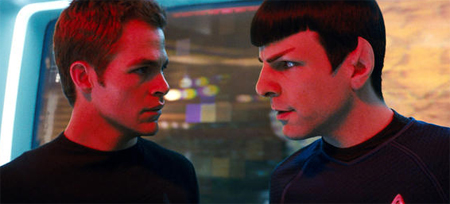
In 1979, Star Trek: The Motion Picture featured the likes of David Gerrold and Bjo Trimble in small roles, transmitting a subconscious wire that, whatever the film’s faults, this was really an expensive telegram for the fans. Thirty years later, with similar commercial circumstances in place, Vulcan Council Member #1 is played by the notorious hack screenwriter Akiva Goldsman — the no-talent Oscar-winning scribe behind Joel Schumacher’s Batman movies, the man who had the effrontery to butcher both Lost in Space and Asimov, and who was recently reported to be sodomizing Dave King’s excellent novel, The Ha-Ha. If this representative casting doesn’t spell out the Sino-British style handover of the Star Trek franchise from the fans to the hucksters, then perhaps you may not understand that Hollywood has remained quite interested in systematically raping your childhood if it will fill its coffers.
Since comparative points are often the best place to start, let’s just say that J.J. Abrams’s Star Trek isn’t as bad as Star Trek V: The Final Frontier or Star Trek: Nemesis. I realize that’s a bit like telling you that having a dentist rip out your molars without anesthetic is better than getting repeatedly stabbed in the eyeballs. For the undiscriminating fanboy who will lap this movie up without complaint, the film is about as good as Star Trek: The Motion Picture and Star Trek: Insurrection. Which is to say that it isn’t up there with the sublime quartet of Star Trek II: The Wrath of Khan, Star Trek IV: The Voyage Home, Star Trek VI: The Undiscovered Country, and Star Trek: First Contact. It isn’t one of those movies you’re going to geek out about, although Eric Rosenfield and I spent more than an hour in a diner expressing our frustrations about the film’s total misunderstanding of basic science (And neither of us are scientists.) There was a point where the film almost had me, but J.J. Abrams betrayed that trust by having three guys in spacesuits enter into a planet’s atmosphere without burning up. This mesospehre-defying trio eventually land on a drill platform tethered to a space elevator that is floating several thousand feet above the planet’s surface. And even after the considerable wind factor has whisked away the token red shirt, the remaining crew members still manage to duke it out with Romulans while standing on the platform. Which is as improbable as Philippe Petit juggling fifty chainsaws while standing on the wire between the Twin Towers in 1974. The man certainly had skills, but the world has physics.
These fighters don’t contend with wind, even as the planet is in seismic upheaval. Indeed, they perform acrobatics while fighting on the platform. (For those who don’t mind spoilers, Eric has outlined some of the egregious specifics in his review.) When John Rambo leaping off a cliff without so much as a scratch on his body carries more plausibility than a Star Trek movie, you know that the latter has serious narrative issues. (And speaking of cliffs, the scientific discussions involving Kirk’s fingers in the trailer are worth revisiting. This post demolishes the physics and even has Neil deGrasse Tyson showing up in the comments.)
All this is a shame because the new cast, who I’ll get to later, is quite good. But the “every other rule” that used to be applied to the Star Trek movies is no longer valid. And that’s because J.J. Abrams and his team really don’t get Star Trek. I suspect that they don’t even like Star Trek. And let’s face it. Today’s most critically and commercially successful franchises are made by geeks like Sam Raimi and Peter Jackson, not cold and calculating businessmen like J.J. Abrams. If Star Wars: The Phantom Menace served as Lucas’s visceral betrayal to his fans, perhaps epitomized best with the unpardonable Jar Jar Binks, then J.J. Abrams’s Star Trek (a more aloof and uninformed vision than Rick Berman’s) is more of an intellectual betrayal. It has a few good ideas to shake up some of the creaky complacency that has set in, but it still staunches the bloodflow. The film is not outright bad. It’s good that the crew of the Enterprise is carrying on in some form. But what now is ultimately the point? The Star Trek of 1968 was utopian and futuristic. It projected a hokey but earnest progressive vision. And even in television reruns, you could somehow believe that this was a future that could happen. But the Star Trek of the last two decades has been constantly playing catch-up with present-day technologies. Despite the presence of geek outreach representative Simon Pegg in the role of Scotty, this Star Trek is all about the cold hard cash. (And to give you some small sense of the commercial sacrifice, Pegg has shaved off his goatee for this. Apparently, there’s no room for true geeks in this new commercial vision. Nor is there any room for the handicapped. In a move that will surely ire legions of handicapped Star Trek fans, at the end of the film, Captain Christopher Pike is stripped of his command and booted up to admiral because he now sits in a wheelchair. Pike isn’t burned or scarred or given two lights to flash his affirmatives and nays before a magistrate, but he remains quite lucid despite having chowed down a Centurion worm. Which leaves one to wonder why the Americans with Disabilities Act isn’t applicable to the rosy humanitarian goals of the future.)
The problem may lie in the conceptualization. It’s a little discussed chapter in the Star Trek franchise history, but shortly after Harve Bennett produced the dreadful Star Trek V, he had an even worse idea called The Academy Years, focusing on Kirk and Spock when they were young Starfleet cadets (believe it or not, John Cusack was in mind for the younger Kirk) and featuring William Shatner and Leonard Nimoy bookending the film in small roles. Top brass were initially wary of a film released around Star Trek‘s 25th anniversary that didn’t feature the regular cast. Bennett wrote more wraparound scenes for the veteran thespians. But the project was eventually scrapped, and Bennett was gone from Paramount not long after.
What’s striking about this reboot is how close it resembles purported descriptions of Bennett’s The Academy Years. Like Bennett’s story, the young Jim Kirk is a reckless rebel smashing up vehicles in Iowa. (In Abrams’s film, he drives a motorcycle instead of Bennett’s speeder bike.) Like Bennett’s story, young Spock is told not to go to Starfleet, with Spock informing his fellow Vulcans that logic suggests that he go anyway. The people of Earth are, in this phase of the Federation’s existence, still bigoted. (What’s interesting about this reboot is that the “green-blooded” racism originates not from McCoy, but from Kirk. It is McCoy who perpetuates this verbal ignominy. The suggestion here that Kirk’s red state beliefs are somehow responsible for sullying Starfleet’s blue state virtues is a daring and subversive one, but one that the writers have neither the skills nor the intelligence to fully weave into their narrative) We may never know whether writers Roberto Orci and Alex Kurtzman (who also “rebooted” the Transformers mythos in disastrous collusion with Michael Bay) were aware of Bennett’s script, or if Paramount felt compelled to draw upon some of the ideas for some source material. But while these two writers may know how to write a dumb yet engaging high-octane thriller, they don’t know elementary science and they sure as hell don’t know Star Trek.
In order to reboot the series, you have to comprehend a number of very important principles behind Star Trek. First, Star Trek has borrowed liberally from science. So much so that physicist Lawrence Krauss wrote a book called The Physics of Star Trek and entire websites exist attempting to provide scientific explanations for the concepts. People have devoted their careers to science because they have been inspired by Star Trek. The transporter beam and the slingshot time travel effect seen in “Assignment: Earth” and Star Trek IV: The Voyage Home may not have any real-world counterparts. But the details are vague enough for us to believe in the premise. So when J.J. Abrams and his writers have a starship hovering next to a black hole, or someone observing a black hole on a nearby planet, and none of this adjacent space gets sucked into a considerable gravitational pull, this goes beyond lazy writing and into the realm of unbridled idiocy. It’s a big fuck you to the fans. (The science geeks aren’t the only ones left huddling in the cold. IT geeks will also bristle over one scene in which Chekhov must run several decks to a transporter room to beam aboard two people. Despite the Enterprise containing limitless displays of consistently shifting text and graphics, Abrams and his team apparently haven’t heard of VPN.)
And while I appreciated the Starfleet skirts returning and the general defiance of political correctness, one of Star Trek‘s appealing qualities has always been its multiculturalism. You’d think that, in an Obama presidency, we’d be given a Uhura who is more than a leggy linguist. But Uhura’s screen time involves fending off advances from Kirk and throwing herself at Spock. She’s a character composite of Nurse Chapel and the Nichelle Nichols incarnation. This is not a character who is permitted to think or offer solutions. Sure, she intercepts and translates a vital radio transmission. But it is Kirk who seizes this information and uses this to advance up the ranks of command without crediting Uhura. Again, if Kirk embodies the ugly capitalist who keeps utopia’s engine running, there’s some promise in the suggestion. But the writers simply don’t have the chops to think along these lines and make this interesting. Indeed, with Uhura so exploited, it’s evident that the writers barely grasp feminism’s second wave. (It’s worth noting that Kirk does sleep with an Orion, but she resembles nothing more than an attractive actress who has been painted green. There is nothing “exotic” about her, and the film offers no contemporary answer to the Vaseline-smeared lens or the strange soft lighting that greeted many of the women in the original series. So even if the film adopts the position that sexual conquest is alive and well, it lacks the courage to be forceful about it. And it becomes as cowardly as the G rating attached to Star Trek: The Motion Picture.)
J.J. Abrams’s film flits through three years in Starfleet Academy with all the contrivances of a by-the-numbers TV movie (complete with a few token “farmboys” that seem more applicable to Luke Skywalker than Jim Kirk), it’s worth pointing out that Kirk and Spock never required an origin story. They were never characters who, outside of homoerotic fan fiction, we were supposed to speculate about. With their cinematic incarnations, we had three seasons of the original series to inform our view. But what we have with Abrams’s Star Trek is a solid cast very familiar with the cultural canon, but a group of filmmakers who fundamentally misunderstand the truth behind the legend. Bennett’s The Academy Years was vetoed for the right reasons. We want to see the Star Trek crew in action, using their seasoned experience and skills to battle it out with Klingons. We want to see them contend with scenery-chewing villains like Khan Noonien Singh or General Chang. We want to see Shatner shout “KHAAAAAAAAAAAAAANNN!” Who is our nemesis in Star Trek? Eric Bana, who could not even pull off Bruce Banner (and caused the studio to act as if Ang Lee’s Incredible Hulk adaptation had never happened). Presumably, he was cast as the Romulan because he starred in a movie called Romulus, My Father. And why have a cheesy actor in the role of a Romulan commander? The Romulans were often commanded by women — most notably the commander in “The Enterprise Incident,” who tempted Spock with both lust and knowledge. But in a typically sexist move by Abrams, we don’t see a single woman on board the Romulan ship. It’s as if Abrams and company confused the Klingons with the Romulans. Indeed, in a prosthetic move that desperately attempts to one-up the ridged Klingon forehead introduced in Star Trek: The Motion Picture, the Romulans have been given bald pates and silly tattooed faces. They look like something out of a bad cyberpunk movie from the 1990s.
And to give us characters fresh out of the academy, permitting them to run the Enterprise through contrived circumstances just days out of the gate, is somewhat entertaining but unacceptable. We get an explanation for the “Bones” nickname, but wasn’t this a mystery better left unknown? We get cliched dialogue like “I knew I should have killed you had the chance,” but this lacks Star Trek II‘s melodramatic poetry (“I’ve done far worse than kill you, Admiral. I’ve hurt you. And I wish to go on hurting you. I shall leave you as you left me. As you left her. Marooned for all eternity in the center of a dead planet. Buried alive.”). (Come to think of it, should there be a reimagined Star Trek II, perhaps Nicholas Meyer might be coaxed to write it.) Even the stardates here have been replaced by crude anno domini.
All Abrams has here to sustain his tentpole picture are desperate references to previous films. An ice planet evoking the Klingon prison planet in Star Trek VI. A slimeless Centurion worm that rips off Star Trek II‘s slimy Ceti eel. The three Vulcan computers used to rehabilitate Spock’s intelligence at the beginning of Star Trek IV. The lone Spock investigative mission in Star Trek: The Motion Picture recycled late in the film. This is a film that offers a phaser with a sliding click, but that simultaneously gives us the fundamentally stupid idea of red matter. This is a film that has the courage to make Spock unapologetically emotional, but that has the fine Karl Urban simply doing an accurate DeForest Kelly impression (complete with a prefatory “My God, man!”). Chris Pine has the ego and the masculine swagger to sell Kirk. And I can even imagine him putting his own spin on the immortal line, “I am Kirok!” But even Pine is given a Shatneresque “Bones” boom when he takes the bridge near the end of the film. John Cho is Harold as Sulu, and it’s just possible that the excitable Anton Yelchin may be his Kumar. But even Zachary Quinto, who was better as Spock than I anticipated, is doomed, like the rest of the cast, to mimic the cast that came before.
Had Abrams taken the chances that Ron Moore did with his Battlestar Galactica reimagining, this might have been a franchise worth getting excited over. But Abrams’s failure to shake up the Star Trek universe while remaining fundamentally true to the franchise’s underlying appeal is a sign that some mausoleums are best left sealed and that reinvention is another way of saying that you’re out of fresh ideas.


 Correspondent: John Updike. He wrote a piece called “On Literary Biography” — I’m pretty sure you’re familiar with it — in which he asked whether we needed literary biographies at all. He concluded that “[t]he vocabularies of psychoanalysis and of literary analysis become increasingly entwined; though we must not forget that these invalids receive our attention because of the truth and poetry and entertainment to be found in their creations.” Now, of course, in the last piece he wrote for the New Yorker, after his death, he reviewed your book. And he wrote that “all this biographer’s zeal makes a heavy, dispiriting read,” where he wanted your narrative “pursued in methodical chapters that tick past year after year, to hurry through the menacing miasma of a life which, for all the sparkle of its creative moments, brought so little happiness to its possessor and to those around him.” So I put forth to you, Mr. Bigshot Literary Biographer, why do we need literary biographies? Are you perhaps more of a literary historian? Because there is a considerable amount of detail in this. Would you call your book more of a history? Is it really gossip-peddling? What’s the deal here? Defend yourself from Mr. Updike’s charges!

 Correspondent: I had a rather funny question. But it’s one concerning your films that I have been obsessed with for some time. And I was pleasantly surprised to see the motif crop up again in Adoration. And that is your propensity to have shots set in airports or custom lines. We have them in the beginning of Exotica. We have them in Ararat with Christopher Plummer.
 Correspondent: You have Emily and Lowboy entering at the 14th Street station. I’m going to get subway geeky with you here.