Posts by Edward Champion

Edward Champion is the Managing Editor of Reluctant Habits.

In Defense of David Denby

In an effort to liven things up, New York Magazine has assigned Adam Sternbergh, the snark practitioner who cut his teeth with Fametracker, to review David Denby’s Snark: It’s Mean, It’s Personal, and It’s Ruining Our Conversation. I don’t believe the subtitle is fair to the arguments contained within the book, but I can understand why some marketing type at Simon & Schuster included it: controversy drums up sales. And controversy, particularly the unthinking and tendentious variety that is on display in Sternbergh’s review, drums up attention.

As someone who has actually read Denby’s book, and as someone who has indulged in snark from time to time, I find myself in the strange position of defending Denby. Sternbergh’s “appropriate response” completely misses the point of Denby’s thesis and Sternbergh, in his efforts to persuade us of snark’s great glory, unintentionally reenforces Denby’s argument.

Denby does not, contrary to Sternbergh’s claims, argue that snark is “humor as a vehicle for cruelty.” Denby states at the beginning that he’s “all in favor of nasty comedy, incessant profanity, trash talk, any kind of satire, and certain kinds of invective.” And he concludes his book on the same note, urging readers and writers to commit “vituperation that is insulting, nasty, but, well, clean.” If one must be vituperative, Denby hopes for writing along the lines of Gore Vidal’s evisceration of Truman Capote in his 1976 essay, “Some Memories of the Glorious Bird and an Earlier Self,” in which Vidal’s carefully worded insult (labeled here as “high snark”) takes into account specific biographical details about Capote. In Denby’s view, this follows quite naturally in Juvenal’s tradition. And even he cannot resist this.

Nor is Denby “rehashing the arguments mounted against irony.” It is indeed irony that Denby is championing. Denby brings up Stephen Colbert’s infamous 2006 appearance at the White House Correspondents Dinner, writing:

I don’t think the jokes are Colbert’s best, yet the event is still a classic of comedy and of citizenly virtue. Why? Because it’s not snark. It’s irony, an apparent act of kinship with the president that is actually a violent unseating of the president. (121)

But irony alone isn’t what Denby’s after here. He believes that good satire involves praising “some corresponding set of virtues, even if only by implication.” And in Sternbergh’s view, it is the “acid-tongued readers” who constantly complain that present “the best fans a culture could hope to produce.” While sarcasm and vituperation certainly have their place, and can be exceptionally potent qualities when a writer wishes to pursue a larger truth, I must again side with Denby here. Is it really “passion” that drives a writer or a commentator who is always sour? Or is there really nothing more than bitter resentment? What is the point of nothing more than nimble flayings if you are not fighting for something better?

Sternbergh also takes umbrage about Denby’s observation that snark “has too modest a rooting interest in artists actually succeeding at anything,” and insists that the contributions to Television Without Pity were “never, ever, disengaged.” But “disengagement” is not what Denby is identifying here. One can be sourly “engaged” when one is merely an “acid-tongued reader” too terrified to express anything joyful or marvelous about the universe. Denby’s wondering why some writers refuse to offer so much as a positive word. And Sternbergh, in his defense of TWoP, never cites a single example from the website in which its writers wrote something along the lines of, “That episode of Lost was fantastic. And the filmmakers should be commended for an intelligent script and taut direction.”

I agree with Sternbergh that Denby doesn’t quite identify where snark originated (but he does make a half-decent effort to pinpoint its contemporary roots at Spy Magazine), but the very irony that Sternbergh identifies as “a defense against inheriting a two-faced world” isn’t the issue here. Because the best defense in these cases is hardly an effective offense. As Denby observes of Spy‘s infiltration of Bohemian Grove, “The malicious rug-pulling was fun to watch, but there was also something creepy, parasitic, and fully meaningless about such minor invasions. Spy never did find out how power worked in New York or what deals between political and corporate honchos were struck in Bohemian Grove; it discovered only where power hung out and what its vulgar habits were.” While I disagree with Denby’s suggestion that pranksterism and tomfoolery fail to loosen minor realities which lead others towards a better understanding of how the world operates (computer hackers, driven by curiosity and mischief, force administrators to enact better security; Sarah Palin is revealed to be woefully unqualified by a Quebec comedy duo), he is right to point to a certain vacuity in many snarky experiments. You can read a website like Television Without Pity and realize that the people who write for it are wasting their talents drinking in nothing but the poisonous tonic of sarcasm. These writers have no desire to understand or properly rebel against the “two-faced world” that’s apparently so evil. Indeed, in TWoP’s case, NBC Universal snatched it up and this caused others to take umbrage at the distilled results.

This is the precise cycle that Denby identifies in Gawker (citing Vanessa Grigoriadis’s “Everybody Sucks”). The real motivations of these young snarky writers are to take the jobs of those within the mainstream. And just as Jessica Coen and Choire Sicha have moved within the gates, so too has TWoP. The “revolters” become the establishment. The founders flee their garret and get good jobs. And then they have friends, such as Adam Sternbergh, defending them at their new vantage point in the parapets. (See an archive of Tara Ariano’s articles for New York and an archive of Sarah D. Bunting’s articles for New York. Both were founders of TWoP.)

Sternbergh quotes Denby’s “lazy generalization” about people in the thirties and the forties being “in the same boat,” but he conveniently elides the sentences that follow:

But at the moment, the attitude is that there is no common boat, and that, if there were one, other people should be thrown out of it. Income inequalities and Rovian tactics that exacerbate ethnic and class differences have made for sandpapery relations or blank indifference, and snark serves not to break down the walls of loneliness and fear but to solidify them by servicing communities held together by resentment. This isn’t the place for economic and sociological analysis, but everyone knows there’s an infinite amount of anger out there.

Now, you could calmly point out Sternbergh’s almost total inability to grok historical context or his failure to challenge Denby on how snark “breaks down the walls of loneliness.” Or you could respond, “Sternbergh, you dumbass, have you ever read any fucking books about the economic and social conditions during the Great Depression or World War II?” Witness Sternbergh’s total disregard for (a) trying to figure out where Denby is coming from and (b) deliberately cutting off his quote so that Denby’s larger point about isolation is curtailed.

Denby is certainly not disputing how Peggy Noonan’s slip clips away at pores in the wall. His argument rests on how snark fails to puncture it. When Maureen Dowd, who Denby devotes a full chapter to, consistently shifts her messages or fixates on Al Gore’s mannerisms (which has nothing to do with political realities), he is pointing out quite clearly that the snarky response is not always the best response and that, without any corresponding set of virtues, it’s utterly meaningless to public discourse.

While there may be some truth to Sternbergh’s theory that snark may turn its volume down if people say what they actually believe, one is likewise struck by Sternbergh’s unwillingness to give Tom Cruise the benefit of the doubt. I’m certainly no Tom Cruise fan, but I’m not such a jaded bastard to view Cruise as a total enemy incarnate (particularly with true scum like Bernard Madoff swindling good people). Cruise has certainly made an ass of himself jumping on Oprah’s couch and the like. But like Denby, I’ve never met the guy. And I probably never will. For all I know, we might get along.

What I can address is Tom Cruise’s strengths and failings as an actor. That is within the legitimate realm of public discourse, because that is my relationship with Tom Cruise. I can likewise address, as Sternbergh suggests, the “draconian information control” that prevents Cruise from answering tough questions about his craft and perhaps growing as an actor. But what contribution does describing Cruise as “a smaller, yappy version of Arnold Schwarzenegger as The Terminator” make to public discourse? How does it help us to understand Tom Cruise? It would be just as ignoble if I described Adam Sternbergh as a “third-rate David Caruso with a silly chin” (based on this photo) or Sternbergh describing Denby as “an Internet-age Andy Rooney” in his review. But what merit or thought do such descriptions have when we are considering thoughts and ideas? None whatsoever.

Denby isn’t asking us to keep our voices down. He’s asking us to reconsider how we use our voices. And unlike previous books that have railed against the Internet (recent volumes from Lee Siegel and Andrew Keen come to mind; Denby, for what its worth, dismisses the former), Denby is not entirely against the Internet’s possibilities for expression. And this is what makes his book more nuanced and more interesting.

He rails against anonymous trolls, but his complaints extend more to the anonymity behind the comment. Why go to the trouble to slander someone when you can put your name to it? (Easy. You divest yourself of responsibility.) He bemoans websites and blogs that don’t bother to check or corroborate information, but that insist that they’re doing a better job than mainstream journalism while they simultaneously declare that they lack the time and the resources to fact-check. (And to demonstrate that Denby is not an enemy of the Internet, he commends Talking Points Memo for its fact-checking.)

He also bravely reveals an excerpt of his own snark, to show that he is not above taking snarky potshots. Indeed, we’re all capable of it. That’s part of the problem. Do we lob Sternberghian spitballs at those whose arguments we cannot intelligently address? Or do we do so with a corresponding set of virtues in mind? Do we say something positive or constructive every now and then? If we work in media, do we close the gates to those who are just starting out? Or do we give these struggling voices opportunities and include them into the framework? Most importantly, do we siphon our rage into something that involves unexpected revelations about the world we live in? Just about anybody can fire off a cheap shot, but it takes a thoughtful individual with real guts to reveal the full scope of terrible truths. And to give Sternbergh the benefit of the doubt, I hope he reconsiders what pursuing these truths really entails.

Grand Central Spams Twitter While Westlake’s Corpse is Still Warm

gcpublishingwestlake

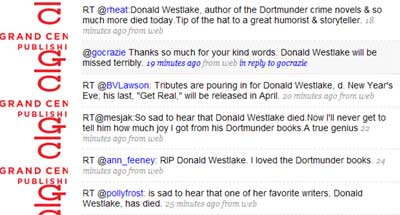
Not less than 24 hours after the news of Donald E. Westlake’s death was broken by the New York Times‘s Jennifer 8. Lee, Grand Central (Westlake’s publisher) has seen fit to flood Twitter with endless retweets of what others have written about Donald E. Westlake, while simultaneously promoting Westlake’s final novel, Get Real.

How would you like it if some huckster was trying to sell you something while you were attending a funeral? In all likelihood, you would punch the huckster in the face. Unfortunately, Grand Central can’t be punched in the face through Twitter.

Adding insult to injury, @GrandCentralPub has been offering a retweet every one or two minutes, polluting all of the collective tweets. So when one searches for “Westlake,” one now has to sift through endless garbage promulgated by the Grand Central people. These “marketing efforts” not only deface Twitter’s community with crude spam, but they are exceptionally crass and highly insensitive towards the feelings of those who loved and revered Donald E. Westlake.

Other publishers, such as Soft Skull and Algonquin Books, have actively engaged with other people on Twitter, participating in conversations but without any prolific marketing efforts. But Grand Central Publishing simply doesn’t get it. Grand Central lacks the maturity and the understanding to view Twitterers as human beings and apparently perceives you as unthinking consumerist sheep. Because of this, I strongly urge all fellow Twitterers to block and unfollow Grand Central. If Grand Central can’t sit at the grown ups table, they need to be relegated to the kid’s room where their base and tacky efforts will be responded to with the appropriate puerile responses.

[UPDATE: For what it’s worth, Grand Central has now apologized, although they have interpreted these feelings as “feedback.”]

Why Was Adam Buckman Let Go From the New York Post?

buckmanOn December 31, Gawker’s Gabriel Snyder reported an unconfirmed rumor. Adam Buckman, the New York Post‘s television editor, according to Snyder’s “tipster”, was escorted out of the offices and his computer was seized. While it is true that Buckman’s last column appeared on December 15, 2008, the story grows more mysterious when one considers that the New York Daily News‘s Jonathan Lemire likewise reported on this story, only for the Daily News to retract the link days later. (The cached version can be found here.)

Lemire reported that “[i]t was not immediately known if his computer was turned over to a law enforcement agency,” and he also reported that a police spokesman informed him that Buckman was not charged with any crime.

There are some questions here: (1) Why was Buckman let go? (2) If the information can be confirmed, why was his computer seized? (3) Why aren’t The New York Post and Buckman talking? (4) Why was Lemire’s article pulled by the Daily News?

I do not believe it is fair to Buckman to toss around accusations until we have some quotes or hard evidence, and I will be conducting some independent investigation on this story to determine some answers.

Nevertheless, if both Snyder and Lemire are relying on rumors (rather than hard information) to smear a man’s reputation with insinuations (there have been unsubstantiated suggestions of potential impropriety in the Gawker thread), they need to come clean and reveal their specific sources.

[UPDATE: I have made efforts to contact Lemire, New York Post editor-in-chief Col Allan, and related parties to this incident.]

[RELATED: It’s worth observing that Mr. Allan has a reputation for a fiery temper in December. On December 18, 2007, the New York Observer‘s John Koblin reported that metro editor Dan Colarusso was upbraided in front of his colleagues and was, at one point, kicked out of a meeting. Like Mr. Buckman, who remains silent, Mr. Colarusso declined then to go on the record.]

Donald E. Westlake Dead

The New York Times is reporting that Donald E. Westlake is dead. I am exceptionally stunned by this. Westlake was a very important writer. And I hope to have something coherent later. Needless to say, if you haven’t read the Dortmunder books or the Richard Stark Parker novels, get on it now. This man was just about the finest writer in mystery. His loss leaves a staggering chasm that won’t be filled anytime soon.

[UPDATE: Assorted links over at Sarah’s.]