- It appears that NPR plans to expand book coverage on its website, largely because “books are among the top three topics attracting traffic to the NPR site.” I can only ponder what the other two topics might be, but I’m guessing that it’s neither gerontophilia nor Half-Life mods. Nevertheless, this does demonstrate that the current demise of books coverage may be greatly exaggerated. If newspapers and other publications wish to carry on as if books don’t matter, and if they wish to live in a future in which they choose not to associate themselves with books, whether it be the coverage or the brand, then people will go elsewhere. To places more reasonably associated with books. So the question that any publication should be asking right now is whether it wants to lose such a prized audience. (NPR, incidentally, is ranked 1,633 on Alexa. So this ain’t exactly a small potatoes question.)
- The rather appropriately named Perry Falwell was accosted by a woman who insisted that he purchase a bundle of books from her deceased husband. He discovered a kinky alternative usage for these tomes. It remains unknown whether the woman in question has been informed of her husband’s sordid secret or if she may have been one of the subjects photographed for these clandestine purposes from beyond the grave. But I’m thinking that she did know what was going on and was only being friendly. We should all be asked every so often if we must really love to read. By the same standard, those at a sex party should probably be asked every so often if they must really love to fuck, so that they might be afforded new literary entry points. (via Bibliophile Bulletin)
- Meanwhile in a London high court, freelance journalist Shiv Malik is being asked to hand over source material and pay legal costs for a book on terrorism. The source material in question was limited to a specific terror suspect only after he fought an overbroad judicial order at the cost of £100,000. What’s striking is that the judges criticized Malik, pointing out that the journalist had “achieved very little from these proceedings.” If by “very little,” the justice is referring to tiny sliver of UK journalistic freedom that now costs a comfortable annual salary to fight, then I suppose he’s right. But I doubt that Josh Wolf and Vanessa Leggett going to jail for similar purposes here in the States amounted to “very little” for them personally. “Very little” is also one of those handy modifiers one can just as readily apply to the probity of such unwavering authoritarianism.
- Character actor Don S. Davis, a man who was born to play authority figures and who I’ll always remember as Major Garland Briggs, has died.
- Ruth Wajnryb kickstarts a linguistic meditation from a sentence taken from an email. Me? So long as the article’s typo stands, I’m now contemplating just what “a friend of mind” is. Does the cerebral attachment to “friend” suggest that one is not permitted to feel when communicating? That there should be some separation between conceptual riffing and giddy exuberance? Did Ms. Wajnyrb type “mind” instead of “mine” deliberately? Is this an Australian thing? And why didn’t she opt for “my friend” in that lede? If she truly meant to pin down a cerebral friend, should it not have been “a friend in mind?” Or is this a reference to Toni Morrison? Sixo loving the Thirty-Mile Woman? Could it be that my problem with this phrase has something to do with my feelings for Morrison? Or perhaps my hesitancy here comes from my objection to the societal expectation that we must separate thoughts and feelings, choosing one or the other. Particularly when we’re writing letters. But if T.S. Eliot objected to this dichotomy, then I feel sufficiently justified in lodging my own complaint (even if I don’t possess even a tenth of Eliot’s poetic knack and acumen) and I would encourage others to do the same. There are some days in which I am careful with my words, and other circumstances in which I am overtaken by a wonderful emotional torrent! To acede to one or the other (and it’s often wholly the mental) seems a rather humdrum and uninteresting life to me, but the choice seems to suit many people and ensures that a swimming pool can be constructed in the backyard or the last ten payments on the luxury car will go through. But for me, it’s resulted in a few awkward social encounters in which I feel compelled to suggest that there is an inverted, if not anarchically fused, way of living.
- And this is most certainly the way to respond to a rejection slip.
Author / Edward Champion

Statement of Intent
1. No matter what happens in the present or the future, I will not remove a name or a reference from any past blog post. If there are significant changes to past content, I will be forthright about why the content has been adjusted or removed and offer a public explanation.
2. Even when I have mixed or negative feelings towards a blogger, if I have found a link from that blogger’s site, I will properly credit them.
3. Critical comments that take to task the posts here are welcome. But if you regularly troll on these pages and wish to pollute meaningful discourse, you will be banned from commenting. I remain as benevolent a dictator as I can. A number of people who have been particularly hostile have still been permitted to comment and have not been banned. Since 2004, I have banned only four people from commenting and viewing this site. These have been truly extraordinary cases. People who visit this site around fifteen times a day and get off on leaving bile (so the logs say). I have banned these people more out of concern for their emotional health than for any particular thing they have to say about me. (I also reserve the right to close a thread, if I feel that it has gone on far enough.)
4. I will not disemvowel any comments. These are the actions of a moderator too terrified to think outside her hermetic bubble. Commenters have been especially helpful in pointing out corrections, changing my mind, and otherwise helping me to articulate better. Even when I violently disagree with a comment, I generally try to find something within it. Therefore, it behooves me to respect their right to express themselves within the parameters of this statement.
5. If I have reported a factual error, please email me and I will correct it. If you wish to change my mind by informing me of certain facts, I remain open to your thoughts. I have been known to update specific posts here when such information has been presented to me.
6. I will not publicly post your private email. I respect your right to privacy. I believe that, as a blogger, there must be a private conduit as well as a public conduit.
7. If I am interviewing you, and you tell me something that is “off the record,” as far as I’m concerned, it’s off the record. (This policy, incidentally, has resulted in a number of great stories delivered to my ears. Too bad that I can’t tell you about them.)
8. If you wish to discuss something with me or clear up something on the phone, I will do this. This has happened a few times and I have listened to the party relay his side of the story.
9. These rules are open to amendment. And if I decide to amend these rules, I will certainly do so. But if I violate any of these rules, you have every right to tear me a new asshole. Particularly if I’m silent for days about it.
The Bat Segundo Show: Fiona Maazel
Fiona Maazel appeared on The Bat Segundo Show #212. Maazel is the author of Last, Last Chance.

[LISTENING NOTE! Please note that this show contains numerous grinding noises. We have endeavored to remove as many of these as possible, and reduce the noise where possible. Alas, SOME aural residue remains.]
Condition of the Show: Considering the niceties of superplagues.
Author: Fiona Maazel
Subjects Discussed: Being under observation, the relationship between kosher chickens and superplagues, rich WASPy girls, individual vs. societal ironies, keeping the protagonist’s name somewhat secret, Mary Shelley’s The Last Man, on not reading Camus for protective purposes, Panic in the Streets, the anxiety of influence, opting for a more realistic plague narrative, using humor to cantilever a dark narrative, devising multiple historical voices, pawing around in the dark, reincarnations, Groundhog Day as the essence of reincarnation, thongs and corporeal elliptical themes, the dangers of reading too fast, perceived titular homages to Nabokov, reviewers who are “certain” about books, auctorial intentions, moving around and setting a portion of the book in Texas, wanting to be T.S. Eliot, pursuing the grit, the pervasiveness of television, revolting against cultural media, Nordic tales, developing a conscious understanding of a deity, Stanley as a barometer, and agitprop.
EXCERPT FROM SHOW:
 Correspondent: If one looks at more lower brow choices, like Stephen King’s The Stand or The Andromeda Strain, or any number of superplague television series, like The Survivors and things like that, one tends to find a narrative that begins with the decimation of humanity. Yours is not that particular book. Again, going back to this question of inversions, I’m wondering if you made a particular choice. You had to have known about The Stand.
Maazel: Sure, it’s true. But I didn’t think it was an inversion. I thought it was credible actually. I did a lot of research about plague and also about the CDC and bioterrorism. And just how unlikely the scenario I proposed is. It’s extraordinarily likely. This isn’t an alternate reality kind of novel. It didn’t seem likely that someone would unleash a plague and actually wipe out all of humanity. That’s just not credible. I wanted to come up with a credible scenario. So I guess from the perspective of someone writing fiction or reading fiction, one might expect something like a terrific slate wiper to come along, as we’ve seen in so many of these movies and books. But I actually wanted something that seemed really realistic. That only 3,000 people would die and the fact that they put a stop to it. For instance, when we had this little anthrax outbreak or even bird flu, people are dying, but they’re still containing it. I was more interested in the anxiety, the terror, the foreboding of what could happen. Might this thing wipe out a hundred million Americans or a hundred million people? That was more interesting to me than watching this disease tramp across the country and actually kill off half the United States.
Listen: Play in new window | Download

Roundup
- Based on the steady onslaught (or is that recent onset?) of dumb feature articles within the Atlantic‘s pages these days, it would seem to me that the magazine lacks even the gooiest scrap of albumin these days. Fortunately, this video clip, featuring Atlantic editor and National Review film critic Ross Douthat attempting to explain his “working sociological theory” on the superhero archetype to the whip-smart Dana Stevens, may offer some context and unintentional hilarity. Because the discussion is executed in split-screen (although, oddly enough, nobody mentions Brian De Palma), one observes Stevens’s face drooping in near disbelief as Douthat offers the most generalized response imaginable to her question. Stevens then proceeds to demolish Douthat in a few sentences. It probably isn’t a fair fight, even with Stevens being kind and subduing her intellect. But if you enjoy this kind of thing (I’m afraid I do and I would pay good money to see a hack like Edward Douglas chewed up by Stevens), you can witness the complete thirty minute smackdown.
- Even at the rate of one show per day, there remain a good deal of Segundo shows that I need to finish summarizing. But for those who need more and who want to jump ahead of the curve, you can find more on the main Segundo site, including a recent conversation with Andre Dubus III that features a strange interruption by a hotel catering manager and a particularly egregious poem about the Olive Garden.
- I think Junot Diaz may be the first Pulitzer Prize fiction winner to confess that he is addicted to a video game. And he’s done all this in a very thoughtful essay. Not even putative Pulitzer geek Michael Chabon, who has bitched quite a lot about snobbery, has had the effrontery to confess anything like this. So for this, I salute Diaz, who comes off as a class act, while Chabon remains a hopeless bellyacher. And this also has me contemplating why America remains so behind the curve on video games. If Martin Amis could get away with writing a book about Space Invaders, then why can’t Richard Russo or Jhumpa Lahiri come out of the closet and confess that they’re big Donkey Kong fans or that they laughed at a Judd Apatow movie? (via Sarah and Shane, the latter of whom has scared the living fucking bejesus out of me with this oversized Camus photo. Tonight’s nightmare will begin, “Mother died today. Or maybe yesterday,” and I will wake up in sweat and tears in the morning, craving cold biscuits.)
- Even authors of crazed picaresque fiction need cheatsheets, although this chart is missing the much-needed “Wacky Sidekick.”
- For all of their folderol of free information and civil liberties, Cory Doctorow and company have proven to be just as adept at Stalinist revisionism. Boing Boing has deleted every reference to Violet Blue in its archives. I’m stunned that anybody would do this. These are the actions of spineless fascists. And, as Rex of Fimoculous observes in the comments, he too was deleted for being remotely critical of Boing Bong. Joanne has more.
- Nigel Beale podcasts Harlan Coben and questions some of Coben’s unapologetic commercialism.
- A man has discovered a German bunker in his garden and is blogging the excavation process.
The Bat Segundo Show: Ed Park
Ed Park appeared on The Bat Segundo Show #211. Park is most recently the author of Personal Days. His book was reviewed today in the NYTBR by Mark Sarvas.
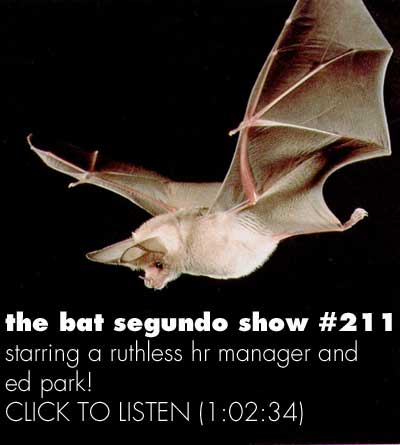
Condition of the Show: Plagued by brutal downsizing.
Author: Ed Park
Subjects Discussed: Literary people named Ed, writing Personal Days and using vacation days while employed at the Voice, counting words written per day, B.S. Johnson, Jonathan Coe’s Like a Fiery Elephant, Harry Stephen Keeler, staying productive as a writer, the other Ed Park novels (The Dizzies, Chinese Whispers, The Diet of Worms, Dementia Americana, et al.), Stone Reader, lost books, writing within tight stylistic constraints, the section titles, “restructuring,” references to Hollywood and the quest for narrative, figuring out “Operation JASON,” waiting for the Eureka moment, making patterns emerge, patterns within character names and working within limitations, the use of italics, writing the third part without a period, having an affinity for exclamation points, Lester Bangs’s Psychotic Reactions and Carburetor Dung, Elizabeth Crane’s “My Life is Awesome! And Great!,” the office as a microcosm for New York, William Gaddis, Harry Matthews, Cigarettes and The Journalist, the relationship between the ability to calculate vs. the loss of the first person plural, consciousness in attrition, Joshua Ferris’s Then We Came to the End, The Office, avoiding the influence of other topical art, Crease in Personal Days vs. Creed in The Office, style vs. content, specific typographical symbols, voice recognition and gobbledygook, William Gibson’s Pattern Recognition and Gaddis’s The Recognitions, office detritus, paperclips that pierce, setting limitations when veering down dark and scatological territory, and the pathological corporate impulse.
EXCERPT FROM SHOW:
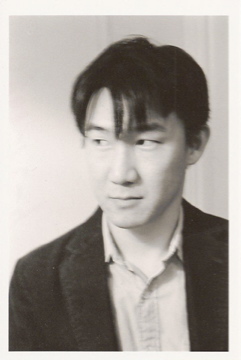 Park: It’s such a pleasure to talk to someone who’s also named Ed.
Correspondent: Yes, I know. I mean, it’s a hell of a first name. There needs to be a Society of Eds set up in the five boroughs.
Park: It’s pretty rare.
Correspondent: I know. I wanted to ask you a commonplace question and then get to the nitty-gritty of this book. I know that you wrote a good chunk of this book while you were working at the Voice. But the sense I got was that you didn’t write all of it at the Voice. So I’m curious as to how much of this was written in a Voice-less setting, so to speak.
Park: Well, if you mean by “at the Voice,” while I was still employed by them, that’s true. Most of it was written before I left the Voice. I was let go at, basically, Labor Day. Right before Labor Day Weekend of ’06. But by that time, I did actually have a draft. There were many changes that I knew were necessary. I wrote it though. In terms of physical space, I could never even write my articles at the Voice. Just in the Voice office. I was hired as an editor. Basically editing, sending emails, on the phone, stuff like that. So it wasn’t really a place where, ironically enough, I could get a lot of writing done. So all the writing took place in my apartment. I was living on 89th Street. A lot of it was the same as I’d done for my previous fictional projects, where I would just try to write in the morning before coming into work. What was a little bit different about this book was that, as things got more tense at the Voice, as things really looked like they were going in a bad way, I took some vacation days, personal days, and would really treat the book as my job in a way.
Listen: Play in new window | Download