- Fans of books turned into Hollywood treacle rejoice! Pat Conroy, not to be confused with Pat Barker, is finishing his first novel in more than a decade. The new book is set in Charleston and is more than 700 pages. Take that, John Irving!
- USA Today has selected “25 books that leave a legacy.” Dan Brown, John Gray and Helen Fielding certainly do leave a legacy: the same one carved out by Spandau Ballet, the starved Twiggy look, and Daniel Boone caps.
- Is it too late to bring civility to the Web? What the fuck are you talking about?
- The hallowed silence of libraries appears to be in jeopardy. (via Bookninja)
- The Chron on what all the recent bookstore closings mean.
- Darby observes Stephen Dixon’s retirement from teaching.
- C. Max Magee is interviewed at Litminds.
- Twin Peaks Season Two: “This TV show did not get workshopped.”
- The latest Pulitzer finalist list.
- Callie Miller investigates the Los Angeles Times Book Prize finalists. (via TEV)
- Erin O’Brien calls out Bryan Appleyard.
- Whitney Pastorek has concerns about the Spider-Man 3 soundtrack.
- Bon Jovi won’t be playing BEA? Lance Fensterman, your “regret” is admirable, but I’m sobbing like a BOP-reading bobbysoxer curling beneath a duvet with a gargantuan teddy bear in a 1985 suburban split-level home. Goddam you, Mr. Bon Jovi! Goddam you all to hell! You cruel, CRUEL man! Well, you can forget about any BEA coverage by this dutiful litblogger. If Jon Bon Jovi can’t back up his literary mojo with his musical mojo, then, while indeed I was halfway there, I shall be living (or perhaps covering BEA) on a prayer. Perhaps if someone takes my hand, I’ll make it. I swear.
- Tim Martin talks with Neil Gaiman. (via Jenny D)
- Charlie Anders: “Just three years in, and the new Doctor Who series already seems to be cannibalizing itself.”
- Christopher Walken had fantastically destructive plans for Silicon Valley in 1985.
- The spring issue of ZYZZYVA is now available online for your literary edification.
- I’m with Lev Grossman. Does anyone still care about the Webbies anymore? Particularly since nominees have to pay $245 to enter into the Awards. The Webbies are the Golden Globes of the Internet: its nominees and ceremonies and sycophantic adulations limited to those who can pay for it. It is about as useful to any discerning Web surfer as a fusillade of pop-up ads.
- The Onion: “‘Most E-Mailed’ List Tearing New York Times’ Newsroom Apart.”
Author / Edward Champion

Indolent Roundup
- Just what the world needs: a Spandau Ballet reunion. When the apocalypse occurs, humans suffering from radioactive sickness will place tinny and barely functioning crystal radio sets to their ears, shuffling in threadbare Chuck Taylor All Stars along the abandoned strip malls and suburban shrapnel, and susurrating, “Ba ba ba ba ba, I know this, much is true.” Then there will be no hope for Western civilization.
- Updike on Wharton bio.
- Sarah Kerr on Joan Didion. (via Laila)
- The new Rupert Thomson book appears very promising.
- The Ray Davis/Jonathan Lethem letters. (via Matt)
- Roberto Bolano! Roberto Bolano! Roberto Bolano! I’m telling you: four people have mentioned The Savage Detective in the past forty-eight hours. You better watch your ass, Joshua Ferris. A new hot author has arrived. Roberto Bolano! Roberto Bolano! Roberto Bolano! I have no basis for this enthusiasm, but everyone else seems excited and I’ll likely check this book out.
- Finn Harvor’s interesting email exchange with Laura Miller.
- Erin O’Brien is one determined woman.
- The top 500 fonts on the web. (via Messr. Peschel)
- The Internet has made obituaries hot again. Perhaps it’s because Internet users spend most of their time surfing in moribund offices.
- Who’s more evil? Ann Coulter or Don Imus? Tough call.
BSS #108: Ken Alder

Condition of Mr. Segundo: Puzzled by polygraphs.
Author: Ken Alder
Subjects Discussed: The connection between polygraphs and Northwestern University, the United States’ fascination with lie detectors and cultural connections, why allied nations use junk science, polygraph tests and employment, the lie detector as coercive device, the CIA, Aldrich Ames, John Larson and William Keeler, Leonarde Keeler, the lie detector vs. due process, waterboarding, August Vollmer, paranoid personal lives of the polygraph progenitors, the subjugation of women, criminal technology and the white male, the polygraph showdown between Ken Alder and Fred Hunter, reliable confessions, American loyalty, detective fiction and tabloid journalism’s role in promulgating the lie detector, polygraphs and movie studios, advertising, Erle Stanley Gardner, asking Doug Moe’s question to Alder, the placebo effect and crime statistics, Alberto Gonzales and contemporary coercion, and the dream of psychological certainty.
EXCERPT FROM SHOW:
Alder: You know, it’s such a bizarre claim. There are different kinds of historians of science, and some historians of science go after the people who have the really big ideas and figure out these great novel ideas like Darwin and Einstein transform the world. And I do the opposite almost. I’m interested in history of the banal — those things that are so ubiquitous, as almost to be invisible. We don’t even notice them anymore. And lie detectors in this country are just part of the landscape and yet we’re the only country in the world that uses them.
Listen: Play in new window | Download
BSS #107: Arlene Goldbard

Condition of Mr. Segundo: Feeling that the community misunderstands him.
Author: Arlene Goldbard
Subjects Discussed: Artistic individuality vs. creative community, the benefits of 20th century funding for the arts, the WPA, community murals, public plays, happenings, the political agenda of “creative community,” collective absolutism, the Forum Theatre and “spectactors,” collaborations between professional and amateur artists, the Great Wall of Los Angeles, the dangers of constant artistic modifications, impoverished people and art, art and fame, reality TV, Stalinism, the Ukiah Players Theatre, and government artistic subsidization.
EXCERPT FROM SHOW:
Goldbard: Marx had this favorite saying: Stadtlyft mach frei. City air makes you free. Which the sense being, in a place of anonymity, you are free to completely express your individual essence and characteristics in a way that you may not be. You may be constrained in the small town you came from. Because people know your name and your face. And you can fool them once, but your probably can’t fool them twice. So there’s a truth that a certain degree of anonymity creates a certain degree of social freedom. And people want that to some extent. You don’t want to be surrounded by gossip. You don’t want people looking over your shoulder all the time. But the kind of community that I aspire to is one in which there’s tremendous permission to be different.
Listen: Play in new window | Download
Johnny Hart, 1931-2007
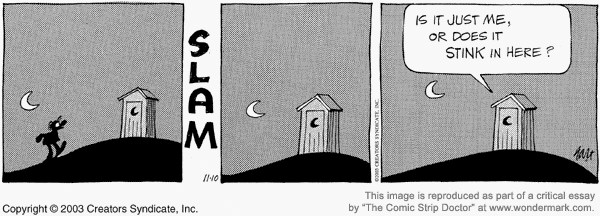
Jewish Journal: “In the days leading up to its publication, the Easter Sunday strip, which featured quotations from the New Testament juxtaposed against images of a burning, seven-branched menorah that transforms into a crucifix, became the object of concern among Jewish watchdog agencies. The 71-year-old Hart has written and drawn ‘B.C.’ since 1958, which appears in roughly 1,300 newspapers, reaching millions of families around the world. Hart, a devout Christian, has increasingly presented strips with explicit religious overtones.”