How This Post Originally Appeared (December 3, 2003):
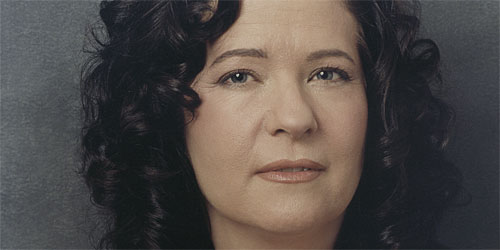
So who is Laura Miller anyway?
Here’s an audio interview* of Miller extolling the wonders of the Internet back in 1999. But, beyond her nasal droll, I must warn you that, if you click on the stream, you’ll probably be frightened by Miller’s pronunciation of the word “niche” or the moment when she kvetches about carrying all those complimentary books around. A harsh life, to be sure. Despite all this, she’s still bitter.
This profile reveals that Miller was born in 1960 and, before getting into writing, started off as a publicist for a co-op that ran “a San Francisco sex toy store and mail order company.” (Apparently, it was Good Vibrations.) One of her first big breaks came with an essay called “Women and Children First”* which appeared in a collection called Resisting the Virtual Life: The Culture and Politics of Information, whereby she proffered the following Third Wave generalizations: “In the meantime, the media prefer to cast women as the victims, probably because many women actively participate in the call for greater regulation of online interactions, just as Abbie Irving urges Wade Hatton to bring the rule of law to Dodge City. These requests have a long cultural tradition, based on the idea that women, like children, constitute a peculiarly vulnerable class of people who require special protection from the elements of society men are expected to confront alone.”
Her last column for The New York Times Book Review section was more about the documentary The Weather Underground than books, but didn’t have nearly as many generalizations as previous inside back page columns. But I’m mystified. Just why is Miller still writing for the Times? And can we hope that Charles McGrath’s replacement will see the light?
To look at this from a pugilistic standpoint, if you threw Michiko Kakutani and Laura Miller into a gladiator pit, I’d favor Michiko by twelve points. At least she has a sense of humor. Plus, the Pulitzer helps.
[3/22/04 UPDATE: Months later, I’ve largely ignored Laura Miller. And looking back at this entry, I see that I’ve demonized her a bit. That isn’t really fair. I should clarify that, since I’ve already spilled my thoughts (some would say foolishly), the transformation of Laura Miller is one of the saddest things that ever happened to books coverage. But I have every hope that the Miller I read five years ago will return.]
Addendum (May 20, 2013):
* — I have made efforts to track down the 1999 Laura Miller audio interview from Platform #3 referenced in this 2003 post, but it appears to have disappeared: no doubt deleted in a frenzy of redesigns and server reorganization over the last fourteen years. But you can read this text version of the same article, which appeared on Radio Australia. Additionally, I believe my original link led to Miller’s early essay, “Women and Children First,” but I can’t find it through Web Archive. I have pointed to someone else writing about it.
It wasn’t fair of me to chastise Miller for her “nasal droll.” But in 2013, Miller suffers from the same problems. When she is edited (such as her essays in The New Yorker), she can be an astute critic. But much of her ongoing work at Salon is not edited. I’m a little embarrassed by my cocky 2004 update. I haven’t been able to ignore Miller, in large part because some people still read her criticism. But her influence has faded in recent years, replaced by the likes of Roxane Gay and Michelle Dean, who have both proven to be more astute critics. But Miller has gone out of her way to ignore me. I only met her once at the National Book Awards, where we were introduced by a well-meaning third party and she gave me the look of someone who had just her dog die in a hot car during summer.
This was the first of many posts that laid into Miller. I had this tendency in my early blogging days to seek out obscure bits of biographical data about people — often material that nobody else had found — in an attempt to try and understand them. From what I’ve learned about Miller from others since, I can see why she would hate this. I didn’t know in 2003 how touchy literary people could be. I have fixed all the non-working links.
Because the Luke Ford reprint of the Examiner article cannot be adequately verified from New York, I’ve confirmed Miller’s stint at Good Vibrations through two separate sources: a biographical note that appeared in the anthology Travelers’ Tales San Francisco: True Stories. Additionally, Sallie Tisdale’s Talk Dirty to Me reports that Miller worked at Good Vibrations, where
“she hosted video nights for women who have never seen pornography. She shows clips from some of the new, more romantic, female-produced films, and then clips from older hard-core films with more traditional themes. “The difficult part for women is that they haven’t had the opportunity to even see what’s available,” she says. The surprise is how many of the women prefer the old hard-core films. “It’s so politically incorrect. I’m glad when they’re willing to admit that it really turns them on, but they also say, ‘It really disturbs me, but this works, and the other one didn’t.'”
Now this Laura Miller sounds really cool.
© 2003 – 2013, DrMabuse. All rights reserved.