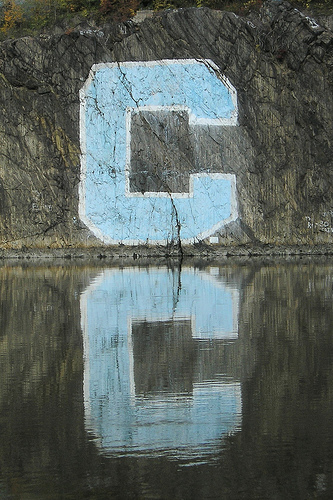
 The cracked light turquoise paint clings to the gneiss on the Bronx side of Spuyten Duyvil Creek, forming the canvas for a stenciled C, a character cloud with a silver lining representing Columbia University. I can report with some small relief that elite rowers are in short supply on a cold February afternoon. But the Amtrak trains that roll across the bridge to the west of the Henry Hudson can be seen emerging on the Bronx side and disappearing behind the Big C. While the rock itself has defiantly exacted fissures through serious chunks of this not-quite-elliptical letter, the paint sits truer near the stems. And you can walk a good hard slog through Inwood Hill Park, slipping on the presently icy trails under the Henry Hudson Bridge leading southwest to Dyckman Street, and not know a damn thing about how the C came to be. You’ll run into friendly geese, with their sinuous necks jutting as slow and methodical and as graceful as their struts, and encounter a number of maps displaying city department propaganda about all the forest preservation going on. But what of the origins of C Rock itself? Nothing. An unknown letter defying history, standing some sixty feet tall but somehow still managing to upstage the large chunks of ice now breaking in the water.
It is commonly understood that a rowing team from Columbia University painted the rock out of school pride. Bill Twomey’s The Bronx suggests an alternate theory: that the rock was painted by engineering students from Columbia and the blue paint was purchased by George Younkheere (along with brushes and rope). In 1994, the New York Times reported that the peninsula was destroyed sometime in 1937 to widen the Harlem River Ship Canal, where the C was later painted. The Times also helpfully informs us that the paint is replenished every few years by Columbia crews. But who? And what authority determines how frequently the rock must be painted? Another Times article four years later informs us that the rock was painted by oarsman in 1955, with then Columbia assistant director of athletics Brian Bodine claiming that the work was done with team members suspended from boatswain’s chairs. But was Bodine there? And how does he know exactly? Are there pictures of the initial rock painting that Columbia is sitting on? (The latter Times article also informs us that there was a touch-up job in 1986. But from my observation, it appeared that the C had been painted a little more recently, perhaps at the stems.)
These shifting details still don’t answer the precise origins of the C, and it may be because the C is perhaps one of New York’s largest items of graffiti. The rock is referred to in some quarters as Geronimo, and there are apparently two physical activities associated with the rock. The first supports the Apache reference transformed into triumphant cry: giddy souls sometimes leap from the top into the creek. The second is reminiscent of that silly climactic scene from the film Gattaca: swim across the creek and back and prove your athletic prowess (and presumably your manhood). The site Inwoodlite claims that C Rock was established on a racist note, but is too diffident to share this with us. It is also known that a Lenape settlement was once situated at the top of the rock. This likewise suggests a clash between civilizations, but perhaps not the kind that the Lenapes would be aware of during their residency.
What’s fascinating is that there haven’t been any legal challenges to the rock. The C was painted and it has endured, quietly endorsed by the Inwood neighborhood and the Bronx dwellers living above the rock. Perhaps it is too unwieldy to rub out. Columbia is understood to have marked its turf on a rock cut by workers, leaving one to wonder whether some ambitious taggers might establish an A Rock and a B Rock somewhere along the Harlem River to ensure an alphabetical symmetry. This will probably not happen. They’ve cracked down on graffiti in the five boroughs, and Ivy Leaguers, it seems, are the only one afforded immunity and a natural canvas. The rest evade bulls and whip out cans and try tagging cars at the ends of subway lines, but their screeds and illustrations, however crude, are washed away to avoid permanence. No such fate for Columbia, whose C may very well be cruder and bolder than the output of today’s taggers.
(Photo credit: jag9889.)
© 2009, Edward Champion. All rights reserved.
Nicely done. It’s nice to see that you have become a true New Yorker.
Yes great article. But I think the only trains that pass behind the Columbia “C” are Metro North trains. Amtrak travels along the Hudson river and crosses at a tresell below the Henry Hudson Bridge.
You may want to check this link to the Columbia wiki, which offers a similar story to yours but with a few different details. [http://www.wikicu.com/Columbia_C] Sadly, it includes no references.
On another point — if you truly feel that “Ivy Leaguers … are the only one[s] afforded immunity and a natural canvas” to graffiti, you should take a walk along St. Nicholas Avenue in Washington Heights. You’ll get a whole new perspective on who gets immunity on permissive painted vandalism.
As for the racist origin (a story I’ve never heard), a re-reading of the Inwoodite blog will clarify that the blogger does not claim the C’s genesis was racist, as you suggest; the blogger instead points out that a tour guide told a racist story about its beginning. Inwoodite, in fact, seems to dismiss the story.
When I was a kid in Inwood in the 50s-60s the “C” was inconplete; it resembled an “L” for many years.
When I was a kid in Inwood in the 50s-60s the “C” was incomplete; it resembled an “L” for many years.
Me and my friends jump off C Rock every summer, especially when the Circle Line comes by.
I remember when the Circle Liner went by 20 or 30 kids mooning the boat as it went by.