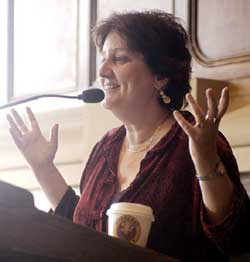
BSS #141: Chimamanda Adichie

segundo141.jpg

Condition of Mr. Segundo: Finding uses for his Kleenex supply.

Author: Chimamanda Adichie

Subjects Discussed: Young novelists and ambitious war novels, horrible Nigerian critics, the novel as the ideal prism for the Biafra conflict, A Woman in Berlin, the advantages of small details, J.G. Ballard, twins, the advantages of narrative dichotomies, adultery and monogamy, relationship fidelity vs. national fidelity, sensuality, specific sexual positions, serial adultery, the skin metaphor, jumping around in time periods, High Life music, the faults of education as a revolutionary galvanizing point, the ethical vacillation of Ugwu, whether sparse details convey the complexities of war, Toni Morrison’s reluctance to write about sex in detail, the advantages of teaching writing classes, names, whether Half of a Yellow Sun is a political book, an unexpected digression concerning Ms. Adichie’s cell phone, and sermonizing in fiction.

EXCERPT FROM SHOW:

Correspondent: I wanted to actually talk about the violence in this book. You describe if often very sparsely. The bodies are decapitated. The people are massacred through brutal racism. But you don’t dwell on really elaborate detail of these particular — of this violence. And even Ugwu’s finale — near the end, I mean, his choice at that bar, it’s only like a half page of ethical vacillation. So I wanted to kind of ask you about that. Do you feel that stopping short sometimes really conveys the complexities of war? Was this an issue for you? Or is this more about the narrative than it is about depicting war?

Adichie: I think it’s about both. I do think that, in much the same way that details work better when you’re writing about something huge. I also feel that if you’re writing about something difficult, violent, that less is more. You know? And that sometimes you run the risk of having it become pornographic. I didn’t see myself — I didn’t want to, quite frankly, describe those bodies over and over. I sometimes feel that one tiny detail is enough. I remember reading something about Toni Morrison, where she said, for her, sex scenes were — she tells the reader, a man is on top, the woman is underneath, and she leaves it there, you know. And I remember reading that and thinking — and she lets the reader and she thinks that’s enough. All you need to know is who’s on top and then you make up the rest. I don’t share that when it comes to sexuality. I sort of want to tell you what happens. But when it comes to violence, I think I do. You know, I want to give you a tiny detail and then — I just don’t want it to get…I think that it’s very easy to go overboard with violence and it makes me uncomfortable. And I think that it also might have something to do with the fact that I was always aware that I was writing about something that really did happen to people. And there’s a kind of — I don’t know if it’s respect. Maybe it’s community that I wanted to bring to those scenes of violence.

Correspondent: I can totally see what you’re saying, but doesn’t this kind of get in the way of pursuing the truth further and really getting at this…?

Adichie: No, I don’t think so. I actually think that sometimes it might make it closer to the truth.

Coming Soon to The Bat Segundo Show

Correspondent: In this title essay, you write, “Observation is my weakness.” And in the second essay, while you openly confess to stalking many of the…

Pollitt: Oh, you know! I’m sorry.

Correspondent: Oh, well…

pollitt2.jpgPollitt: I didn’t mean to interrupt you.


Correspondent: Well, go for it. Go for it. I’ll jump in.

Pollitt: I was just going to say, I was wondering, if I had called that story, instead of calling it “Webstalker,” if I had called it “Googling my Ex-Boyfriend,” would people have been so horrified by it? I really don’t understand this. Maybe you can explain this.

Correspondent: Well…

Pollitt: This is something everybody does. And yet somehow, it’s, you know, I have been called in reviews — maybe she’s insane, why would she reveal such a terrible thing about herself, maybe she needed the money. I mean, I can’t believe it! I thought I was sort of like, well, here we all are and, in fact, in the story — in the story, I have a young friend who introduces me to this word, which I had never heard before. And she was surprised I didn’t have a whole file on my boyfriend, which she had on hers, with a social security number and everything like this. I get the feeling that there are a lot of people that are very suspicious of their mates.

Correspondent: Yeah?

Pollitt: Which I never was. All I did was I sat at my computer and I Googled. And for this, I am being pilloried as if I was a crazy person. I just don’t understand it.

Correspondent: I would think that people are possibly objecting to the fact — they seem to pinpoint precisely, like you guessing the password and wondering what it might be. And hacking someone’s email. Maybe it comes from doing casual Googling, which everybody sort of accepts. But even your friend having the social security number, well there, we get into invasion of privacy issues. So maybe that’s probably the touchy thorn that’s caused…

Pollitt: Well, you know, I hope that that story and the other ones are written in a humorous way. I not only did not manage to get into my boyfriend’s email system. It was really basically a joke. I would be the last person in the world to be figure out how to do that.

[RELATED: In today’s Salon, Rebecca Traister offers a lengthy article about the hostile reception that has greeted Katha Pollitt’s Learning to Drive. (via Bookslut)]

BSS #140: Naomi Klein

segundo140.jpg

PROGRAM NOTES: (1) Our Young, Roving Correspondent claimed that Milton Friedman supported the New Deal. Naomi Klein claimed that he did not. As it turns out, both Our Young, Roving Correspondent and Klein were wrong. In an October 2000 interview, Friedman professed his support for the parts of the New Deal that involved providing jobs and relief for the unemployed. This was the “very exceptional circumstance” that Our Young, Roving Correspondent referred to. Apologies on our end for failing to clarify. (2) For more information on United States suicide rates, here is a solid overview. If suicide is, as Klein suggests, linked explicitly to an economic downturn, what explains the slow rise in suicide during the Roaring Twenties — a then unprecedented period of prosperity? While it is certainly true that the suicide rate rose during the Great Depression, the point worth considering is that suicide is not completely linked to economics. (3) While Klein did not provide a supportive endnote in her book for the post-Solidarity Polish journalistic label “shock therapy,” here is a helpful reference point for those looking for more information: No less an authority than Jeffrey Sachs, who Klein identifies as one of the chief instigators of the “shock doctrine,” observed how “shock therapy” came to be in a 1994 lecture delivered at the University of Utah. Sachs believed that the journalistic label “shock therapy” played into the Eastern European belief that a drastic alteration of the economic system would produce results. While Klein is right to point out that this was a term in use, it remains our belief that it would have been more helpful to outline the specific points of causation.

Condition of Mr. Segundo: Abdicating to journalists.

Author: Naomi Klein

Subjects Discussed: Milton Friedman and the University of Chicago school of shock economics, polarization of the superwealthy, consumer boycotts and “market democracy,” the New Deal, Augusto Pinochet, the good things about Friedman, Edwin Black’s IBM and the Holocaust, the damage from economic ideology vs. innate business corruption, writing an “alternative history,” relying too much on the “shock” label, Samantha Power’s A Problem from Hell, post-Solidarity Poland and “shock therapy,” quibbling with Klein’s footnotes, whether suicide rates can be exclusively linked to economic factors, Israel’s defense export economy, Margaret Thatcher’s England, and whether reduced inflation or the Falklands War boosted Thatcher’s approval rating.

EXCERPT FROM SHOW:

Klein: I’m not sort of just projecting Chicago school ideals onto a country. I’m talking about specific places where key graduates of the program…

Correspondent: Well, I’m not disputing that.

Klein: …came to positions of power.

Correspondent: I am not disputing that there…

Klein: I’m just not quite sure where IBM fits in.

Correspondent: Well, what I’m saying is is that it’s not exclusively this Friedmanesque ideology that is causing these particular factors. I mean, what I’m wondering is — is I present the IBM scenario as, well, here’s a case of, in my view anyway, clear unethical business practice and yet it has nothing to do with Friedman economics. Just as, I mean, yeah, there are plenty of examples you give. The various leaders who are listening to lectures on tape and, of course, all the Chicago Boys, and all that stuff. I’ve definitely read the book. I’m just asking, where does Friedman depart from some of the unfortunate shock treatment that you describe to various…?

Klein: Well, I think the key thing to understand is that I am not arguing that this group of people, that they are the first people to employ these tactics to advance their political goals. And I, you know, I piss off people on the left by quoting Mao and Pol Pot and all these, you know, Communist figures of the past who shared a similar desire to use shock and crisis to push through their agenda, dreamed of societies being a blank slate on which they could build their ideals. I also draw…I also talk about fascism and Nazism and you know, I think that, the reason why I’m focusing on this group of people of the past thirty-five years, as opposed to the book just being a history of everybody who’s ever used shock is that I’m trying to present an alternative history of how we got to where we are. I’m trying to present an alternative history of the ideology that is the dominant ideology of our time, so dominant that we don’t see it. It’s the air we breathe. And I think that we have been living with a fairy tale version of history.

BSS #139: George Saunders

segundo139.jpg

Condition of Mr. Segundo: Feeling a little dead down there.

Author: George Saunders

Subjects Discussed: Writing fragmentary travelogue pieces, trying not to pre-process experiences, observational criteria, Dubai, responding to Ben Ehrenreich’s claim of “pulled punches,” journalistic integrity, on taking people to task, writing comprehensive journalistic accounts vs. one-week accounts, Saunders’s “limited talent,” on “liking to be liked,” the difference between fiction and nonfiction, Minutemen on the US/Mexico border, on taking on a persona, Bob Dylan, the response that came from “‘Borat’: The Memo,” on being called a “tool” and a “young fogey,” cheap edits, mean satire, political labels and satire, generalizations about everything between Los Angeles and New York, not going beyond the first impression, Donald Barthelme, Freitag’s triangle and rising action, why Saunders is savage in fiction, and writing rules vs. writing voice.

EXCERPT FROM SHOW:

Saunders: Each one of the GQ trips was an eight to ten day thing. So really, in a certain way, the form would follow the experience. You know, you go to a place and you’re taking notes like crazy for eight days. And you don’t really know what’s good or what’s interesting and then you come home and start writing them up. And as certain things — you know how it is when you’re writing — sometimes, a certain thing would just lurch forward and it’s writable in some way you didn’t anticipate when you were there. So in a way, it was kind of like taking X number of those things, the ones that would sort of step forward and allow themselves to be polished, and then kind of trust that that was happening for a reason.