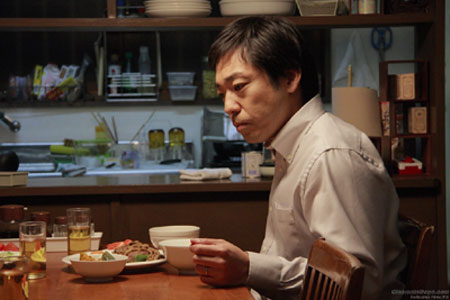
Shortly after I posted my review of Tokyo Sonata, I was contacted by screenwriter Max Mannix out of the blue. While Mannix was putting the finishing touches on his forthcoming film adaptation of Barry Eisler’s Rain Fall (which he also directed), he graciously agreed to take some time out of his busy schedule to answer a few questions via email. For full effect, if you missed the Bat Segundo podcast with director Kiyoshi Kurosawa, you can listen to it here. Tokyo Sonata is set for U.S. release on March 11, 2009.
Of the three films you are credited with, you’ve co-directed one (Dance of the Dragon) and fully directed the forthcoming Rain Fall. The old Hollywood cliche is that everyone wants to direct. But Tokyo Sonata suggested to me that you really wanted to write.
Correct. I love writing. I have quite a few scripts that are yet to go out. With Tokyo Sonata, I had a story to tell, and I wanted to express it, but it was also a film that I wanted to direct.
Did you enter the film world by accident?
Not at all. I entered the film world after I’d written a Chinese script, which lead to representation by Creative Artists.
Were there any specific real-life individuals who served as inspiration for the Sasaki family?
Nobody. I spent 11 years in Japan. During that time I saw a lot of things, mostly how people react to one another. It is distinctive to anything else I’ve experienced, and it taught me a lot about Japan. I am now back in Japan doing the film grade on Rain Fall. Yesterday I sat at a cafe for an hour and watched people walk by at a busy intersection — I couldn’t help but take notes.
Did you intend from the get-go to set Tokyo Sonata up as an allegory?
Definitely. I believe that the original screenplay I wrote is befitting of the Japanese.
How much did you draw upon your own observations in Japan?
The script was based on my own observations in Japan, but nothing in the story was about anybody in particular.
How many of the personality details here were invented?
I believe the characters in the original screenplay accurately depict people that you would find in any city throughout Japan.
Topography plays a very important role in Tokyo Sonata. Kiyoshi Kurosawa told me that the rail line behind the Sasaki house came about by accident, after he found the house during location scouting.
Perhaps a happy accident, and also ironic, because the screenplay I wrote was subtly influenced by Ozu. I say that unashamedly. Ozu’s work was beautifully observational, and I am strikingly familiar with his films, therefore my storyboards for Tokyo Sonata also had subtle Ozu influences. So, like I said, perhaps a happy accident, because Ozu enjoyed repeating certain elements in his films, and one of those repeated elements was the inclusion of a rail line.
To what degree was your screenplay concerned with location?
Location, in the general sense, was not a major concern when writing the screenplay, but I wanted things to feel real rather than contrived.
Did you defer much of these visual decisions to Kiyoshi?
Kiyoshi Kurosawa was the director, so all decisions were deferred to him.
Did you insert specific ambiguities within the script that would encourage Kiyoshi to think along specific locational lines?
When I wrote the script, it was my intention to direct the film, so I certainly didn’t insert ambiguities to encourage Kiyoshi Kurosawa. I inserted scenes and built characters that I felt portrayed Japan, and Japanese life, but I did it with the knowledge that the story was going to be on screen, so there had to be a cinematic undertone.
To what extent does your screenwriting involve writing directly for a director — to get his creative juices flowing?
My first objective when writing is to write for myself, because unless I’m inspired, how can an audience be moved or inspired or drawn into the world before them? For me, it has nothing to do with pleasing a director, and everything to do with pleasing myself and the audience.
Were you responsible in any way for the various dei ex machinis near the end of the film?
Not at all. The original screenplay that I wrote didn’t ask the audience to trust me here and there, then suspend belief when it was convenient for me. The script I wrote was a consistent piece about what appeared to be an average family. An average family that could not communicate, love, or trust one another.
How much of the film’s final thirty minutes were yours and how much were Kiyoshi’s?
There were, in my opinion, some pretty bizarre story threads in the film. You mentioned that you interviewed Kiyoshi Kurosawa, so I’m sure you already have the answer to this question.
The infamous job interview scene in the boardroom suggests that the pen may not be mightier than the sword. And yet there is likewise a great concern for appearance — such as the cleaning man who emerges from the restroom wearing a suit to return home to his family. To what degree do you concern yourself with symbols?
I don’t, but Japanese society does in a very significant way. The story itself needed to convey that these men were prepared to carry the burden (of job loss) without distressing their families. I mean, when a man loses his job, does it help, or hinder, if he goes home and tells his pregnant wife? Would he be a liar to withhold the information? Or, would he be seen as caring for his wife (and unborn child) to withhold the truth? How would he — with such knowledge in his head — lay in bed at night? How would he look in the mirror when shaving the next morning? How would he dress after he shaved? And, what might he say when his wife asked a normal question, like, “What time will you be home from work?” I find life in Japan incredibly intriguing because things like this are very real, and whilst people might see such actions as cowardly or deceitful, I can clearly understand why they do it.
How much of the script was written from emotional intuition and how much was of it was crafted with semiotics in mind?
One weekday morning when I was living in Tokyo, I went to a library. What I found surprising was that there were so many suited men around. These men looked like they could have been the presidents of multi-national companies. At first I thought there must have been a corporate event on, but I soon noticed that they weren’t communicating with each other. The place was crowded, but everybody seemed lonely. Some ate lunch on the steps, on benches in the park, but none went home. It was later revealed to me that these men were unemployed, and were killing time until the return to home was consistent to when they had held down a job. So, you could say that some of the script was written from my own observations, while other parts were written from emotional intuition and semiotics.
If the latter, do you find that overplanning a screenplay is detrimental?
I think that over-planning anything is detrimental because story ideas need to have time to evolve and mature. Great ideas today can look pretty lame tomorrow, and I have never seen anything good come from a forced, or over-planned, idea.
Kiyoshi told me that he felt your original version or the script was somewhat stereotypical.
If we watched Carlito’s Way tomorrow, much of what is a fantastic film could also be considered stereotypical of that genre, as could the characters that are portrayed in the film, but the key to the film is that the characters are so incredibly believable, as is the path and development of the story. The audience is respected and kept in the story, and not jolted out of it with onscreen actions that temporarily have the viewer disbelieve what he or she is watching. Kiyoshi is certainly is entitled to every opinion he has, but it was the “appearance” of a stereotypical family that provided the set-up for the disaster in Tokyo Sonata. I have heard quite a few Japanese people say — to me directly — that Tokyo Sonata, in part, is quite bizarre. I doubt that Japanese people would say such to Kiyoshi, in fact, I am sure that they wouldn’t. Furthermore, Japanese people have actually accused me of the military angle in the film, when in reality I had nothing to do with it, because it is so far removed from reality in Japan that is verges on fantasy, and it is therefore a story line that I would not consider. I understand that there was obviously a desire to show a flow-on effect from international circumstances, but for this type of film, for what it is, I would personally prefer to lean towards “stereotypical” rather than encroach on bizarre.
Kiyoshi’s contributions were certainly more on the wild side of things.
Tokyo Sonata was designed to portray “an average Japanese family.” From what was set up, I didn’t see the opportunity to move towards the “wild side” of things. I think the intention to move towards such is something that has to have evolved from the story that is there, as well as the belief patterns that you have requested from the audience, rather than to personally desire an end result, or the inclusion of wild scenes, that perhaps don’t fit with the platform that you have crafted.
Did Kiyoshi convey any of these creative differences to you? Were there efforts to hash things out for Kiyoshi’s more looser vision?
Kiyoshi Kurosawa is Kiyoshi Kurosawa. He is very highly respected, and his involvement is what greenlit the film, so everybody was/is grateful of his inclusion and always will be. As his previous films attest, he has unique ideas about doing things, so it was good that the film could be made by a person of his repute.
Do you regret that certain elements were thrown out?
I don’t regret it because I was not the person that dismissed those elements. Am I disappointed that some things were changed? That’s a different question.
Is this a scenario in which you — as screenwriter and a director — knew that you have to abdicate in some sense to the director’s vision?
When I wrote the original screenplay, I was hopeful of it being made as I wrote it. That’s pretty obvious. But, the reality is that once another director picks up a piece, there is a very solid chance that different interpretations will be employed. I did the same thing with Rain Fall. The film is very different to the novel, so I am aware of such, and I respect these things as being part of the film making process.